Aquascaping for Beginners: Your First Beautiful Tank
Table of Contents
- What Is Aquascaping
- Choosing Your First Tank
- Choosing the Right Substrate
- Hardscape Basics
- Easy Plants for Beginners
- Planting and Filling
- Cycling Your Tank
- Your First Livestock
- Budget Breakdown (SGD)
- Common Beginner Fears Addressed
- Frequently Asked Questions
What Is Aquascaping
Aquascaping is the art of arranging aquatic plants, rocks, driftwood, and substrate in an aquarium to create an underwater landscape. Think of it as gardening and interior design combined — but underwater. The results can range from lush forests to stark stone valleys, from wild jungle tanks to meticulously groomed Dutch gardens. This guide sits inside our broader Freshwater Aquarium Complete Beginner Hub reference.
If you are reading this, you have probably seen stunning aquascapes online and wondered whether you could create one yourself. The answer is yes — and it is far more approachable than you might think. At Gensou, we have been helping Singapore hobbyists start their aquascaping journeys for over 20 years. This guide walks you through every step, from choosing your first tank to introducing your first fish.
Choosing Your First Tank
Your first aquascaping tank does not need to be large or expensive. In fact, we strongly recommend starting with a 60cm tank (approximately 60-70 litres). Here is why:
- Big enough to be forgiving. Larger water volumes are more stable. A 20-litre nano tank can swing in temperature and chemistry rapidly, while 60 litres gives you a buffer.
- Small enough to be manageable. Water changes, plant trimming, and maintenance are quick and easy at this size.
- Fits in most HDB and condo spaces. A 60cm tank on a suitable stand fits comfortably in a living room corner, study, or bedroom.
- Affordable. Tanks, stands, and equipment for this size are competitively priced in Singapore.
What to Look For
- Low-iron (optiwhite) glass if budget allows — it is clearer and does not have the greenish tinge of standard glass. The difference is most noticeable from the side.
- Rimless design — gives a cleaner, more modern look and allows better access for planting and maintenance.
- Standard dimensions (60 x 30 x 36cm) — equipment, lighting, and accessories are widely available for this size.
Choosing the Right Substrate
Substrate is the foundation of your aquascape — both visually and functionally. For a planted tank, your substrate needs to support plant growth.
Recommended Options for Beginners
- Aquasoil (e.g. ADA Amazonia, Tropica Aquarium Soil, UNS Controsoil): Purpose-made nutrient-rich substrate. Lowers pH slightly, provides nutrients for root-feeding plants, and has a natural dark appearance. This is the standard choice for planted aquascapes. Expect to pay $20-40 SGD per 9L bag.
- Inert gravel with root tabs: A budget-friendly alternative. Use fine natural gravel (2-4mm) and insert fertiliser root tabs every 10-15cm. Plants grow well, though not quite as vigorously as in aquasoil.
- Sand (cosmetic layer): Bright sand in the foreground creates visual contrast against darker substrate in planted areas. Use a thin layer (1-2cm) and keep it separate from the planting substrate using small stones or hardscape as a natural border.
How Much Substrate Do You Need
For a 60cm tank, aim for a depth of 4-6cm at the front sloping to 8-10cm at the back. This slope creates depth perception and gives background plants more rooting room. You will need approximately 9-12 litres of substrate (1-2 bags of aquasoil).
Hardscape Basics
Hardscape refers to the rocks and wood that form the skeleton of your aquascape. This is arguably the most important step — a strong hardscape layout will look good even before any plants are added.
Keep It Simple
For your first aquascape, resist the temptation to use too many materials. Start with one of these approaches:
- 1-2 pieces of driftwood — spider wood, manzanita, or Malaysian driftwood. Create a focal point off-centre (not directly in the middle).
- 3-5 rocks of the same type — Seiryu stone, dragon stone, or lava rock. Odd numbers look more natural. Vary the sizes — one large “hero” stone with smaller supporting pieces.
- Wood and rock combination — use the wood as the main feature and a few stones to anchor its base.
Place your main piece at approximately the one-third point of the tank (from left or right), not dead centre. This follows the rule of thirds and creates a more dynamic, natural composition.
For detailed hardscape arrangement techniques, see our hardscape layout guide.
Preparing Hardscape
- Rocks: Rinse thoroughly under running water. Scrub with a stiff brush to remove dust and loose particles. No soap.
- Driftwood: Soak for 1-2 weeks to waterlog it (so it sinks) and leach out tannins that discolour the water. Change the soaking water daily. Alternatively, pour boiling water over it to speed the process.
Easy Plants for Beginners
Start with 3-5 plant species. More than that becomes confusing and makes maintenance harder. Choose plants that are forgiving, widely available in Singapore, and do not require CO2 injection.
| Plant | Position | Light Requirement | Growth Rate | Price (SGD) |
|---|---|---|---|---|
| Java Fern (Microsorum pteropus) | Midground, attached to hardscape | Low-medium | Slow | $4-8 |
| Anubias ‘Nana’ | Foreground-midground, attached to hardscape | Low | Very slow | $5-10 |
| Java Moss (Taxiphyllum barbieri) | Attached to wood or rocks | Low | Moderate | $3-5 (portion) |
| Cryptocoryne wendtii | Midground, planted in substrate | Low-medium | Moderate | $4-7 |
| Vallisneria spiralis | Background | Low-medium | Fast | $3-5 |
| Hygrophila polysperma | Background | Low-medium | Very fast | $3-5 |
| Bucephalandra (various) | Midground, attached to hardscape | Low-medium | Very slow | $8-20 |
A Simple Beginner Planting Plan
- Background: Vallisneria spiralis — grows tall and creates a green backdrop.
- Midground: Cryptocoryne wendtii — fills in around the hardscape with attractive textured leaves.
- Attached to hardscape: Anubias ‘Nana’ and Java moss — glue or tie these to your rocks and wood.
- Optional foreground: A small clump of dwarf Sagittaria or leave open substrate for a clean look.
Planting and Filling
Planting
- Add substrate to the dry tank, sloping it higher towards the back.
- Position your hardscape. Spend time getting this right — it is much harder to adjust once the tank is filled and planted.
- Mist the substrate with a spray bottle to keep it damp.
- Plant your substrate plants (Cryptocoryne, Vallisneria) using tweezers. Push the roots gently into the substrate at a slight angle, then pull the plant upward until the crown (where roots meet the stem) is at the substrate surface.
- Attach epiphyte plants (Anubias, Java fern, Java moss) to hardscape using cyanoacrylate superglue (aquarium-safe gel type) or cotton thread. Never bury Anubias or Java fern rhizomes in substrate — they will rot.
Filling
- Place a small plate, plastic bag, or colander on the substrate.
- Pour water gently onto this surface to diffuse the flow and prevent disturbing your planting and substrate.
- Fill slowly — rushing this step dislodges plants and clouds the water with substrate particles.
- Add water conditioner (e.g. Seachem Prime) to neutralise chloramine from Singapore’s PUB tap water.
Cycling Your Tank
Before adding any fish, your tank needs to cycle — the process of establishing colonies of beneficial bacteria that convert toxic ammonia into less harmful nitrate. This is non-negotiable and is the single most important step in setting up any aquarium.
Fishless Cycling Steps
- Set up the filter and let it run continuously. Do not turn it off during cycling.
- Add an ammonia source. Pure ammonia (available at some hardware stores), fish food left to decompose, or a commercial bacterial starter product.
- Test water daily using a liquid test kit (API Freshwater Master Test Kit is the standard — see our test kit guide).
- Watch the pattern: Ammonia rises first, then nitrite appears as bacteria begin converting ammonia, then nitrate appears as a second bacterial colony converts nitrite. The cycle is complete when ammonia and nitrite both read 0 ppm and nitrate is present.
- Typical duration: 4-6 weeks. In Singapore’s warm water (28-32°C), bacterial growth is faster, and cycling may complete in 3-4 weeks.
Plants help the cycling process by absorbing ammonia directly. A heavily planted tank cycles faster and more smoothly than a bare one.
Your First Livestock
Once your tank is cycled, add fish gradually — never all at once. Start with a small group and add more over the following weeks.
Great Beginner Fish for Planted Tanks
- Neon tetras or cardinal tetras — classic schooling fish; start with 8-10 for a 60cm tank.
- Rasboras (Harlequin or Lambchop) — peaceful, active, and attractive; native to Southeast Asia.
- Corydoras catfish — bottom dwellers that scavenge uneaten food; keep in groups of 4-6.
- Cherry shrimp (Neocaridina) — colourful, algae-eating, and fascinating to watch; start with 10-15.
- Otocinclus catfish — small, peaceful algae eaters; keep in groups of 4-6.
Avoid aggressive, large, or plant-eating species in a planted aquascape. Goldfish, most cichlids, and silver dollars will destroy your plants.
Budget Breakdown (SGD)
Here is a realistic budget for a complete 60cm beginner aquascape in Singapore.
| Item | Budget Option | Mid-Range Option |
|---|---|---|
| 60cm tank (rimless) | $50-80 | $100-180 (low-iron) |
| Tank stand / cabinet | $40-80 | $100-200 |
| LED light (planted tank grade) | $30-60 | $80-150 |
| Filter (HOB or small canister) | $25-50 | $60-120 |
| Aquasoil (9L bag) | $20-30 | $30-40 |
| Hardscape (rocks or wood) | $15-30 | $30-60 |
| Plants (5-6 species) | $20-35 | $40-70 |
| Water conditioner | $8-12 | $8-12 |
| Test kit (API Master) | $35-50 | $35-50 |
| Basic tools (tweezers, scissors) | $10-15 | $25-50 |
| First livestock | $15-30 | $30-60 |
| Total | $270-470 | $540-990 |
You can absolutely start a beautiful aquascape for under $500 SGD. The budget option delivers a genuinely attractive planted tank — you do not need premium equipment to create something you are proud of.
Common Beginner Fears Addressed
- “I will kill all my fish.” If you cycle your tank properly and add fish gradually, the risk is minimal. Fish are hardier than most beginners expect.
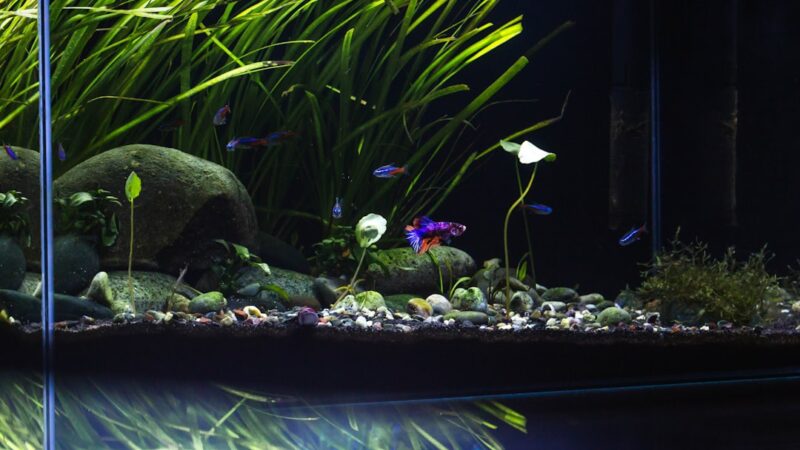
- “Aquascaping looks too complicated.” Start simple. A single piece of driftwood, three plant species, and some schooling fish is a stunning setup. Complexity is optional.
- “I do not have a green thumb.” The beginner plants listed above are nearly indestructible. Java fern, Anubias, and Java moss thrive on neglect.
- “Maintenance takes too much time.” A well-set-up 60cm tank needs about 30 minutes per week — a water change and a quick glass clean. That is less time than watering a balcony garden.
- “My HDB is too small.” A 60cm tank fits on a desk or a small cabinet. Nano aquascapes (30cm) are even smaller. Space is rarely the real barrier.
- “It costs too much.” See the budget breakdown above. The initial investment is comparable to a mid-range home appliance, and ongoing costs are minimal (fish food, water conditioner, the occasional plant or replacement part).
For common pitfalls and how to avoid them, read our guide on aquascaping mistakes beginners make.
Frequently Asked Questions
Do I need CO2 injection for my first aquascape?
No. CO2 injection accelerates plant growth and enables you to keep more demanding species, but it is absolutely not necessary for a beautiful beginner tank. The plants recommended in this guide all grow well without supplemental CO2. You can always add a CO2 system later as your skills and ambitions grow.
Can I set up an aquascape in a tank I already own?
Absolutely. Any glass aquarium can be aquascaped. If your existing tank is larger or smaller than 60cm, simply adjust the quantities of substrate, hardscape, and plants proportionally. The principles remain the same regardless of tank size.
How long does it take before my aquascape looks “finished”?
Plants need time to grow in. A typical beginner aquascape starts looking lush and established after 6-8 weeks, with the best results at 3-4 months once the plants have filled out and the ecosystem has matured. Be patient — the growth process is part of the enjoyment. Take progress photos each week; you will be amazed at the transformation.
Where can I buy aquascaping supplies in Singapore?
Local fish shops in areas like Clementi, Yishun, and Serangoon stock a wide range of plants, hardscape, and equipment. Online platforms like Shopee and Carousell are also excellent sources. And of course, you are welcome to visit us at Gensou, 5 Everton Park, where we carry curated supplies and offer hands-on guidance for beginners.
Start Your Aquascaping Journey with Gensou
Ready to create your first aquascape but want expert guidance? Our team at Gensou has helped hundreds of beginners in Singapore set up their first planted tanks. From selecting the right equipment to choosing plants and arranging hardscape, we walk you through every step. Visit our shop at 5 Everton Park or get in touch to start your journey.
Related Reading