How to Enter Your First Aquascaping Competition

Aquascaping competitions are the pinnacle of the hobby — a chance to have your work evaluated by experts, benchmark against the global community and push your creative boundaries. Entering a competition for the first time can feel intimidating, but the process is more accessible than most people think. This guide on how to enter aquascaping competition from Gensou Aquascaping at 5 Everton Park walks you through the journey.
Major International Competitions
IAPLC (International Aquatic Plants Layout Contest): The world’s most prestigious aquascaping competition, founded by Takashi Amano and organised by ADA. Open to anyone worldwide. Submit one photograph of your aquascape. Entry is typically free. Thousands of entries from over 60 countries compete annually. Results are announced at a gala event in Japan.
AGA (Aquatic Gardeners Association) Contest: One of the oldest international competitions. Entries are categorised by tank size and style. Judges provide written feedback — invaluable for improvement. Free to enter.
CIPS Aquascaping Contest: Growing competition based in China with increasing international participation. Multiple categories and prizes.
Local and Regional Competitions
Singapore hosts aquascaping events through the Singapore Aquatic Art Society (SAAS) and various shop-sponsored competitions. Regional competitions across Southeast Asia — in Malaysia, Indonesia, Thailand and the Philippines — are accessible from Singapore. Local competitions have smaller entry pools, making it easier to place well as a newcomer. They also offer the advantage of in-person tank viewing by judges.
Preparing Your Entry
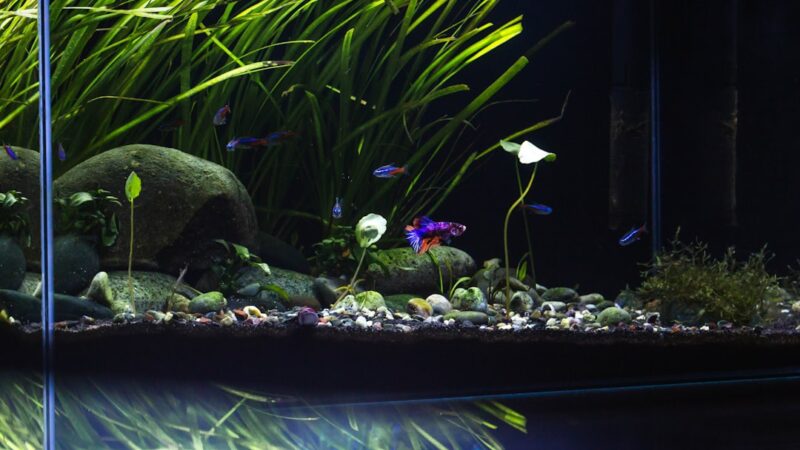
Start planning months in advance. Create your aquascape with competition timing in mind — most contests have submission windows between March and July. Your tank needs to be in peak condition: healthy plants at full growth, clean glass, no visible equipment and fish positioned to complement the layout. Plan the maturation timeline: most aquascapes reach their visual peak at three to six months after planting.
The Critical Photograph
Most competitions are judged from a single photograph, making photography skills as important as aquascaping skills. Clean all glass inside and out. Remove all visible equipment (heaters, thermometers, filter pipes — or photograph from an angle that hides them). Turn off room lights and rely solely on tank lighting. Use a tripod and timer to eliminate camera shake. Shoot in RAW format for maximum post-processing flexibility. Take hundreds of shots and select the best one.
Photography Setup for Competition
Use a dark or white background — black creates drama, white creates a clean studio look. Both are acceptable. A DSLR or mirrorless camera with a 50–85 mm lens produces the best results, but high-end smartphones are increasingly competitive. Ensure the camera is perfectly level and centred on the tank. Fish should be visible but not blocking key compositional elements — feeding them to one side helps control their position.
Post-Processing Guidelines
Most competitions allow basic adjustments: white balance correction, exposure adjustment, cropping and sharpening. Some explicitly prohibit compositing (combining multiple images), removing objects digitally or adding elements that are not in the tank. Read each competition’s rules carefully. The goal of post-processing is to represent your tank accurately at its best — not to create a fictional version of it.
Judging Criteria
Competitions typically evaluate: overall impression and visual impact, composition and layout technique, plant health and condition, use of space and perspective, creativity and originality, naturalness (does it look like a believable scene?), technical skill in plant selection and maintenance and fish compatibility with the design. Understanding these criteria helps you design with intent rather than just aesthetics.
Common Beginner Mistakes
Overcrowding the tank with too many plant species creates visual chaos. Using fish that are too large for the tank breaks the sense of scale. Submitting a photograph with visible equipment or dirty glass costs points. Entering a layout that is not yet mature — patience to let the tank peak is essential. Copying famous layouts too closely rather than developing a personal style. Start with a simple, well-executed concept rather than an ambitious but poorly executed one.
Singapore-Specific Tips
Singapore has a growing competitive aquascaping scene with several local events annually. Connect with SAAS for competition calendars and workshop opportunities. Many Singapore aquascapers have placed highly in IAPLC and other international competitions — the local community has deep expertise to draw from. Visit established aquascaping shops to study competition-grade tanks in person for inspiration and technical reference.
Conclusion
Entering an aquascaping competition is the best way to accelerate your skills, connect with the global community and gain recognition for your work. Even if you do not place highly in your first attempt, the process of designing, growing and photographing a competition entry teaches you more than years of casual fishkeeping. Visit Gensou Aquascaping at 5 Everton Park for competition-grade plants, hardscape and expert design guidance.