How to Aquascape for a Medaka Ricefish Tank: Surface and Open
Medaka — Japanese ricefish (Oryzias latipes and related species) — are surface-oriented, light-loving fish that spend most of their time in the upper third of the water column, often hovering directly beneath floating plants. A well-designed aquascape for a medaka tank leans into this biology: open water at the surface for fish movement, floating or emergent plants for cover and spawning, and a simple, uncluttered lower half that does not compete visually with the fish themselves. This guide from Gensou Aquascaping at 5 Everton Park, Singapore covers how to aquascape a medaka ricefish tank that is both biologically appropriate and aesthetically refined.
Understanding Medaka Behaviour
Ricefish are open-water surface swimmers native to Japanese rice paddies, slow streams, and ponds. They favour still or very gently moving water, bright light, and surface vegetation under which to shelter and spawn. In the wild, their environment is sparse below the surface — silted, sandy substrate, minimal submerged plants, and shallow water of 20–60 cm depth. Any aquascape built for them should reflect this: generous horizontal swimming space near the surface, not the tall vertical structure suited to deep forest aquascapes.
Singapore’s warm climate (28–30°C ambient) suits medaka perfectly without any heating — they thrive in the same temperature range as our indoor rooms.
Tank Shape and Dimensions
Wide, shallow tanks suit medaka far better than tall, narrow ones. A low-profile tank — 60 × 30 × 20 cm or a standard 60 × 30 × 30 cm — gives ample surface area relative to volume, supports good gas exchange without surface agitation (medaka dislike strong surface ripple), and allows easy viewing of the fish from above, which is where their colours and finnage show best. Japanese-style trough tanks and sumibachi bowls are traditional medaka vessels; rectangular rimless tanks in the 30–75 litre range are the practical modern equivalent.
Surface Plants: The Primary Element
Floating plants are the defining element of a medaka aquascape. Salvinia natans is ideal — its small, textured leaves create a mosaic of shade and light at the surface without blanketing the entire tank. Limnobium laevigatum (American frogbit) is another elegant option with round floating leaves and trailing white roots that medaka often spawn into. Pistia stratiotes (water lettuce) grows large in Singapore’s warmth and provides substantial shade — use it sparingly or it will cover the entire surface within weeks.
Aim to cover 40–60% of the surface with floating plants, leaving clear open sections for the fish to surface and feed. Medaka are top-feeding fish and need unobstructed access to the surface for food.
Submerged Plants: Support, Not Spectacle
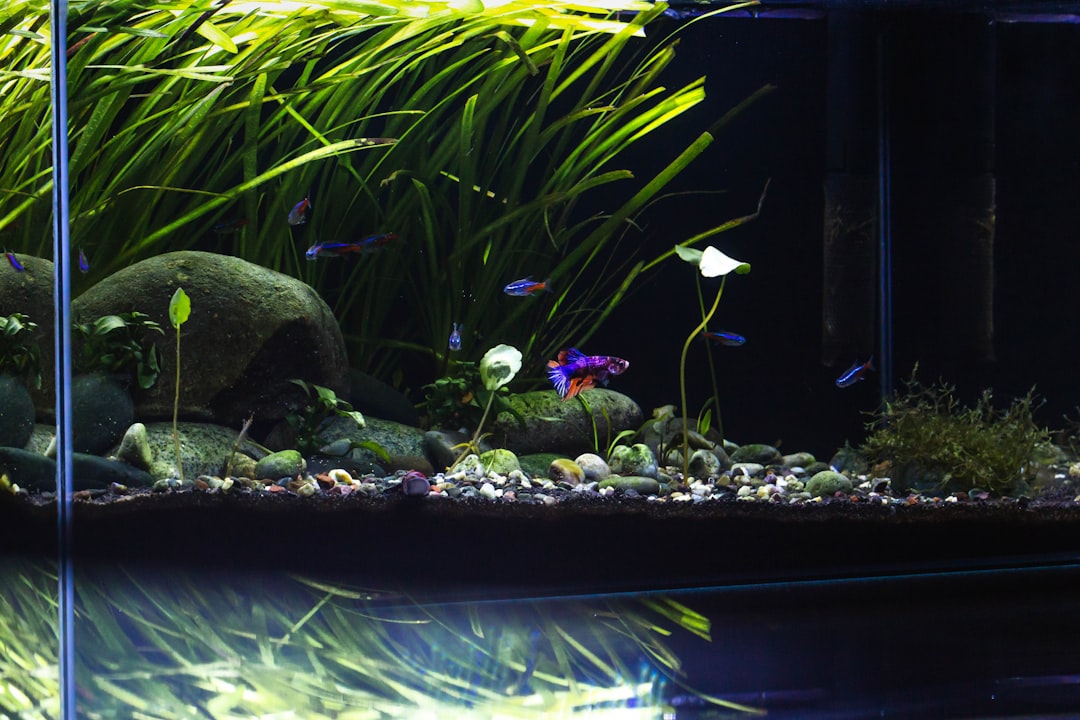
The submerged portion of the tank should be understated. Clumps of Egeria densa or Hornwort (Ceratophyllum demersum) in the back corners provide both oxygenation and spawning substrate — female medaka trail egg clusters from their vents and deposit them in fine-leaved plants or fibrous material. Avoid tall stem plants with large leaves that crowd the mid-water swimming space. A simple approach is a thin layer of fine sand substrate with one or two low-profile plant clusters and perhaps a small smooth stone or two — enough structure to anchor the layout without dominating it.
Hardscape: Minimalism Is Correct
Rice paddy aesthetics do not include dramatic stones or complex driftwood arrangements. If hardscape is used at all, limit it to a few flat, smooth pebbles or a single horizontal piece of thin driftwood placed low in the tank. The Japanese wabi-kusa ball — a ball of substrate and plants that sits partially submerged at the waterline — is a beautiful and authentic addition for medaka tanks, creating a natural looking emersed plant cluster that the fish will use for cover. Wabi-kusa balls are available from specialist shops in Singapore or can be DIY’d with substrate and stem plant cuttings.
Lighting
Medaka are photoperiod-responsive — they spawn more actively under longer day lengths. Run the light for 10–12 hours per day over a medaka tank. Moderate intensity is sufficient; these fish evolved in shallow, sun-exposed paddies and tolerate and even appreciate bright lighting. Strong lighting supports robust growth of both floating and submerged plants, which benefits egg collection. Natural ambient light from a bright window can supplement or even replace artificial lighting for outdoor or semi-outdoor setups common in Singapore landed homes — a windowsill trough tank is a beautiful and traditional medaka keeping setup.
Egg Collection and Spawning Integration
Medaka spawn readily in a well-set-up tank. Females can be seen in the morning with clusters of 10–20 translucent eggs trailing from their vents, which they deposit into fine-leaved plants or fibrous roots within an hour of lights on. Collect eggs by gently combing the floating plant roots with your fingers over a white dish — eggs detach easily. Transfer to a shallow rearing container with water from the main tank and mild aeration; at 28°C, eggs hatch in 8–10 days. At Gensou Aquascaping, we consider the medaka tank one of the most rewarding and achievable breeding setups for Singapore hobbyists — simple to establish, beautiful to observe, and productive almost immediately.
Related Reading