Aquascaping With Sagittaria Only: Grass-Like Simplicity
There is a particular confidence in restraint. Single-species planted tanks strip away compositional complexity and force you to find beauty in texture, movement and repetition. A Sagittaria-only aquascape — built entirely from one or more species of this grass-like flowering plant — can be a deeply satisfying project: low maintenance, visually coherent and genuinely striking under good lighting. Gensou Aquascaping at 5 Everton Park, Singapore works with clients who want planted tanks that won’t demand daily attention, and Sagittaria is one of our most reliable recommendations.
Why Sagittaria Works as a Solo Species
Most aquatic plants have a natural size range that limits their use to one zone of the tank — either foreground, midground or background. Sagittaria is unusual in offering species across all three. Sagittaria subulata stays compact at 5–15 cm with bright light and minimal fertilisation, making it a foreground or midground plant. Sagittaria platyphylla (broadleaf Sagittaria) reaches 30–50 cm with broad strap-like leaves suited to background use. Mixing these two species in a single tank creates genuine depth and variation using one genus — a compositionally clean approach.
Substrate Requirements
Sagittaria is a root-feeding plant that extracts nutrients primarily from the substrate rather than the water column. A rich aquasoil base — ADA Aqua Soil Amazonia, ANS Plantscape Pro or similar — supports strong growth and compact, healthy foliage. In a substrate-only fertilisation approach (no liquid fertilisation), plants grow more slowly but stay shorter and neater, which suits this style of scape. Cap the soil with 1–2 cm of fine river sand if you want a cleaner visual surface. Root tabs every 8–10 cm refresh nutrient reserves as the soil ages past 12–18 months.
Layout Principles for a Grass Meadow Scape
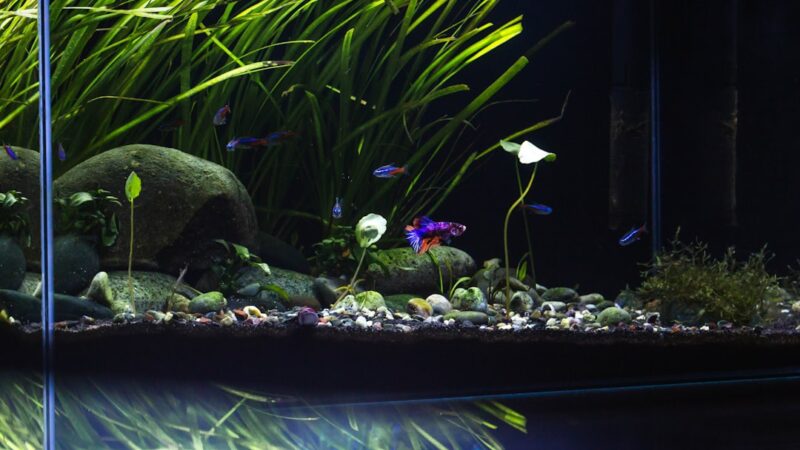
The visual power of a Sagittaria-only scape comes from dense, even coverage interrupted by deliberate open space. Plant individual runners 2–3 cm apart across the foreground and allow the mid and background species to spread naturally over three to four months. Avoid planting the entire tank uniformly — leave a clear sand path or open midground area to create depth and visual rest. Gentle curves in the planting lines look more natural than straight rows. The resulting tank should suggest an underwater meadow rather than a manicured lawn.
Lighting: Compact, Bright and Even
Sagittaria species thrive under moderate to high lighting — 30–50 PAR at substrate level suits most conditions. Insufficient light produces tall, pale plants reaching for the surface rather than compact, dense growth hugging the substrate. LED fixtures with good PAR distribution across the full tank footprint are preferable to spotty high-intensity centres with dim edges. In Singapore’s un-airconditioned rooms, a chiller or fan is not required for Sagittaria — it tolerates 26–30°C without issue, making it well-suited to local ambient conditions.
CO2 and Fertilisation
Sagittaria does not require CO2 injection, which is one of its key advantages for low-maintenance setups. Without CO2, growth is slower and internode spacing slightly longer, but the plants remain healthy and eventually achieve good coverage. If you do run CO2 at 20–30 ppm, growth accelerates noticeably and leaf colour intensifies — the choice depends on how quickly you want the tank to fill in. Liquid fertilisation with a balanced NPK formula at half-dose, once or twice weekly, supplements the substrate for water column absorption by runners in more open areas.
Managing Runners and Spread
Sagittaria spreads prolifically via horizontal runners sent out just below the substrate surface. Left unmanaged, it will eventually colonise every open sand area in the tank — which is either a feature or a problem depending on your design intent. Trim runners before they reach areas you want to keep open; simply cut the runner near the parent plant and remove the new plantlet, or replant it in a gap. In a 60-litre tank, expect to perform this maintenance every three to four weeks once the tank is established.
Suitable Tank Mates for a Sagittaria Meadow
The horizontal, grass-like structure of a Sagittaria scape suits bottom-dwelling and mid-water species that benefit from dense cover at lower tank levels. Small schooling fish like Hemigrammus bleheri (rummy-nose tetra) or Trigonostigma heteromorpha (harlequin rasbora) complement the green tones beautifully. Avoid goldfish, large cichlids or herbivorous species that will uproot runners — the open sand areas of this scape are particularly vulnerable to digging. Otocinclus catfish make excellent algae-control companions without disturbing the plant structure.
Related Reading