Aquascaping With Microsorum Varieties: Java Fern Collection Tank
Java fern is often treated as a beginner plant — easy to keep, hard to kill, not particularly interesting. But that assessment ignores the extraordinary variety within the Microsorum genus and its close relatives. From the narrow-bladed Microsorum pteropus ‘Narrow’ to the deeply ruffled ‘Undulata’, the needle-pointed ‘Needle Leaf’, and the dramatic M. pteropus ‘Windeløv’ with its branching tip structure, a Microsorum variety collection aquascape can be a showcase of remarkable botanical diversity. Gensou Aquascaping at 5 Everton Park, Singapore has assembled collection-style fern tanks that consistently attract attention for their texture and depth.
The Microsorum Genus: More Than One Java Fern
Taxonomically, what hobbyists call “java fern varieties” spans Microsorum pteropus and its cultivated forms, along with related rheophytic ferns. The standard green form reaches 20–30 cm. ‘Narrow’ stays at 15–20 cm with strap-like leaves. ‘Windeløv’ (also called ‘Trident’) produces branched, antler-like leaf tips at 15–20 cm. ‘Undulata’ has wavy, ruffled margins. ‘Needle Leaf’ offers extremely fine, almost grass-like fronds at 10–15 cm. ‘Trident’ (not to be confused with ‘Windeløv’) has deeply forked leaves with three to five tines. Each variety has a distinct silhouette, making them visually complementary when grouped on the same piece of driftwood.
Attachment Rather Than Planting
Microsorum is a rheophyte — in nature it grows attached to rocks and wood in stream currents, not rooted in sediment. Burying the rhizome in substrate causes rot. Instead, tie or glue the plant to hardscape. Fine cotton thread (which biodegrades harmlessly) or aquascaping gel glue both work well. The rhizome should be in full contact with the wood or stone surface; roots will attach naturally within four to six weeks, at which point any remaining thread can be removed. Superglue gel (cyanoacrylate) used underwater sets in seconds and holds immediately — particularly useful for positioning in awkward spots.
Designing a Collection Layout
The key compositional principle for a Microsorum collection tank is variety contrast. Position the largest-leafed standard form at the back or on prominent midground wood, where its mass anchors the design. Smaller, finer varieties like ‘Needle Leaf’ and ‘Windeløv’ work best closer to the viewer — foreground wood stumps or angled pieces that bring the fine detail within easy view. ‘Undulata’ catches light differently from smooth-leafed varieties and creates visual movement even in still water. Avoid symmetry — a natural stream bank where these plants grow is never symmetrically ordered.
Lighting Requirements: Lower Than You’d Expect
Java ferns are famously shade-tolerant, but shade-tolerant doesn’t mean they prefer darkness. At 15–25 PAR, they grow steadily and produce healthy green fronds. Under intense light (50+ PAR) without CO2, older leaves may develop brown patches and transparent spots — a condition often misread as disease but actually a light stress response. If your tank runs high lighting for other plants, position Microsorum under the shadow of taller hardscape or floating plant cover. No CO2 injection is required, though optional CO2 at 10–15 ppm accelerates growth noticeably.
Water Parameters and Singapore Conditions
Microsorum species tolerate a wide parameter range: pH 5.5–7.5, temperature 22–30°C, soft to moderately hard water. Singapore’s PUB tap water at GH 2–4 and ambient room temperature of 28–30°C suits them without any modification. They’re one of the few plants that actually perform better without a chiller in our local conditions. Fertilisation needs are modest — a weekly dose of liquid micronutrients (iron, manganese, boron) at half the recommended rate keeps leaves dark green. Heavy nitrogen or phosphate dosing is unnecessary and may contribute to algae on the slow-growing leaves.
Propagation and New Growth
Java ferns propagate by adventitious plantlets that develop along the leaf margins or directly from old, browning leaves. These tiny plantlets — each a miniature version of the parent with a small rhizome — detach naturally or can be gently removed once they reach 3–5 cm in height. Attach them to small pieces of wood or stone for future hardscape elements. This makes a collection tank self-sustaining in terms of supply: established plants continuously produce new specimens that can fill gaps or be traded with other hobbyists.
Ideal Tank Mates for a Fern Collection
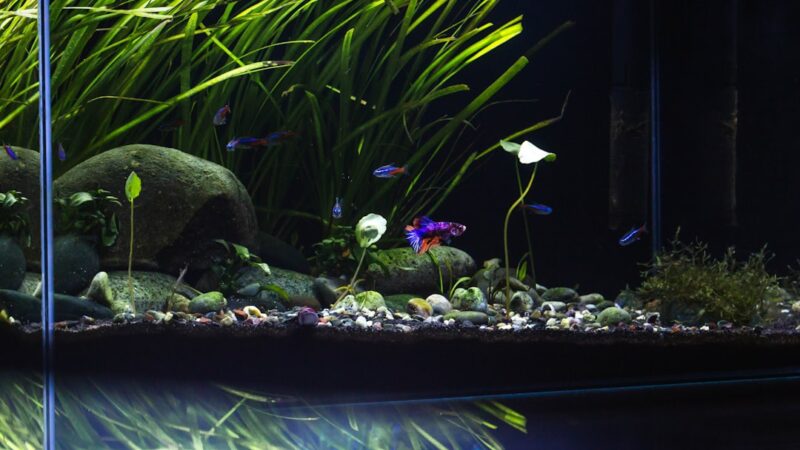
The open midwater space in a driftwood-heavy fern tank suits schooling tetras, small rasboras and dwarf cichlids beautifully. Avoid large herbivorous fish and goldfish varieties. Caridina and Neocaridina shrimp thrive in the crevices between rhizomes and provide algae grazing on leaf surfaces. Otocinclus are ideal algae-control partners. The deliberate open-water aesthetic of a collection fern scape pairs naturally with active, mid-swimming fish that fill the space without dominating it.
Related Reading
- Aquascaping With Cryptocoryne Wendtii Varieties: Green, Brown and Red
- Aquascaping With Eleocharis Varieties: Hairgrass Collection Tank
- Aquascaping With Java Fern Varieties Only: Windelov, Trident and Narrow
- Aquascaping With Moss Varieties Only: Flame, Weeping and Christmas
- Aquascaping With Rotala Varieties Only: Colour Gradient Tank