Biotope Contest Aquascaping: Authentic Habitat Recreation for Competitions
Biotope aquascaping demands something most other styles do not — proof. Every plant, fish, invertebrate, and substrate element must occur together in the same geographical location in the wild, and judges verify your research. For hobbyists who love natural history as much as aesthetics, biotope contests offer a uniquely rewarding challenge. This biotope contest aquascape guide from Gensou Aquascaping at 5 Everton Park, Singapore covers the research process, design principles, and presentation standards that separate casual biotope tanks from competition-winning entries.
Understanding Biotope Contest Judging
Major competitions like the Biotope Aquarium Design Contest (BADC) score entries across several categories: biotope accuracy, aquarium condition, visual impression, and documentation. Accuracy carries the heaviest weight. Judges cross-reference your species list against published ichthyological and botanical databases. A single species from the wrong drainage basin costs significant points. Your written description — citing collection localities, GPS coordinates, and water parameters from scientific literature — matters as much as the tank itself.
Choosing Your Biotope
Start with a specific location, not a broad region. “Southeast Asian blackwater stream” is too vague. “Forest stream tributary of the Batang Hari River, Jambi Province, Sumatra” is precise enough to build a defensible entry. Select habitats that align with species and materials available to you. Southeast Asian biotopes resonate with Singaporean hobbyists because many endemic species — Betta species, Rasbora, Pangio loaches — are readily available from local importers and collectors.
Researching Species and Habitat Data
Scientific papers, FishBase, and published field reports are your primary sources. Document every species with its scientific name, collection locality, and a citation. Photograph or screenshot relevant pages for your submission binder. Social media posts from field collectors can supplement formal literature, but peer-reviewed sources carry more weight with judges. Water parameters at the collection site — pH, temperature, conductivity, dissolved oxygen — form the targets for your tank setup.
Sourcing Authentic Materials
Substrate, leaf litter, and hardscape should match the natural habitat as closely as possible. For a Southeast Asian blackwater stream, use fine sand with scattered leaf litter from Terminalia catappa (Indian almond) and Ketapang leaves — both abundant in Singapore. Driftwood should resemble submerged root tangles rather than stylised aquascaping wood. Collect or purchase botanicals like seed pods, bark, and dried leaves that replicate the detritus-covered stream beds documented in your research.
Setting Up Water Parameters
Blackwater biotopes require soft, acidic water — often pH 4.5-6.0 with TDS below 50 ppm. Singapore’s PUB tap water is soft (GH 2-4) but near neutral pH, making it a reasonable starting point. Filter through peat or dose with commercially available blackwater extract to lower pH and tint the water. For Rift Lake biotopes, buffer with coral sand and mineral supplements to achieve the alkaline, hard water conditions those habitats demand. Match your research data as closely as equipment allows.
Designing for Visual Impact
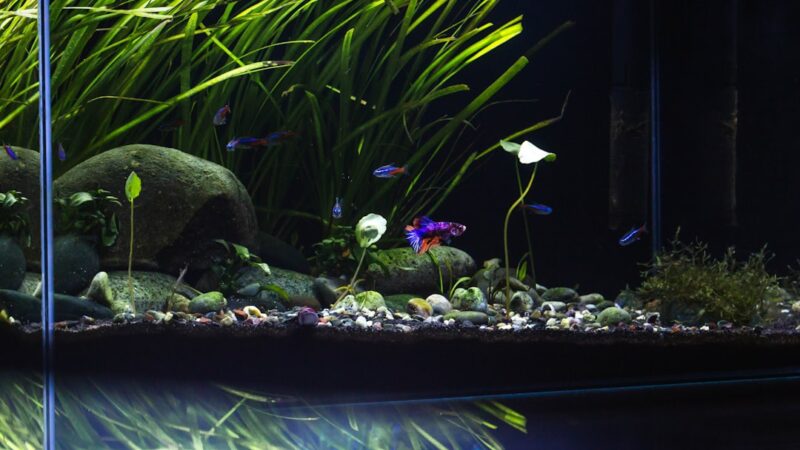
Authenticity does not mean boring. Arrange hardscape and botanicals to create an engaging composition while staying true to the habitat structure. A blackwater stream floor benefits from strategic placement of root tangles that frame negative space, drawing the viewer’s eye through the scene. Layer leaf litter at varying densities — thick accumulations against root structures and thin coverage over open sand — to mimic natural deposition patterns. Resist the urge to manicure; a degree of natural disorder is the hallmark of a convincing biotope.
Photographing and Documenting Your Entry
Contest photographs must show the entire tank from a single front-on perspective. Clean the glass meticulously and use a tripod with manual white balance. Include close-up shots of individual species for identification verification. Your written submission should read like a field report: location description, coordinates, habitat characterisation, species list with citations, and water parameter targets versus achieved values. This documentation distinguishes a serious entry from a decorative tank with a biotope label.
Common Mistakes That Cost Points
Mixing species from different river systems is the most frequent error. Keeping Paracheirodon axelrodi (cardinal tetra) with Hemigrammus rhodostomus (rummy-nose tetra) looks natural but fails biotope accuracy — they inhabit different tributaries. Using commercially dyed gravel or artificial decorations is an automatic disqualification in serious contests. Neglecting to document sources, submitting blurry photographs, or presenting an unkempt tank with visible algae all reduce scores. Attention to detail across every category separates the podium from the participation certificate.
Related Reading