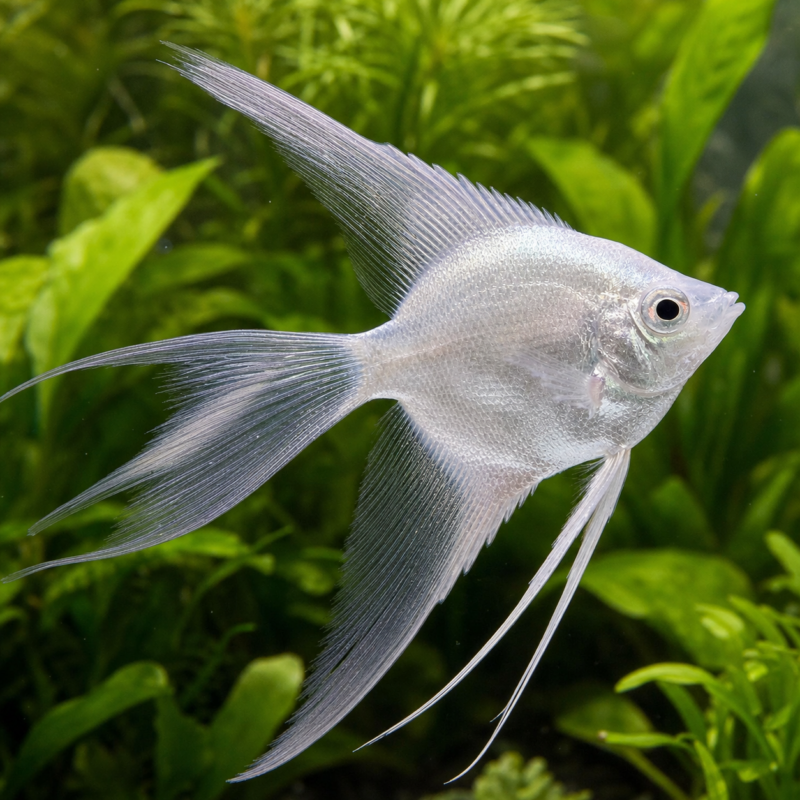
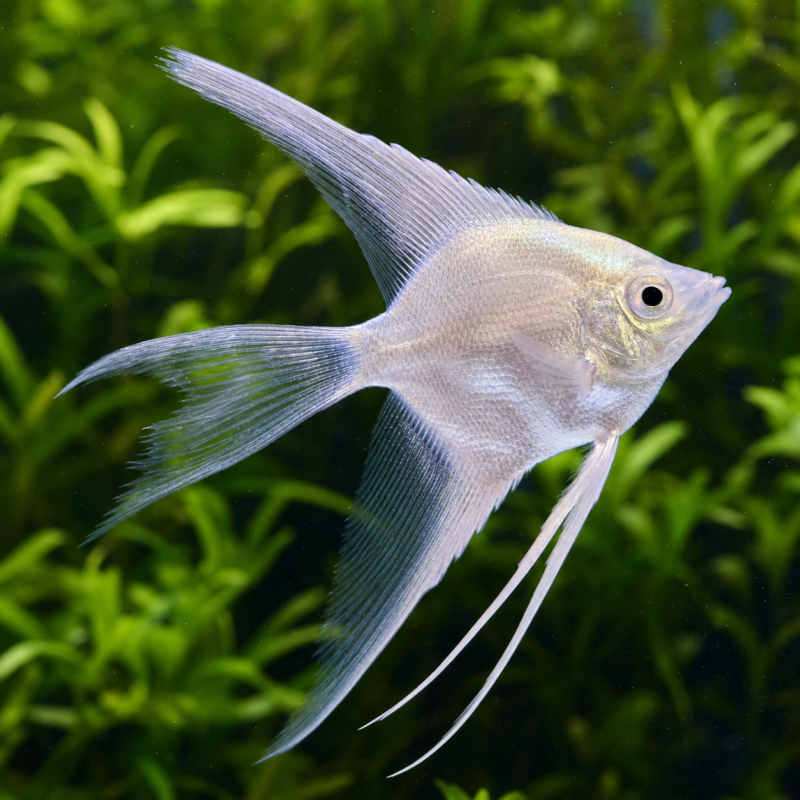
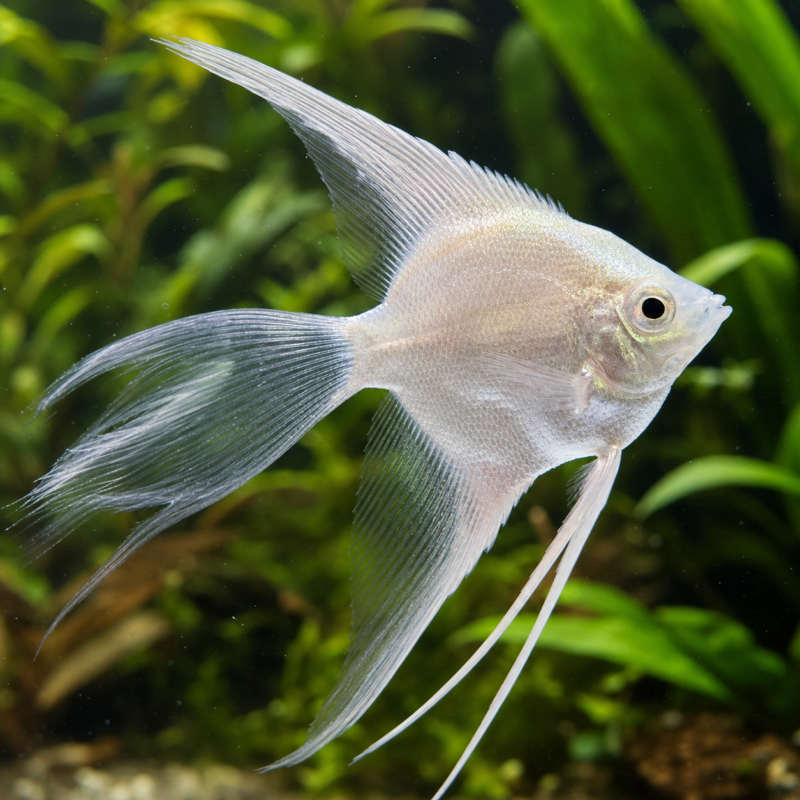
Platinum Angel Veiltail
Pterophyllum scalare · Semi-aggressive; territorial when pairing · Intermediate care
You save
A pure pearl-white angelfish trailing extravagant veil fins. A serene, elegant centrepiece that glows against green plants in a tall, mature tank.
Out of stock
Ask on WhatsAppAt a glance
Species profile Pterophyllum scalare
Origin
Amazon basin, South America (captive-bred colour/fin form)
Family
Cichlidae (cichlid family)
Adult size
Up to 15 cm body, much taller with veil fins
Diet
Quality flake/pellets plus frozen and live foods (bloodworm, brine shrimp) (Omnivore (carnivore-leaning))
Temperament
Semi-aggressive; territorial when pairing
Swimming level
Middle
Minimum group
1+ (shoaling)
Lifespan
8-10 years
Minimum tank
150 L (40 gal), at least 45 cm tall
Water type
Freshwater
Size to scale
15 cm adult length, shown to scale against an iPhone 15 Pro (14.66 cm).
Natural range
Where it comes from — South America
Amazon basin, South America (captive-bred colour/fin form)
Water
Singapore tap water vs its needs
Hardness: Soft to medium (3-12 dGH).
In the aquarium
How it lives in the tank
Swims in the middle of the tank
Sensitivity Index — Moderate
Adaptable, but happiest with stable parameters in a matured tank.
Our own read on how forgiving this species is of water changes — not a formal standard.
Keeping & care
What this fish needs
Family
About the Cichlidae family cichlid family
Cichlidae is one of the largest and most diverse families of freshwater fish, with well over a thousand species native mainly to Africa, Central and South America, and parts of southern Asia. Most are deep-bodied, laterally compressed fish with a single continuous dorsal fin, and they range from small dwarf species a few centimetres long to substantial fish over 30 cm. As a group they are intelligent, often territorial, and typically show strong parental care of eggs and young; care demands vary widely by species, from peaceful dwarf cichlids suited to planted community tanks to large, boisterous fish needing spacious hard-water setups.
Choose by species: peaceful dwarf cichlids (e.g. Apistogramma, rams, kribensis) fit a well-planted community with soft, slightly acidic water, while larger or Rift Lake cichlids are more territorial and need generous space, robust filtration and stable water matched to their origin—check each fish's individual requirements before mixing.
Breeding
Substrate- or cave-spawning parental carers (many species; some are mouthbrooders)Cichlids are among the most readily bred aquarium fish and are renowned for their parental care, which broadly splits into two strategies. Substrate spawners (such as angelfish, discus, kribensis and many South American dwarfs) lay eggs on a cleaned surface, rock, leaf or inside a cave, and both parents usually guard the eggs and shepherd the free-swimming fry. Mouthbrooders (common among African Rift Lake species) hold the fertilised eggs and later the fry inside the mouth for protection; across the family, breeding is generally triggered by good water conditions, conditioning on quality food, and a settled pair with adequate space, and fry can often be raised on infusoria, crushed flake or newly hatched brine shrimp.
Feeding
Recommended food
Compatibility
Best tankmates
Community