How to Aquascape for Celestial Pearl Danios: Galaxy Rasbora Nano
Celestial pearl danios — widely sold as galaxy rasboras despite being true danios — are among the most spectacularly coloured nano fish available to hobbyists. Males display deep teal bodies dotted with pearl-white spots, scarlet fins edged in black, and a luminosity that photographs almost impossibly well under the right lighting. An aquascape designed for Celestial Pearl Danios frames these tiny fish at 2.5 cm against dense vegetation and open swimming space, producing a nano tank that looks genuinely professional. Gensou Aquascaping at 5 Everton Park, Singapore keeps CPDs as display fish and has refined what makes this scape work over many iterations.
Understanding Celestial Pearl Danio Behaviour
Danio margaritatus originates from shallow, heavily vegetated pools in Myanmar at altitude — water temperatures of 22–24°C, slightly soft and clear. Males are territorial in a loose sense: they posture, display and chase rivals, but serious injury is rare in a well-structured tank. The critical insight for scaping is that CPDs are shy without cover. In an open tank they become colourless and hide constantly. Dense planting transforms their behaviour — confident fish, full colour, active display, natural shoaling. The scape is not optional for this species; it’s essential.
Tank Size and Format
A nano tank of 20–45 litres suits a group of 12–15 CPDs beautifully. The classic format is a cube (30 × 30 × 30 cm or 35 × 35 × 35 cm) or a shallow long tank (60 × 20 × 20 cm). Both formats suit planted nano scaping well. Avoid very deep tanks — CPDs are mid-water and surface-oriented fish that rarely venture to the bottom of a 40 cm deep tank. Depth wastes space better used for lateral swimming room. A low water level (75–80% of tank height filled) also suits them by providing a shallow water column that mimics their natural habitat pools.
Plant Selection: Dense and Fine-Leaved
Fine-leaved plants that CPDs can weave through and shelter between are the priority. Eleocharis parvula (mini hairgrass) or E. acicularis creates a lawn that frames the fish against open substrate. Rotala rotundifolia and R. h’ra provide dense mid to background cover with warm pink-orange colouration that complements the fish’s red fins dramatically. Java moss attached to stone or wood creates spawning sites (CPDs scatter eggs into moss) and provides fry refuge. Floating plants like Salvinia auriculata diffuse light and complete the dense, enclosed feel these fish prefer.
Hardscape and Composition
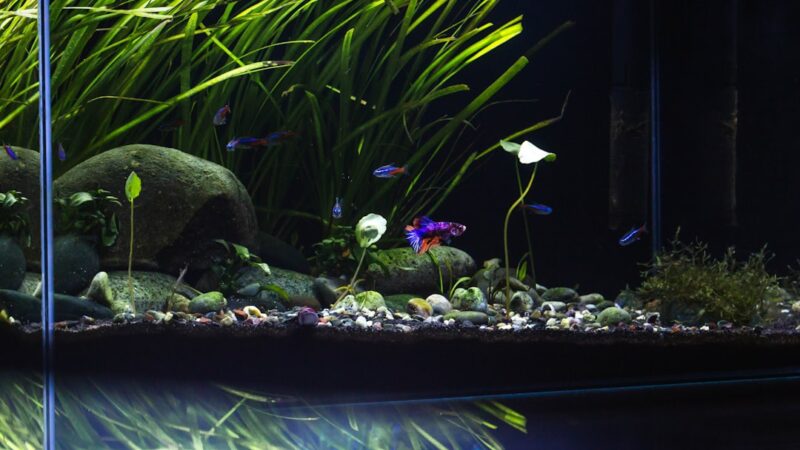
Small scale is essential — oversized stones or thick driftwood look mismatched against 2.5 cm fish. A cluster of small seiryu or dragon stone pieces, 5–10 cm in height, creates a focal point without overwhelming the scale. Thin branchy twigs or small pieces of spiderwood add structural complexity without mass. Position hardscape off-centre; a compositional ratio of roughly one-third open substrate to two-thirds planted creates visual balance. The open substrate area serves as the CPDs’ natural display arena — males will regularly spar and court in the open zone while retreating to planted areas between interactions.
Water Parameters and Temperature
The key challenge in Singapore for CPDs is temperature. Their native highland pools sit at 20–24°C — significantly cooler than Singapore’s ambient 28–32°C. At sustained temperatures above 27°C, CPDs are stressed, colours fade and lifespan shortens. A small nano chiller or USB clip fan to increase evaporative cooling is necessary for long-term husbandry in un-airconditioned Singapore rooms. In an air-conditioned room at 24–25°C, CPDs can be kept without a chiller. This is a genuine hardware investment to plan for before choosing this species. Water softness (GH 2–5, pH 6.5–7.0) is less critical but soft water brings out the best colouration.
Lighting for CPD Colouration
Moderate lighting at 25–40 PAR at substrate, combined with floating plant cover on 40–50% of the surface, produces the dappled, natural feel these fish respond to. Under very bright light without cover, males tend to stay hidden. Under appropriately dimmed conditions, they remain in open water and display actively. A blue-spectrum LED used as a dawn simulation before the main photoperiod often triggers the most dramatic morning display behaviour — if you can observe your tank at that time, it’s genuinely worth setting up a dawn ramp on your light timer.
Compatible Tank Mates
CPDs work beautifully as a single-species display, but gentle companions are possible. Small Corydoras species like C. pygmaeus or C. habrosus occupy the bottom without competing for CPD territory. Neocaridina cherry shrimp coexist peacefully and provide active substrate-cleaning. Avoid fish that are larger than 3 cm or nippy — CPDs are timid and will be outcompeted for food or injured. A group of 12–15 CPDs, a small Corydoras trio and a colony of cherry shrimp in a well-planted 30-litre cube is one of the most complete and visually rewarding nano setups available to Singapore hobbyists.
Related Reading
- How to Breed Celestial Pearl Danios: Galaxy Rasbora Fry Guide
- Celestial Pearl Danio Care Guide: Galaxy Rasbora in Nano Tanks
- Celestial Pearl Danio vs Ember Tetra: Which Nano Fish to Choose
- Celestial Pearl Danio vs Neon Tetra: Which Is Right for You?
- How to Aquascape for Clown Killifish: Surface Nano Design