Colombian Llanos Biotope Aquascape: Orinoco Grassland Flood

Each wet season, the vast Llanos grasslands of Colombia and Venezuela flood for months, transforming open savannah into an enormous shallow lake. Fish, insects and amphibians colonise the inundated grass; aquatic plants exploit the nutrient surge; water drains slowly clear as the season progresses. Replicating this Colombian Llanos biotope aquascape produces one of the most atmospherically honest scapes possible — not a manicured garden, but a living system caught in seasonal transition. At Gensou Aquascaping, 5 Everton Park, Singapore, we find biotope work among the most intellectually rewarding aquascaping disciplines.
Understanding the Llanos Environment
The Llanos is not jungle. It’s open tropical savannah — seasonal grassland with patches of gallery forest along waterways. During flooding, water chemistry shifts from the dry season’s warmer, harder conditions toward softer, more acidic water as organic matter from the grassland leaches in. Peak flood conditions: temperature 26–29°C, pH 5.5–6.8, GH 1–3, TDS 50–120 ppm. Water clarity varies — early season water is turbid with suspended organics; later flood water often clears significantly as solids settle.
Hardscape and Substrate
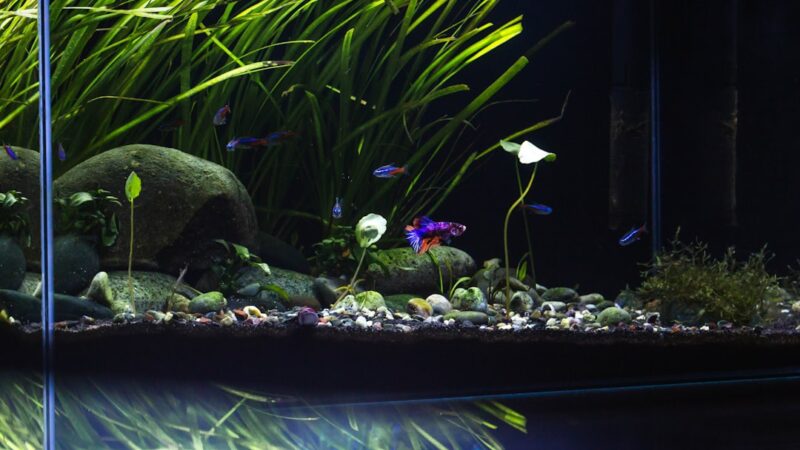
Avoid traditional aquascaping stones — they’re not a dominant feature of the Llanos. Instead, use fine river sand in warm beige or off-white, with submerged grass stems (dried or living), dried seed pods and a scattering of leaf litter from botanicals like ketapang (Indian almond) leaves or oak leaves. Thin, branchy driftwood representing flood-submerged shrubs adds structure without dominating. The overall impression should be of open grassland interrupted by occasional woody debris — horizontal rather than vertical composition.
Plants of the Flooded Llanos
Sagittaria species are historically documented from this habitat and make an excellent foreground or midground plant. Cabomba aquatica and Limnobium laevigatum (South American frogbit) as floating cover are regionally appropriate. For strict biotope presentation, avoid Asian species like Vallisneria nana or Microsorum pteropus. Eleocharis hairgrass species that occur in South American grasslands work beautifully as grass-stand mimics and remain true to the biome.
Fish: The Llanos Ichthyofauna
The Orinoco drainage is spectacularly diverse. For a manageable display tank, consider Pterophyllum scalare (wild-type angelfish) as the centrepiece, supported by a school of Hyphessobrycon tetras, a group of Corydoras species documented from the region (such as C. melanistius or C. aeneus), and a pair of dwarf cichlids like Apistogramma macmasteri or A. viejita, both confirmed Llanos inhabitants. A school of 8–12 cardinal or neon tetras fits seasonally — they occur at the Orinoco forest margin, which overlaps during flood events.
Water Parameters for Orinoco Species
In Singapore, achieving Llanos water chemistry from PUB tap water requires partial RO dilution. A 50:50 mix of RO and tap typically produces GH 1–2 and TDS 60–80 ppm. Acidify gently with Indian almond leaf extract or peat filtration to reach pH 6.2–6.8. Temperature of 27–28°C requires no heater in most Singapore conditions without air conditioning — a distinct advantage for this biotope. Avoid carbonate buffering materials in the hardscape; limestone and calcite rock will raise pH and KH counter to the habitat profile.
Lighting and the Seasonal Visual Story
Llanos flood water is not crystal clear. A slight warm tint from botanical leaching is authentic and actually beneficial — it reduces UV-sensitive species’ stress, mellows the light spectrum and creates an atmospheric depth that sterile clear water cannot match. LED fixtures at a moderate intensity (30–40 PAR at substrate) suit the plant species used and creates the diffused, under-canopy feeling of open flooded grassland. An 8-hour photoperiod is appropriate.
Maintenance and Evolution Over Time
One of the joys of a Llanos biotope is that it evolves naturally. Leaf litter breaks down, adding tannins. Sagittaria spreads into open sand areas. Floating plants multiply and need thinning. This is not a scape you trim into a rigid shape — you guide its natural development instead. Seed pods can be replaced periodically to maintain the botanical input. The result, over six to twelve months, is a scape that feels genuinely lived-in rather than just designed. The team at Gensou Aquascaping can advise on sourcing regionally appropriate botanicals and plants for your Llanos build.
Related Reading