
Jack Dempsey Cichlid Care Guide: Bold Colour and Big Personality
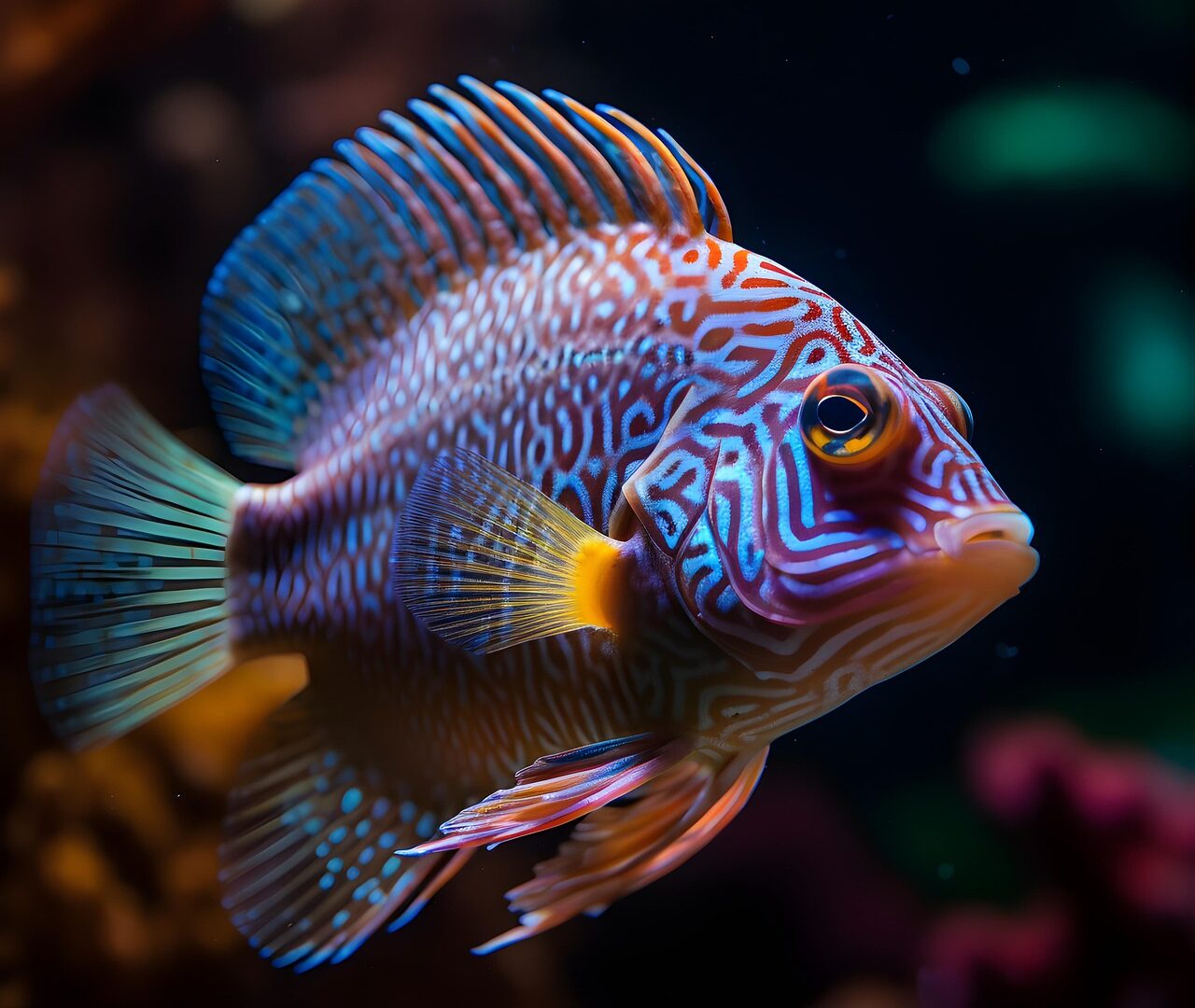
The Jack Dempsey cichlid (Rocio octofasciata) is a classic Central American cichlid named after the legendary boxer for its aggressive temperament and powerful build. Males display stunning iridescent blue, green and gold spangles across a dark body, making them one of the most visually striking freshwater fish. This Jack Dempsey cichlid care guide from Gensou Aquascaping at 5 Everton Park covers both the standard and coveted Electric Blue variants. This guide sits inside our broader Tropical Fish Species Master Index reference.
Jack Dempsey Overview
Jack Dempseys originate from the slow-moving rivers and swamps of Mexico, Belize, Guatemala and Honduras. Males reach 20–25 cm and females around 15–18 cm. Their base colour is dark grey to black, covered in sparkling blue-green iridescent spots that intensify with age and mood. The Electric Blue Jack Dempsey is a naturally occurring colour morph that displays an all-over neon blue — it is smaller, less aggressive and more delicate than the standard form. With proper care, Jack Dempseys live for 10–15 years.
Tank Requirements
A single Jack Dempsey needs at least a 200-litre tank, and a pair requires 300 litres or more. They are territorial and need space to establish boundaries. Use sand or fine gravel as substrate — they enjoy digging and rearranging the bottom. Maintain the temperature between 22 °C and 30 °C, pH 6.5–8.0 and GH 8–15 dGH. Singapore’s warm ambient temperature keeps them comfortable without much effort.
Aquascaping for Jack Dempseys
Provide plenty of caves, rock formations and driftwood to create territories and hiding spots. Jack Dempseys will rearrange lightweight decorations to their liking, so secure hardscape well. Live plants are possible with tough species like Anubias, Java Fern and Vallisneria, but be prepared for some uprooting. Many keepers opt for a rock-and-wood hardscape without rooted plants.
Diet and Feeding
Jack Dempseys are omnivores with a preference for protein. Offer high-quality cichlid pellets as the staple, supplemented with frozen bloodworm, brine shrimp, krill and mysis shrimp. They also accept blanched vegetables and occasional earthworms. Feed once or twice daily in amounts consumed within two to three minutes. Avoid overfeeding — they are prone to obesity in captivity.
Tank Mates
Standard Jack Dempseys are semi-aggressive and need similarly robust tank mates. Suitable companions include firemouth cichlids, convict cichlids, Salvini cichlids, larger catfish like plecos and Synodontis, and silver dollars. Avoid small fish that will be eaten and overly aggressive species that will harass them constantly. The Electric Blue variant is more peaceful and can sometimes be kept with less aggressive mid-sized fish, but should still be housed with species that can hold their own.
The Electric Blue Jack Dempsey
The Electric Blue (EBJD) is a naturally occurring recessive colour mutation that produces a breathtaking all-over metallic blue colouration. They are smaller (15–20 cm), less aggressive and unfortunately more fragile than standard Jack Dempseys. EBJDs are more susceptible to disease, grow more slowly and have a slightly shorter lifespan. They require pristine water quality and less stressful tank mates. Despite these challenges, their beauty makes them one of the most sought-after freshwater fish.
Breeding
Jack Dempseys are substrate spawners that form monogamous pairs. They clean a flat surface — a rock, piece of slate or even the glass bottom — before the female deposits 500–800 eggs. Both parents guard the eggs aggressively, and the fry are free-swimming within a week. Feed fry baby brine shrimp and crushed flake. Breeding pairs become extremely territorial and will attack any tank mate that approaches the nest.
Common Health Issues
Head and lateral line erosion (HLLE) is the most common issue, caused by poor water quality, nutritional deficiency or stray electrical currents in the water. Improve water quality, vary the diet and check for grounding issues with equipment. Ich can occur after temperature drops. Standard Jack Dempseys are generally hardy, but EBJDs require more diligent care to avoid stress-related illnesses.
Related Reading



