






Description
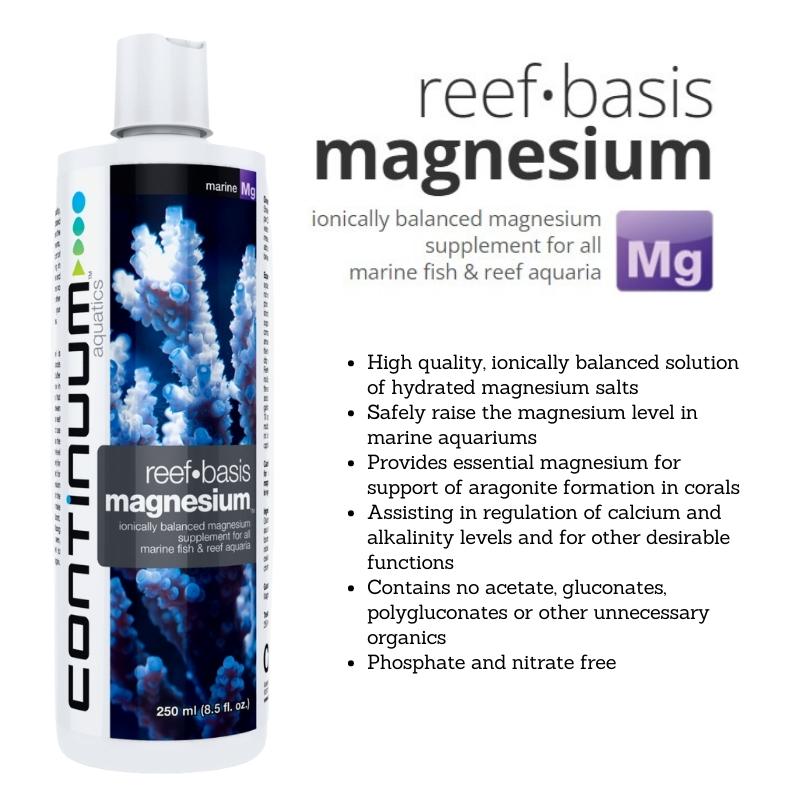
High quality, ionically balanced solution of hydrated magnesium salts
Safely raise the magnesium level in marine aquariums
Provides essential magnesium for support of aragonite formation in corals
Assisting in regulation of calcium and alkalinity levels and for other desirable functions
Contains no acetate, gluconates, polygluconates or other unnecessary organics
Phosphate and nitrate free
Reef Basis Magnesium is a high quality, ionically balanced solution of hydrated magnesium salts designed to safely raise the magnesium level in marine aquariums, providing essential magnesium for support of aragonite formation in corals, assisting in regulation of calcium and alkalinity levels and for other desirable functions. It contains no acetate, gluconates, polygluconates or other unnecessary organics to pollute your aquarium. It is phosphate and nitrate free.
Use in aquarium keeping.
Proper control of magnesium level is imperative for the health and growth of corals as well as maintenance of calcium and buffer levels. Some sea salt mixes are low in magnesium. Continuum recommends that you maintain a magnesium level of between 1,250 and 1,350 mg/L (ppm) for normal reef keeping. This product is also suitable for use by hobbyists who want to raise the magnesium level up to the range of 1,500 to 1,800 mg/L (ppm) for special uses.
If you raise the magnesium level that high, be sure to closely monitor the condition of corals and other animals to make sure that they remain healthy and vibrant. Should negative signs such as corals refusing to open, poor coloration etc. be seen, discontinue use and allow the level to decrease until the animals look healthy again.
Directions and protocol.
Shake well prior to use. Add 1 capful (5 ml) per 25 US-gallons (100 L) of marine aquarium water 3 to 4 times per week.
For best results, measure the magnesium concentration and add as required to maintain the concentration between 1,250 and 1,350 mg/L (ppm).
Expert use.
Dosing through use of a drip system is a superior method of addition. Do not mix with buffers or alkalinity supplements prior to addition. You may mix it with strontium, calcium, and many other supplements.
See our website for compatibility of supplements. Determine the amount of magnesium consumption during the time it takes add the entire volume of your drip system. Determine the amount of ReefBasis Magnesium to add in milliliters by multiplying your tank capacity in gallons by the amount you want to raise it in mg/l (ppm) and by 0.0533.
(Example: if you have a 50 gallon tank and you want to raise the level by 10 ppm with the entire dose, you would multiply 50 x 10 x 0.0533 which equals 26.65 ml of ReefBasis Magnesium or about 5-1/4 capfuls).
Caution: Keep out of reach of children. Not for human consumption. Contains magnesium salts, if ingested drink water, call a poison control center immediately! If in eyes flush with water.
Continuum Reef Basis Magnesium for Stable Reef Chemistry
Magnesium is the quiet partner to calcium and alkalinity in a reef, and when it drifts low everything else gets harder to control. Reef Basis Magnesium is an ionically balanced solution of hydrated magnesium salts that raises magnesium safely while supporting aragonite formation in corals. Crucially, holding magnesium in its proper range is what lets calcium and alkalinity stay stable together, since without enough magnesium those two tend to fight each other and precipitate. The formula stays clean too, free of acetate, gluconates, polygluconates, phosphate and nitrate.
For Singapore reefers, stable chemistry is half the battle, because our warm tanks run fast and parameters can shift quicker than in cooler climates. Test magnesium before dosing and raise it gradually toward target rather than chasing a big correction in one go, which keeps corals comfortable. Once magnesium sits where it should, your two-part or balling routine for calcium and alkalinity becomes far more predictable.
Browse our wider marine additives range to complete your dosing setup. Our calcium and magnesium guide and calcium-alkalinity stability guide explain how the three parameters interlock.








Reviews
There are no reviews yet.