New Guinea Rainbowfish Biotope Aquascape: Tropical River Basin
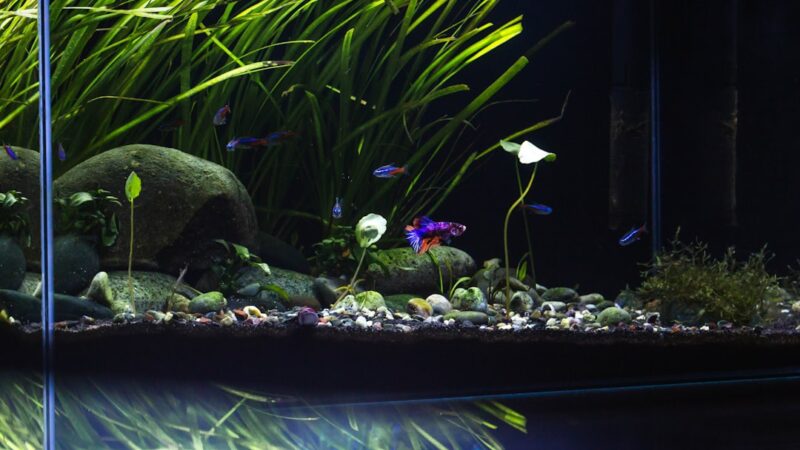
New Guinea’s rivers and lakes harbour some of the most vibrantly coloured freshwater fish on the planet. A New Guinea rainbowfish biotope aquascape captures that brilliance in your living room — think shimmering blues, golds, and reds flashing across a naturalistic stream layout. At Gensou Aquascaping in Singapore, we have designed several rainbowfish display tanks for clients who want colour without sacrificing authenticity.
The Natural Environment
Rainbowfish species like Melanotaenia boesemani, Glossolepis incisus, and Melanotaenia praecox inhabit clear to moderately tannin-stained rivers, forest streams, and alkaline lakes across Papua New Guinea and Irian Jaya. Water conditions vary widely — pH ranges from 6.5 in forest tributaries to 8.0 in Lake Sentani. Temperatures sit between 24-30 °C, aligning perfectly with Singapore’s ambient conditions, making heaters unnecessary for most setups.
Recommended Tank Size
Rainbowfish are active swimmers that display best in groups of six or more. A 120-litre tank (90 x 30 x 45 cm) is the minimum for a shoal of medium-sized species like M. boesemani. Larger tanks — 180 to 250 litres — let you keep multiple species together and provide the swimming length these fish need to exhibit natural chasing and display behaviour. In HDB flats, a 90 cm tank on a proper aquarium stand distributes weight safely across the floor.
Hardscape: Rocks and Wood
New Guinea streams feature rounded boulders, submerged logs, and exposed root tangles. Use smooth river rock in warm browns and tans — avoid sharp-edged stone that could damage the flowing fins of displaying males. Arrange two or three larger focal stones off-centre, with driftwood pieces bridging the gaps. Malaysian driftwood or Sumatran spider wood provides the right organic look. Leave the centre and front relatively open to give the shoal room to swim.
Authentic and Substitute Plants
True Papuan aquatic plants are nearly impossible to source commercially. Fortunately, visually appropriate substitutes exist. Vallisneria nana creates tall background curtains that sway in current, mimicking grass beds found in New Guinea lakes. Ceratopteris thalictroides (water sprite) floats or roots, providing natural cover. For the midground, Hygrophila corymbosa adds broad green leaves. Avoid manicured carpets — the biotope floor should show patches of open substrate between plant clusters.
Substrate and Filtration
A mix of fine gravel (2-4 mm) and coarse sand replicates the river-bottom look. Inert substrates suit this biotope since most rainbowfish prefer neutral to slightly alkaline water — active aquasoils would push pH too low. Run a canister filter rated for at least twice the tank volume; rainbowfish produce moderate waste, and the extra flow simulates river current that encourages natural shoaling. A spray bar distributes output evenly across the tank length.
Water Parameters for Singapore
Target pH 7.0-7.8, GH 6-12, and temperature 26-30 °C. Singapore’s tap water (GH 2-4) is softer than ideal, so add a small bag of crushed coral or limestone chips to your filter to raise GH gradually. Monitor with a GH test kit weekly until the buffer stabilises. Temperature rarely needs intervention — your tank will naturally sit at 28-30 °C year-round, which is well within the comfort zone for most Melanotaenia species.
Stocking and Behaviour
Keep rainbowfish in groups with a higher ratio of females to males — two females per male reduces aggression and keeps displays frequent. Males colour up most intensely during morning hours when competing for female attention. Add a small group of Tateurndina ocellicaudata (peacock gudgeon) — another New Guinea endemic — for bottom interest. Avoid mixing in unrelated species that dilute the biotope theme.
Maintaining the Biotope Long Term
Weekly 25-30 % water changes with dechlorinated PUB water keep nitrate below 20 ppm. Feed a varied diet of quality flake, frozen brine shrimp, and occasional live daphnia to maintain colour intensity. Over time, driftwood may soften the water — counteract this by refreshing crushed coral every three to four months. A well-maintained New Guinea rainbowfish biotope is a living display of some of the world’s most spectacular freshwater colour.
Related Reading