
How to Breed Red Cherry Barbs: Easy Egg Scatterers for Beginners
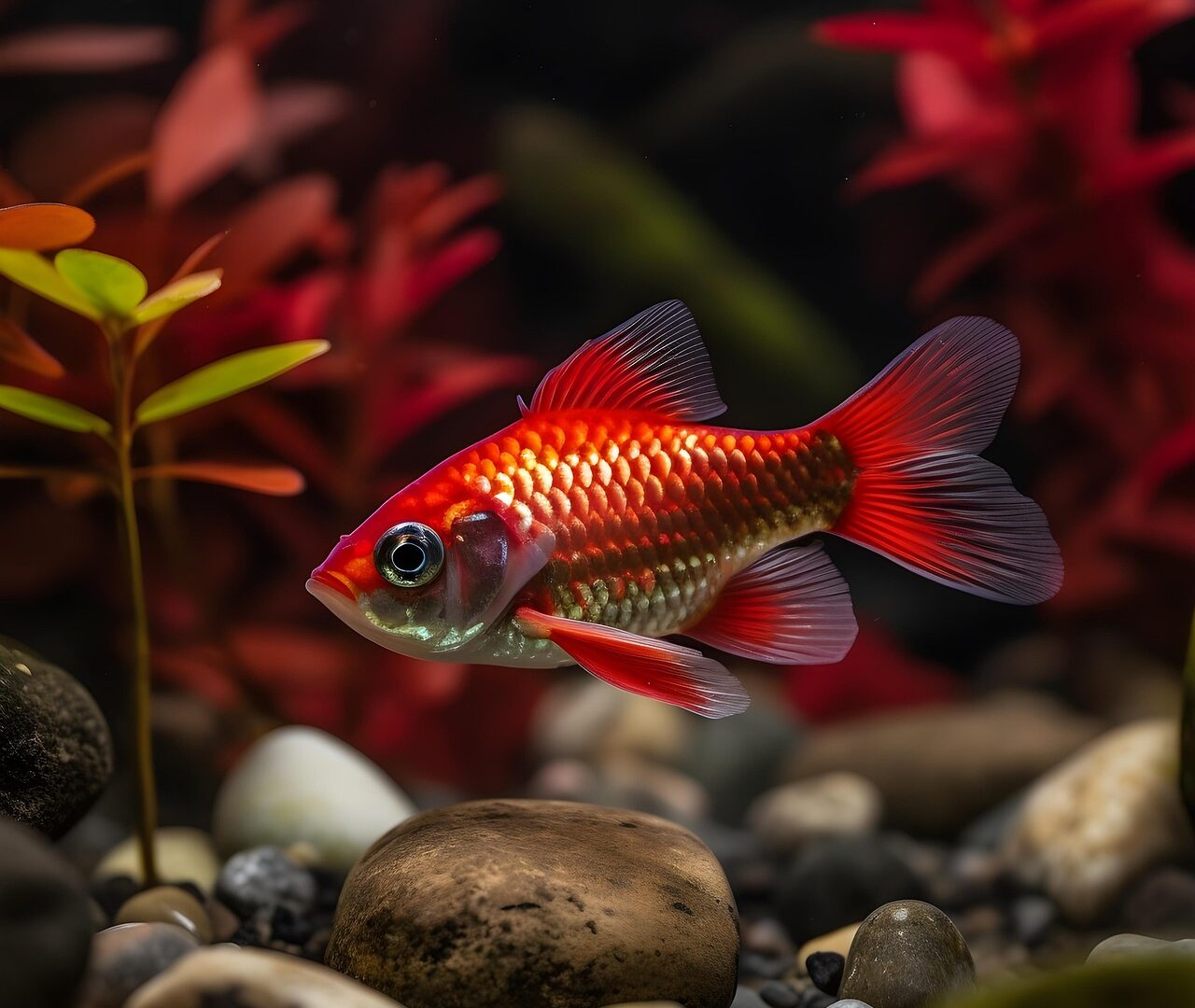
Few aquarium fish reward a beginner breeder as quickly and reliably as the red cherry barb. Breeding red cherry barbs — Puntius titteya — requires nothing exotic: a small tank, fine-leaved plants, clean water, and a well-conditioned pair. The species is forgiving of minor parameter variations, spawns readily once in condition, and produces hardy fry that aren’t difficult to raise. Gensou Aquascaping at 5 Everton Park, Singapore regularly recommends this species as a first breeding project for hobbyists stepping beyond simply keeping fish alive. Here is exactly how to do it.
Recognising Males and Females
Sexual dimorphism in red cherry barbs is among the clearest of any small barb species. Adult males are a vivid, unbroken cherry red across the entire body — the intensity deepens further during courtship. Females are a warm golden brown with a faint horizontal dark stripe and a noticeably rounder belly when mature. The difference is visible even on juvenile fish at around 2 cm, though the male’s colour continues to intensify until full adulthood at roughly 4–5 cm.
Setting Up the Spawning Tank
A 20–30 litre tank is plenty. The key requirements are soft water (GH 4–8 suits this Sri Lankan native), slightly acidic to neutral pH (6.5–7.2), and a temperature of 24–27°C. Singapore’s dechlorinated PUB tap water sits comfortably within these ranges without modification. Line the bottom with a fine layer of dark gravel or leave it bare — bare-bottom tanks make egg spotting easier. Cover two-thirds of the bottom with java moss or spawning mops; eggs scatter into these and become very difficult for the parents to locate and eat.
Filtration should be gentle: a small sponge filter is ideal. Power filters create too much current and can trap eggs or fry. A thin layer of floating plants — frogbit or salvinia — dims the light, which encourages more confident spawning behaviour.
Conditioning the Breeding Pair
Separate males and females for one to two weeks before the breeding attempt, feeding both heavily on varied live and frozen foods. Daphnia, baby brine shrimp, and frozen bloodworms all work well. The female should become visibly gravid — belly noticeably swollen — before you introduce the pair. A male that has been separated will display strongly the moment the female is added, which usually triggers spawning within 24–48 hours.
The Spawning Event
Cherry barbs spawn in bursts throughout the morning hours, typically beginning around sunrise. The male drives the female into vegetation, pressing alongside her body as she releases eggs. Each pass deposits a handful of eggs — transparent, slightly adhesive, around 1 mm — among the plant leaves or moss. A full spawning session over two to four hours can produce anywhere from 100 to 300 eggs depending on the female’s condition and age.
Remove both adults immediately after spawning. Cherry barbs are indiscriminate egg eaters and will consume an entire clutch in a few hours if left in the tank. This single step separates successful breeders from those who wonder why the tank is suddenly empty of eggs by midday.
Incubation and Early Fry Care
Eggs hatch in 24–48 hours at 26°C. The larvae spend another two to three days absorbing their yolk sac before becoming free-swimming. At the free-swimming stage they are tiny — roughly 3 mm — but already actively hunting. Infusoria or commercial liquid fry food covers the first week. Baby brine shrimp nauplii can be introduced from day seven onwards and accelerate growth noticeably. Keep the tank dim during this period; bright light stresses very young fry.
Growing Out Fry to Juvenile Stage
Red cherry barb fry grow faster than many nano species. By four weeks, most reach 1 cm and accept micro-pellets and crushed flake food. Partial water changes — 15–20% every two days — are essential to prevent nitrate accumulation, which stunts fry growth. By eight weeks, juveniles should be identifiably male or female and large enough to join a community tank safely. At this size they are available at local shops on Carousell and Shopee for around $1–$2 each; if you raise a good batch, fellow hobbyists are often grateful recipients.
Maximising Breeding Success
Cherry barbs can spawn every few weeks once conditioned. The fastest production comes from maintaining two or three females per male — this distributes the male’s courtship energy and keeps all females cycling. Between spawning attempts, return all fish to the main tank and feed heavily for ten to fourteen days before the next separation. A female that spawns repeatedly without adequate recovery time between sessions will gradually produce smaller clutches and show signs of stress — watch for faded colouration or sunken belly as early warnings.
Related Reading
- How to Breed Cherry Barbs: From Courtship to Free-Swimming Fry
- Cherry Barb vs Gold Barb: Colour, Size and Temperament Compared
- How to Breed Denison Barbs: Torpedo Barb Spawning in Captivity
- Fire Red Cherry Shrimp Selective Breeding: From Sakura to Painted
- Red Cherry Shrimp vs Crystal Red Shrimp: Beginner vs Advanced



