How to Aquascape a Half-Moon Tank: Working With the Curve

Half-moon tanks sit in living rooms and office receptions across Singapore, their curved front glass creating an immersive panoramic view that rectangular tanks cannot match. But that same curve introduces aquascaping challenges — distortion at the edges, awkward depth perception and difficulty creating balanced compositions. Knowing how to aquascape a half-moon tank properly turns these quirks into advantages. At Gensou Aquascaping, we have designed dozens of curved-front displays, and the principles that follow will save you considerable trial and error.
Understanding Curved Glass Distortion
Curved front panels act like a lens, magnifying objects near the centre and stretching those near the edges. Fish swimming along the sides appear wider; hardscape at the periphery looks elongated. This effect is stronger in smaller half-moon tanks (under 40 litres) and less noticeable in larger ones. Rather than fighting this, embrace it — place your focal point slightly off-centre where magnification is moderate, and use the edges for background fill rather than detailed focal elements.
Hardscape Placement Principles
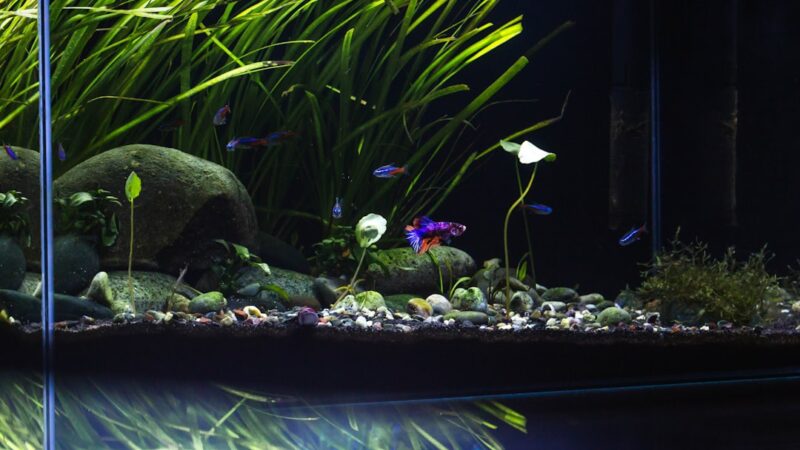
Position your main stone or driftwood piece at roughly one-third of the way across the front viewing arc — not dead centre, which looks static, and not at the edge, where distortion flattens it. Curved tanks naturally draw the eye inward toward the centre, so an off-centre focal point creates pleasing tension. Use smaller supporting stones that decrease in size toward the edges, following the curve. This radial arrangement feels organic and works with the tank’s geometry rather than against it.
Avoid tall, narrow hardscape pieces near the curved edges. The glass stretches them horizontally, making them look squashed and unnatural. Broader, lower stones fare better in these zones.
Substrate Depth and Slope
Create a substrate slope that rises from the front centre toward the back corners. In a half-moon tank, the deepest point is at the centre-back, giving you 8-12 cm of planting depth for stem plants. Keep the front edge shallow — 2-3 cm — so the sand or soil meets the curved glass cleanly without visible layers of dirt against the pane. Use substrate retainers (plastic mesh strips or small stones) to prevent the slope from collapsing over time, especially in active tanks where fish disturb the bottom.
Plant Selection for Curved Tanks
Choose plants that complement the organic, flowing feel of the curve. Soft, feathery species like Rotala rotundifolia, Myriophyllum mattogrossense and Limnophila sessiliflora echo the tank’s rounded aesthetic. Stiff, geometric plants (tall Vallisneria, rigid Echinodorus) can look awkward when the curved glass distorts their straight lines. Carpeting plants work beautifully — Monte Carlo or Eleocharis mini flowing across the front creates a meadow effect amplified by the lens-like glass. For mid-ground, Anubias ‘Petite’ attached to stones adds compact green accents.
Working With Depth Limitations
Half-moon tanks are typically shallower front-to-back than equivalent rectangular tanks of the same volume. A 60-litre half-moon might offer only 25-30 cm of depth at the centre. Maximise this by keeping foreground elements very low and using vertical height in the back to create an illusion of greater depth. Tall background stems trimmed into a gentle dome shape that follows the curve of the glass produce a satisfying sense of enclosure. Avoid cramming too many layers into limited depth — two distinct planes (foreground carpet and background stems) often read better than three congested layers.
Lighting Considerations
Curved tanks often come with built-in hoods that house the light fixture, limiting your upgrade options. If the stock light is insufficient for plants (many half-moon kits ship with weak LEDs), consider a clip-on LED light positioned at the top-centre of the arc. Light spreads naturally along the curve, reducing shadow pockets compared to rectangular tanks where corners can go dark. Aim for 30-50 lumens per litre for a planted half-moon tank. Run lights 7-8 hours daily on a timer.
Fish Selection
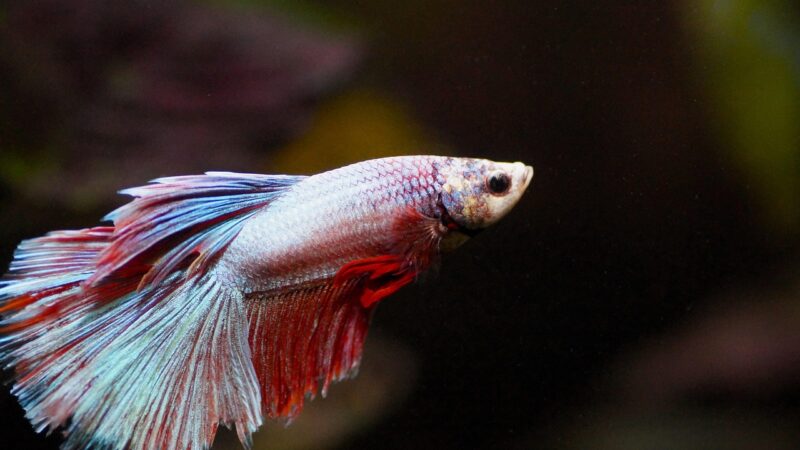
Small, active schooling fish look spectacular in half-moon tanks. The curved glass creates a cinematic effect as a school of ember tetras or celestial pearl danios sweeps across the panoramic view. Avoid large-bodied fish — the magnification effect makes them appear unnaturally bulky, especially near the centre. Shrimp colonies are another excellent choice; Neocaridina cherry shrimp grazing across a curved carpet of Monte Carlo is endlessly watchable. For Singapore hobbyists, a betta in a well-planted half-moon of 15 litres or more makes a striking desk display.
Maintenance Access
Half-moon tanks are notoriously difficult to clean due to the curved glass and often narrow top opening. Invest in a flexible magnetic glass cleaner designed for curved surfaces — flat magnet cleaners leave unscraped arcs. Long, angled tweezers and curved scissors make planting and trimming easier in tanks with restricted top access. During water changes, use a narrow-diameter siphon tube to navigate around hardscape without disturbing your carefully arranged slope. Planning for maintenance access at the design stage — leaving your hand enough room to reach every corner — prevents frustration down the line.
Related Reading