How to Aquascape a Front-Viewing Only Tank: One-Sided Design
Most aquascaping guides assume a tank placed in the centre of a room, viewed from all angles. But the majority of display tanks in Singapore homes — sitting against a wall in an HDB flat or built into a cabinet unit — are viewed exclusively from the front. That constraint changes everything about how the layout should be composed. Designing an aquascape for a front-viewing only tank means building depth into a flat wall rather than a three-dimensional space, and understanding which compositional principles create the illusion of distance when the observer is always in a fixed position. Gensou Aquascaping at 5 Everton Park, Singapore, designs primarily for wall-facing installations, and this guide reflects years of practical experience with that specific challenge.
The Fundamental Difference From All-Angle Viewing
When a tank is viewed from all sides, every surface must be considered: the back, sides, and even from above. For a wall-facing tank, only the front viewing plane matters — the back glass is a backdrop, the sides are invisible, and the top is irrelevant to the composition. This simplification allows you to focus design energy entirely on what reads from the front: height variation, foreground-to-background depth layering, and the visual clarity of the main focal element as seen from a seated or standing position in front of the tank.
Depth Illusion Through Plant Layering
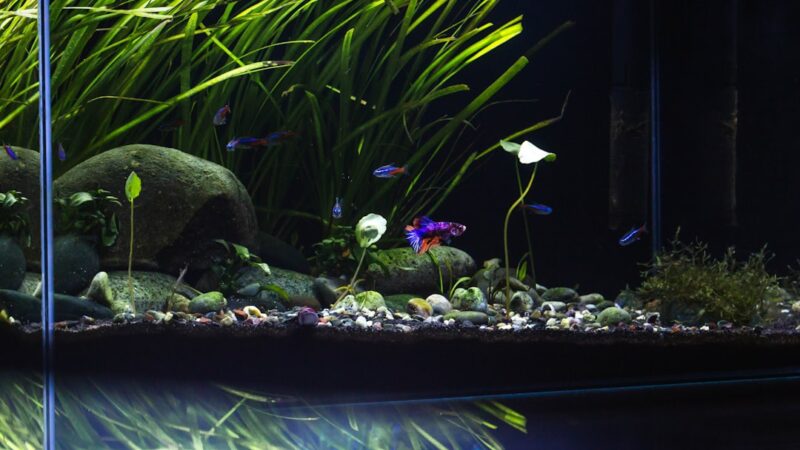
Without side and back views to create genuine three-dimensionality, depth must be constructed through foreground/midground/background plant layering and substrate slope. Raise the substrate from front (3–4 cm) to back (12–15 cm) steeply to push hardscape and background plants visually further from the viewer. Place low-growing foreground plants (carpet species or small rosette plants) in the front 20% of the tank. Medium-height plants in the middle 40%. Tall background plants covering the back 40%. This three-layer system creates a convincing foreground-to-horizon depth gradient that reads clearly from a fixed frontal position.
The Role of the Background
The back glass in a wall-facing tank should be treated as a canvas. Dark backgrounds — black backing paper or film — eliminate reflections and make plants appear to float in space. Green or natural stone-pattern backgrounds work if they complement rather than compete with the layout. Some aquascapers use the back glass itself as a planting surface, attaching mats of Taxiphyllum moss or Microsorum fern to create a living green wall at the rear. This approach maximises the visual depth impression by placing plant material at the very back plane of the composition.
Hardscape Placement for Frontal Compositions
In a frontal tank, the rule of thirds applies along the horizontal axis: place your dominant focal element at approximately one-third or two-thirds of the tank width from the left side. Avoid centred focal points — they create static, symmetrical compositions that look formal and dated. An off-centre rock or driftwood piece, with secondary elements balancing the composition from the other side at a lower height, produces the natural asymmetry that makes aquascapes interesting. The focal element should also be positioned at a depth (front-to-back) that places it roughly in the midground — not pressed against the front glass, not hidden at the rear.
Side Panel Management
Even though the sides aren’t the viewing angle, they’re often visible as peripheral elements, and untidy side panels detract from the frontal composition. In built-in cabinet tanks, the side panels may be opaque and hidden. In freestanding tanks placed against a wall, frosted window film applied to the side panels eliminates any interior view from the side and focuses attention on the front glass. This is a simple modification costing $5–$15 in film material that significantly cleans up the overall presentation of a wall-facing aquascape.
Lighting Setup for Wall-Facing Tanks
Lighting in a front-viewing tank should emphasise depth: slightly brighter in the midground-to-background zone draws the eye into the tank, while the foreground sits in relative shade. Positioning the light slightly toward the back of the tank hood — rather than centred — achieves this naturally. Shadow cast by taller background plants onto the foreground adds to the depth impression. For built-in cabinet tanks with custom lighting, a second lower-intensity LED strip at the back of the hood independently of the main light gives precise control over this front-to-back light gradient.
Maintenance Access in Wall-Facing Setups
Wall-facing tanks are often tight on access — particularly built-in cabinet units where the sides and back are not reachable at all. Plan the layout accordingly: avoid plants in back corners that require side-access trimming. Use attach-and-grow epiphytes that can be reached through the front opening. A long-handled scissor set (30 cm handle length is ideal for 60 cm deep tanks) allows accurate trimming without leaning over the open front. Weekly water changes using a long siphon hose directed from the front are feasible in tanks up to 150 litres without requiring removal from the cabinet — a practical consideration for the reality of most Singapore home aquarium placements.
Related Reading