Aquascaping With Ferns and Anubias Only: Zero CO2 Elegance
There is a quiet confidence to a tank built entirely from ferns and Anubias — no CO2 system humming, no complex fertiliser regimen, no carpet plants demanding intense light. Just durable, slow-growing epiphytes anchored to wood and stone, thriving on neglect and low technology. This aesthetic, sometimes called the low-tech or Zen approach, produces tanks that are genuinely serene to look at and remarkably easy to maintain. This guide from Gensou Aquascaping at 5 Everton Park, Singapore covers how to aquascape with ferns and Anubias only — and make it look intentional rather than lazy.
Why This Combination Works
Java fern (Microsorum pteropus) and Anubias species share two critical traits: both are epiphytes that attach to hardscape rather than rooting in substrate, and both tolerate very low light and no CO2 injection. This means you can build a complete, visually rich aquascape without aquasoil, without a CO2 cylinder, and without intense lighting — reducing both setup cost and ongoing complexity dramatically. The limitation is growth rate: these plants are slow. A fully mature fern-and-Anubias aquascape takes 6–12 months to fill in completely, but the result is stable, low-maintenance, and genuinely beautiful.
Selecting Your Varieties for Visual Range
Anubias barteri var. nana is the most compact and widely available, with dark oval leaves 3–5 cm long — ideal for foreground and mid-ground placement on small stones or driftwood stumps. Anubias barteri var. barteri grows larger (leaves to 10 cm) and suits background driftwood. Anubias coffeifolia has beautifully ridged, darker leaves that catch light differently from nana, adding visual texture. For ferns, standard Microsorum pteropus provides broad, deep-green leaves; ‘Windelov’ offers a delicate, lace-tipped variant; ‘Narrow Leaf’ reads lighter and more graceful; and ‘Trident’ has highly divided leaves that add complexity. Combining three or four of these varieties gives a palette wide enough for a rich composition without introducing any species outside the genus pair.
Hardscape: The Foundation of This Layout
Because neither fern nor Anubias roots in substrate, hardscape is not just decoration — it is the actual growth medium. Design the hardscape layout first, before introducing any plants. Driftwood — particularly branching pieces with multiple attachment points — is ideal for this style. Spider wood, manzanita, and bog wood all work. Stones can supplement driftwood as additional Anubias attachment surfaces. Arrange hardscape in an asymmetric composition with a dominant piece to one side and smaller elements echoing the main structure on the other side. Leave deliberate negative space — open water areas — that the plants will partially occupy as they grow in.
Attaching Plants Without Damaging Rhizomes
Both Anubias and java fern are attached via their rhizome — the thick horizontal stem from which both leaves and roots emerge. Never bury the rhizome in substrate or attach it in a way that constricts it. Super glue gel (cyanoacrylate) is the easiest attachment method: apply a small dot of glue to the hardscape surface, press the root mass of the plant against it, and hold for 20–30 seconds. The glue is inert once cured and fully aquarium-safe. Alternatively, use thin cotton thread or fishing line to tie plants loosely — the thread biodegrades over 4–6 weeks, by which time the plant’s own roots have gripped the hardscape naturally.
For Anubias, avoid gluing or tying the rhizome directly — attach the root mass beside the rhizome and allow the rhizome to sit free of the surface.
Lighting for a Low-Tech Fern and Anubias Tank
Both genera prefer low to moderate light — 15–35 PAR at plant level is sufficient. Higher light does not accelerate their slow growth meaningfully but does encourage algae on the broad, slow-growing Anubias leaves, which is the primary algae problem in this style of tank. Run the photoperiod at 6–8 hours per day. If algae appear on Anubias leaves, reduce the photoperiod first before reaching for chemical treatments. A siesta period — lights on for 4 hours, off for 3 hours, on again for 3 hours — can reduce algae without reducing total daily light for the plants.
Fish That Complement This Layout
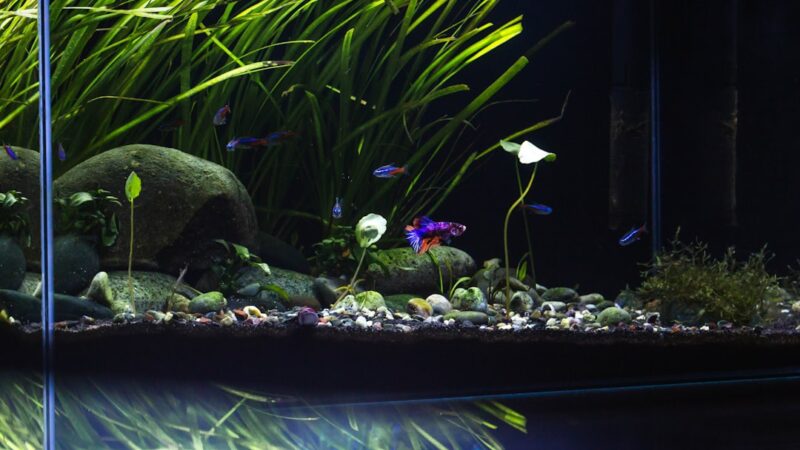
The ferns-and-Anubias aesthetic pairs beautifully with darker, slower-moving fish that the low-tech environment suits. Chocolate gouramis, dwarf gouramis, and black ghost knife fish (if the tank is large enough) all look striking against the dark greens. For smaller tanks, a school of black neon tetras or exclamation point rasboras (Boraras urophthalmoides) provides movement without overwhelming the serene character of the composition. Avoid fast-schooling fish that make the tank feel busy — the fern-and-Anubias style rewards calm, contemplative observation.
Long-Term Care: What Changes and What Does Not
After the initial setup, maintenance is minimal. Trim dead or damaged Anubias leaves at the base. Remove any yellowing java fern leaves — new growth emerges from the rhizome naturally. Fertilise lightly with a low-dose liquid fertiliser every two weeks; these plants are not heavy feeders. Water changes of 20–30% weekly keep nutrients balanced. At Gensou Aquascaping, this style of tank is often recommended for clients with busy schedules or for office environments where maintaining a complex planted system is impractical — it delivers visual quality without demanding daily attention.
Related Reading