
Bucephalandra Brownie Purple Care Guide: Rare Borneo Rheophyte
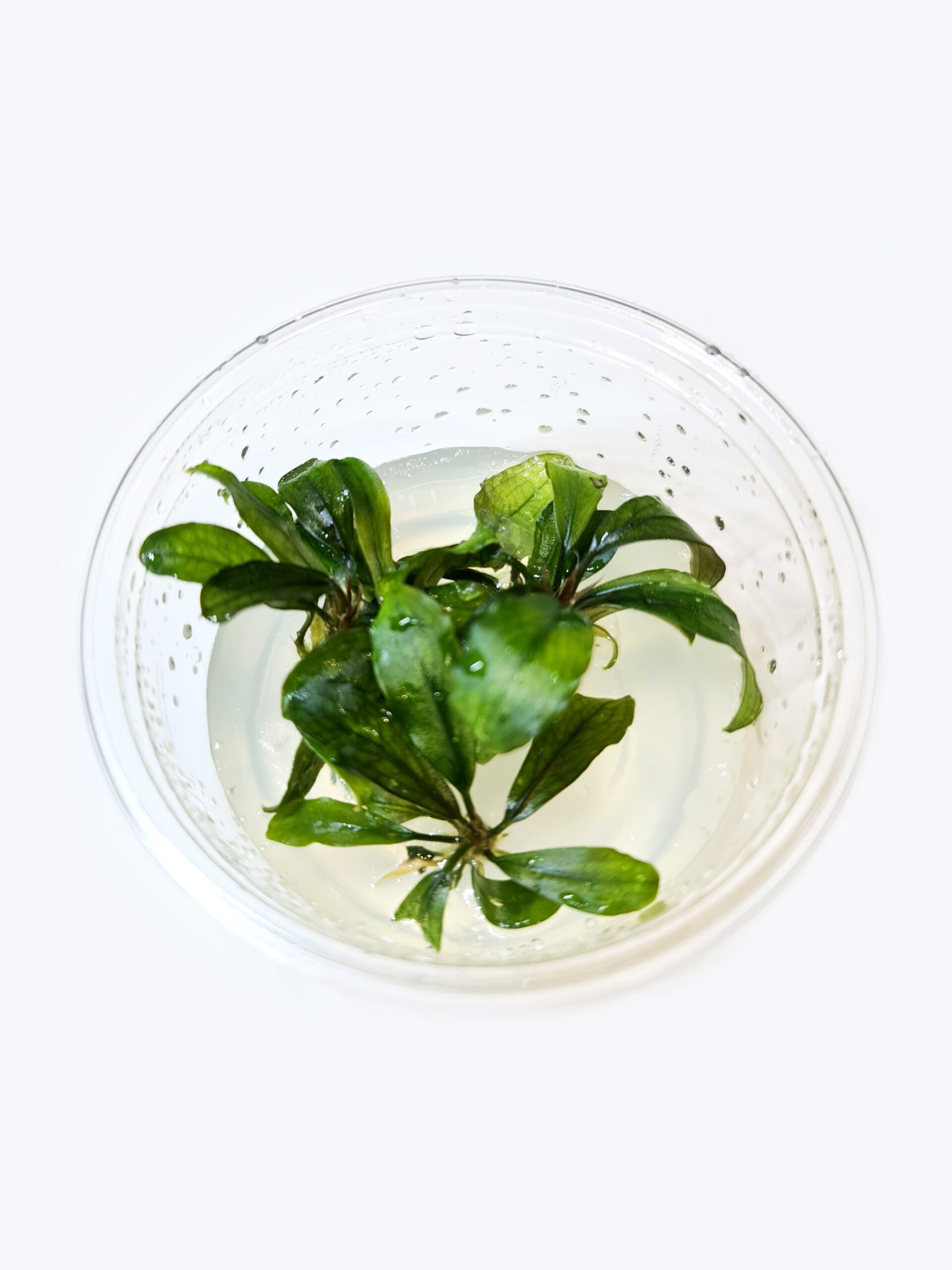
Bucephalandra ‘Brownie Purple’ occupies a unique space in the planted tank hobby — it’s a genuine collector’s plant with iridescent blue-purple leaf surfaces, slow but steady growth, and tolerance for low-tech conditions that most equivalently rare plants cannot match. A reliable Bucephalandra Brownie Purple care guide needs to honestly address the gap between what the name suggests (delicate rarity) and the reality (tougher than it looks, if parameters are right). At Gensou Aquascaping at 5 Everton Park, Singapore, Bucephalandra is a cornerstone of our epiphyte setups.
Understanding Bucephalandra as a Genus
Bucephalandra is a genus of rheophytic aroids endemic to Borneo, where they grow attached to rocks and submerged wood in fast-flowing rivers. The genus contains dozens of described and undescribed variants — ‘Brownie Purple’ is a trade name for a cultivar or locality variant characterised by deep olive-brown leaves with vivid blue-purple iridescence that becomes most intense under certain light angles and water conditions. Like all Bucephalandra, it produces tiny cream-white spathes when healthy, one of the few flowering aquatic plants that regularly blooms submerged.
Water Parameters and Adaptability
Bucephalandra are more adaptable than their slow growth rate and collector status suggest. Brownie Purple tolerates a pH range of 5.5–7.5, temperature 22–28°C, and GH 1–10. Soft, slightly acidic water (pH 6.0–6.8, GH 2–5) produces the deepest blue-purple iridescence and fastest growth. Singapore’s PUB tap water, once dechlorinated and settled at room temperature, sits within acceptable range — though adding a small proportion of RO water improves the purple colouration visibly over time.
Avoid sudden temperature swings. Singapore’s ambient temperature of 28–30°C is at the upper limit — keep the tank in an air-conditioned room or use a fan to maintain stability below 28°C. Brownie Purple will survive at 28°C but colours are more vivid and growth is slightly faster at 24–26°C.
Lighting Requirements
One of Bucephalandra’s genuine advantages is its tolerance for low light. Brownie Purple grows well at 20–40 PAR — the shaded areas of a tank where most plants would become etiolated or die. Under low light, growth slows but the plant remains healthy and maintains its iridescence. Higher light (50–80 PAR) accelerates growth and can intensify colouration but also increases the risk of algae colonising the broad, slow-growing leaf surfaces. Keep light moderate and consistent rather than intense and variable.
Attachment and Placement
Bucephalandra must not be planted in substrate with its rhizome buried — doing so causes rot within weeks. Instead, attach the rhizome to hardscape: tie to driftwood or stone with cotton thread or use aquarium-safe superglue gel (cyanoacrylate glue, available at hardware shops for under $5) to bond the rhizome to a porous surface. Once attached, the plant sends out fine roots that grip the surface permanently over several weeks.
Brownie Purple looks superb on dark driftwood — the contrast between brown wood and purple-iridescent leaves is striking. Position in moderate flow areas where its leaves sway gently; stagnant conditions increase algae growth on leaf surfaces.
Fertilisation and CO2
Bucephalandra is a light feeder. Standard liquid fertiliser at half the recommended dose, applied weekly, is sufficient. Brownie Purple grows well without CO2 injection — a genuine low-tech option — though adding CO2 at 15–25 ppm doubles growth rate and amplifies the blue iridescence under appropriate lighting. Potassium and iron are the most important micronutrients; slight iron supplementation (0.05–0.1 mg/L) deepens leaf colour noticeably.
Propagation and Colony Building
Propagation is simple: the rhizome branches over time, producing side shoots. Once a side shoot has two to three leaves, carefully separate it from the parent rhizome with clean scissors or a razor and attach it independently. This slow division means a healthy plant doubles to a colony over six to twelve months. Tissue culture Bucephalandra — available in Singapore from specialist aquatic shops for $12–25 per cup — offers a pest-free starting point and typically adapts to submersed conditions within four to eight weeks. The patience required is amply rewarded: a mature colony of Brownie Purple covering a piece of driftwood is among the most impressive sights in planted tank aquascaping.
Related Reading



