How to Aquascape a Corner Tank: Triangular Depth and Flow
Corner tanks are an underused format that fits neatly into room corners where a standard rectangular aquarium would jut awkwardly into living space. The triangular footprint creates unique design challenges, but also unique opportunities. This aquascape corner tank guide covers how to work with the geometry rather than against it, turning what many hobbyists see as a limitation into a genuine advantage. Gensou Aquascaping in Singapore has installed corner tanks in HDB flats and condos where floor space is at a premium, and the results consistently surprise clients.
Understanding Corner Tank Geometry
Most corner tanks have two flat back panels meeting at a right angle and a curved or angled front viewing panel. Depth varies dramatically: the back corner is deep while the front edges are shallow. This natural depth gradient is actually a gift for aquascaping because it mirrors the foreground-to-background depth progression that scapers work hard to create in rectangular tanks.
Substrate Slope and Height
Build the substrate highest in the back corner, tapering down toward the front edges. A rear height of 8-10 cm sloping to 2-3 cm at the front creates a dramatic sense of depth when viewed from the curved front panel. Use aqua soil or a capped inert substrate. Support steep slopes with hardscape barriers, small rocks wedged into the substrate prevent soil from sliding forward over time.
Hardscape Placement
Place your tallest or most dramatic hardscape piece in or near the back corner, where it has maximum depth behind it and maximum visual impact from the front. A single tall piece of driftwood reaching upward or a vertical stone arrangement draws the eye into the deepest point of the tank. Smaller accent stones and wood pieces can radiate outward from this focal point, following the triangular geometry naturally.
Avoid placing large hardscape near the front edges where it would block sightlines and make the tank feel cramped.
Plant Layout Strategy
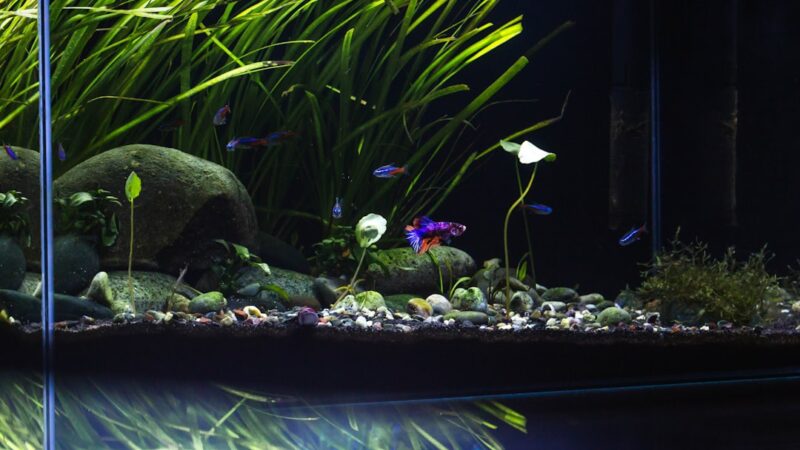
Tall background plants go into the deep back corner. Vallisneria spiralis, Hygrophila corymbosa, or tall Cryptocoryne species like Cryptocoryne balansae fill the rear zone with lush vertical growth. Mid-ground species such as Staurogyne repens, Cryptocoryne wendtii, and Anubias on wood occupy the transition zone. Low foreground carpets of Eleocharis parvula or Marsilea hirsuta edge the front where substrate is shallowest.
This three-tier approach exploits the natural depth gradient and ensures the aquascape looks full from every angle visible through the front panel.
Managing Flow in a Triangle
Water circulation in corner tanks can be tricky. The deep back corner tends to become a dead zone where detritus accumulates if the filter outlet is poorly positioned. Aim the outlet along one of the back glass panels so current sweeps across both back walls and returns along the front. A small powerhead or adjustable nozzle helps direct flow into the corner.
Check for debris buildup in the back corner during water changes. A long-handled gravel vacuum or turkey baster reaches into the deep zone effectively.
Lighting Challenges
Standard linear LED fixtures do not match the triangular footprint, leaving the back corner underlit. Pendant-style or puck-shaped LED lights mounted centrally above the tank provide more even coverage. If using a linear fixture, position it diagonally from one back edge to the opposite front edge, and supplement the far corner with a small clip-on LED. Uneven lighting causes plants in dark zones to stretch and weaken.
Fish Selection and Stocking
Corner tanks generally hold 40-80 litres, which limits stocking to small species. Nano fish like Boraras rasboras, ember tetras, and small Corydoras work well. The curved front panel gives a slight magnification effect that makes small fish appear slightly larger and more detailed than they would through flat glass. Avoid active swimmers that need long horizontal runs, as the triangular shape limits straight-line swimming distance.
Making the Most of the Format
A corner tank is not a compromise. With thoughtful scaping, it becomes a three-dimensional display that draws viewers in from multiple angles. The key is embracing the depth gradient, anchoring the design in the back corner, and keeping the front open and inviting. An aquascape designed specifically for a corner tank can become the most eye-catching feature in a room. Gensou Aquascaping in Singapore is always happy to consult on corner tank layouts for hobbyists looking to make the most of limited space.
Related Reading