
Spirulina vs Astaxanthin Color Enhancer: Fish Colour Diet
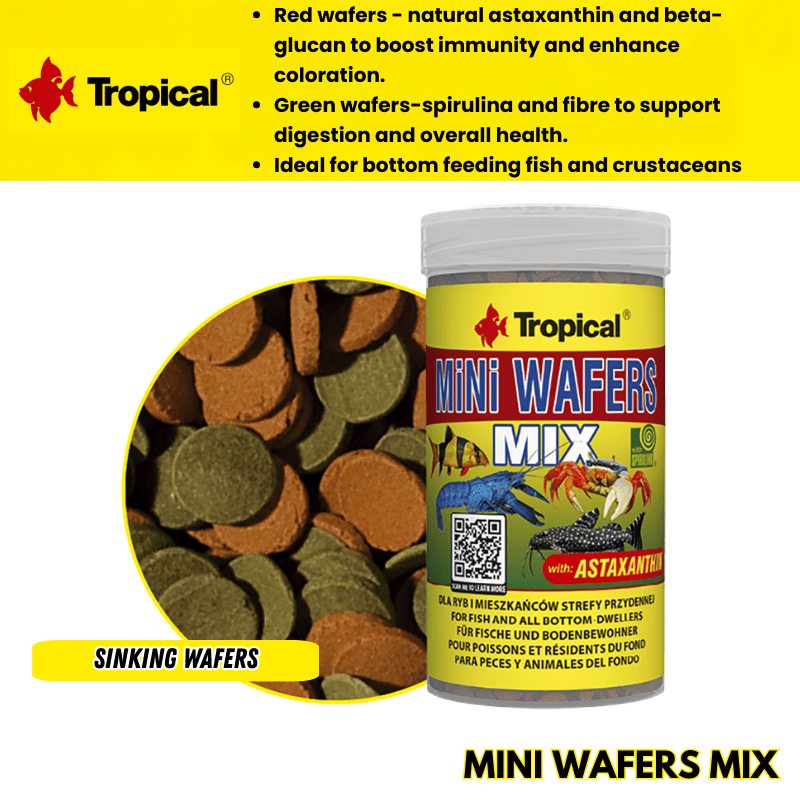
Walk the food aisle at any Singapore aquarium shop and two words dominate the colour-enhancement claims: spirulina and astaxanthin. Both work, but they do very different things inside the fish, and stacking them blindly wastes money. This spirulina vs astaxanthin color enhancer comparison from Gensou Aquascaping at 5 Everton Park, Singapore, explains the biochemistry, effective dosages, and species where each supplement actually moves the needle, drawn from 20 years of conditioning show fish and breeding stock.
What Spirulina Actually Delivers
Spirulina is a blue-green cyanobacterium, roughly 60-70 per cent protein by dry weight, loaded with chlorophyll, phycocyanin, and beta-carotene. The beta-carotene and phycocyanin drive colour gains — yellows, greens, and some blues. Fish convert beta-carotene to vitamin A and use the residual pigment to deepen yellow scales and yellow fin margins. Spirulina also supports mucus layer health and gut flora, which indirectly improves colour by letting fish absorb nutrients more efficiently.
What Astaxanthin Does Differently
Astaxanthin is a carotenoid produced by the microalga Haematococcus pluvialis and absorbed up the food chain — krill, salmon, flamingos all get their red from it. Fish cannot synthesise astaxanthin de novo. Fed in diet, it deposits directly into scale and skin pigment cells, producing reds, oranges, and deep pinks. Synthetic astaxanthin is chemically identical and works just as well at equivalent doses; natural sourcing matters only for marketing.
The Colour Spectrum Each Targets
Spirulina pushes the yellow-green-blue end of the spectrum: yellow labs deepen, green terrors green up, and blue cichlids gain saturation. Astaxanthin pushes red-orange-pink: peacocks go flame red, discus intensify, Endlers glow, and ember tetras turn near-fluorescent. Fish with mixed colouration — most peacocks, many rainbows, koi — benefit from both running simultaneously, since the pigments deposit in different cell types and do not compete.
Effective Dose Ranges
In pelletised food, 1-2 per cent spirulina inclusion is standard; 3-5 per cent produces visible gains within four weeks. Astaxanthin needs 50-100 ppm (roughly 0.005-0.01 per cent) to show effect, and above 150 ppm gives diminishing returns because fish excrete what they cannot deposit. Over-dosing astaxanthin turns water orange-tinted in a heavy feed and does not make fish any redder.
Timeline for Visible Results
Spirulina gains show in 3-4 weeks on most tropicals. Astaxanthin takes 4-6 weeks for initial visible change and 8-10 weeks for full colour expression because the pigment must deposit through scale turnover. Fish that have never received supplemental carotenoids show the biggest jumps; fish already on premium pellets see smaller gains because they are closer to their genetic ceiling.
Species Where Each Works Best
Spirulina shines on mbuna, yellow labs, tropheus, silver dollars, and herbivorous marines like yellow tangs. Astaxanthin shines on discus, peacocks, flowerhorns, koi, goldfish, many killifish, ember and cardinal tetras, and marine clowns. For flowerhorns chasing maximum kok and red, astaxanthin is the non-negotiable supplement, usually dosed at the upper end of the range alongside krill-based pellets.
Combining Them in a Diet
The two supplements do not interact biochemically, so combining is safe and often optimal. A mixed community of cichlids benefits from a rotation: three days on a spirulina-heavy vegetable pellet, three days on an astaxanthin-enriched colour pellet, one day on frozen food. Within eight weeks every species in the tank improves. Do not dose either as a top-up powder into the tank — fish absorb these pigments through the gut, not the skin.
Natural Food Sources
Frozen krill, mysis, and cyclops all contain astaxanthin. Blanched spinach and spirulina flake contain beta-carotene. A diet that includes 2-3 frozen feedings per week delivers meaningful colour support without relying exclusively on pellet formulations. Homemade gel food is the cleanest way to dose precise amounts — a quarter teaspoon of pure astaxanthin powder per 500g gel batch hits roughly 100 ppm.
Heat and Storage Considerations
Both pigments degrade under heat and light. Spirulina is relatively stable but loses potency after 12 months even unopened. Astaxanthin is highly light-sensitive; a tub left near a tank light loses 30-40 per cent of its colour-delivering capacity within six months. Store both in a cool dark cupboard, decant into small jars, and keep backup in the freezer. This matters doubly in Singapore where ambient humidity and warmth accelerate oxidation.
When Colour Gains Stop
Every fish has a genetic colour ceiling. If you have fed a correct diet for 12 weeks and colour has plateaued, the fish has hit its expression limit. Further supplement dosing yields nothing. This is why breeders cull pale individuals early — no amount of astaxanthin turns a grey peacock into a red one; it only unlocks the genetics already present.
Cost vs Benefit in Singapore
Pure spirulina powder costs around $15-20 for 100g locally; astaxanthin powder runs $30-50 for 20g. Used at correct dose in DIY gel food, one $50 tub of astaxanthin lasts nearly a year in a mixed community. Commercial colour-enhancing pellets cost more per effective milligram of pigment, so DIY is the economical route for serious hobbyists.
Related Reading



