Frodo Stone vs Seiryu Comparison: Texture, pH, Cost
A direct frodo stone vs seiryu comparison matters more now than it did five years ago because genuine Kyoto seiryu is effectively off the market and “seiryu” sold today is mostly Chinese mimic limestone. This analysis from Gensou Aquascaping at 5 Everton Park looks at how Frodo stone (also called Elephant Skin) stacks up on the criteria scapers actually care about: visual impact, chemistry impact, cost and long-term stability. If you have been trying to decide between the two for an iwagumi build, the answer usually hinges on your livestock and your water change schedule.
The Stones in Brief
Seiryu, real or imitation, is a grey limestone with bold vertical striations and sharp cleavage planes. Frodo stone is a harder igneous material with finer wrinkled surface texture that reads darker under cool lighting. Both come from Chinese quarries today, both ship into SG through the same importers, and both suit nature-style aquascaping. Aesthetically they overlap; chemically they do not.
Visual Texture Compared
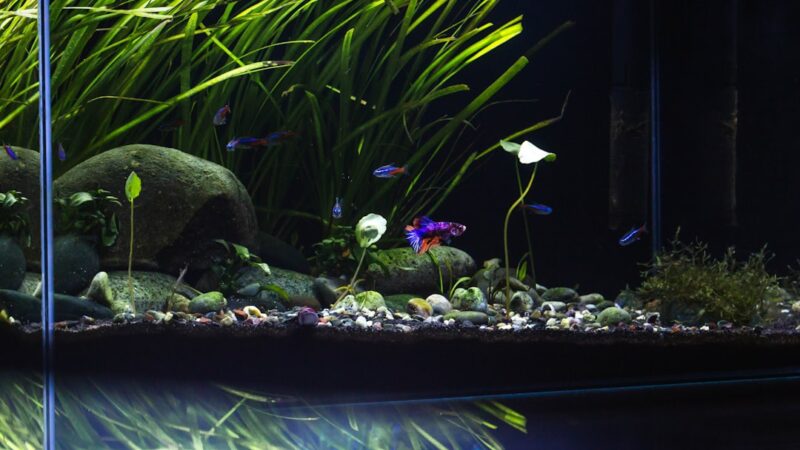
Seiryu’s appeal has always been its dramatic ridges: angular, sharp, photogenic. Frodo gives you closer-grained folds and creases, less dramatic at a glance but more sculptural up close. In a 60 cm tank photographed from 1.5 metres, seiryu reads more boldly; in person while sitting beside the tank, Frodo’s detail actually shows better. For contest-style composition logic see our aquascape iwagumi style step by step article.
Impact on pH and Kh
This is where the comparison becomes decisive. Seiryu and its imitators dissolve slowly in aquarium water, raising kH by 3 to 5 dKH over a month in a 60 litre tank and dragging pH upward by 0.5 to 0.8 units. Frodo is close to inert. In the same tank it might lift kH by 0.5 dKH over a month, an insignificant amount for most livestock. The mechanism is explained in our aquarium co2 ph kh relationship breakdown.
Fit With Singapore Tap Water
PUB tap water arrives at roughly GH 2-4 and kH 1-2, slightly acidic and soft. Dropping seiryu into that baseline fundamentally changes the water profile, which suits African cichlid keepers but fights against shrimp keepers and soft-water tetra setups. Frodo keeps the tap water’s native character, so you can match plant and livestock choices to the water you actually have rather than the water the stone makes.
Cost Per Kilogram
C328 and Polyart price imitation seiryu at $8 to $12 per kilogram. Frodo lands at $6 to $10 per kilogram for comparable grades. For a 90 cm scape needing 12 kilograms of hardscape, you save roughly $30 on Frodo; not huge, but combined with chemistry benefits it tips the scales. Genuine Kyoto seiryu, when it surfaces on Carousell, commands $30 to $50 per kilogram and is not worth the premium unless you are shooting a specific biotope documentary.
Carving and Cutting Differences
Seiryu is a soft limestone that cuts beautifully with a hand chisel; Frodo is harder and needs a diamond disc or angle grinder. For shapers working indoors in HDB apartments, that matters: Frodo work generates sharper dust and needs better ventilation. Our rock cutting shaping aquascape tools article covers the gear. If you want to reshape pieces on the fly, seiryu is the more cooperative stone.
Algae and Biofilm Behaviour
Seiryu’s carbonate content encourages green spot algae and coralline-style encrustation in freshwater, which some scapers love and others hate. Frodo stays visually cleaner for longer, showing a softer brown biofilm after a month that wipes off with a toothbrush. If you like patina, seiryu ages faster; if you like the initial look preserved, Frodo is the choice.
Livestock Compatibility
Seiryu-buffered water suits Mbuna, Tanganyikans, livebearers and goldfish. It fights shrimp, Apistogramma, wild angels, most tetras and soft-water Discus. Frodo works across the whole spectrum. If your stocking plan is locked in already, let that decide; otherwise default to Frodo for versatility. See also our aquascape for african cichlid tank guide for where seiryu still makes sense.
Long-Term Stability
Both stones last the life of the tank physically, but seiryu’s buffering slows over time as surface carbonate depletes. Expect kH impact to halve between year one and year two. Frodo’s chemistry stays constant because there is nothing meaningful to deplete. That predictability matters for dosing routines and CO2 tuning over multi-year tanks.
Making the Call
For a soft-water planted scape with shrimp or wild-type fish: Frodo, without hesitation. For an African cichlid tank that wants hard alkaline water: seiryu (or limestone generally). For a mixed community in Singapore tap water that you want stable: Frodo again, because PUB water needs no help getting harder. Our seiryu stone replacement alternatives guide offers the broader shortlist when neither suits.
Related Reading