How to Draw a Fish Tank Guide: Step by Step
Drawing a fish tank is the first sketching project we recommend to children because it teaches shape, proportion and shading inside a clean rectangular frame — no complicated perspective, no horizon line, no human anatomy. This how to draw a fish tank guide walks through a numbered step sequence that a seven-year-old can follow with a Popular pencil set, while giving adult beginners the same foundation for serious aquascape studies. Gensou Aquascaping at 5 Everton Park runs weekend drawing sessions for kids and the exercise below comes straight from our handout sheets.
Supplies Before You Start
A single HB or 2B pencil, a soft eraser, a ruler, and an A4 sheet of plain paper. That is the full list. Fancy supplies are optional — this tutorial uses gear that fits in a SGD 8 school pencil case. Popular and Art Friend both stock Staedtler Noris or Faber-Castell Grip at SGD 1.20 per pencil. Sharpen to a fine point before starting. If teaching kids, print the finished sketch from this guide as a reference alongside their paper.
Step 1: The Tank Outline
Draw a horizontal rectangle in the middle of your paper, about 15 cm wide and 10 cm tall, using the ruler. Add a slightly thinner rectangle along the top edge for the frame or lid — 1 cm tall is enough. At the bottom, add another slim rectangle for the stand base. The tank is now a box with a hat and feet. This is the skeleton everything else hangs on.
Step 2: The Substrate Line
About 2 cm up from the inside bottom of the tank, draw a gentle curving line from left to right — higher in the middle-back, lower at the front. This is the substrate (gravel or sand). Do not draw it as a perfectly straight horizontal line; a slight hill at the back adds depth. Later you can shade this darker to suggest the sand or aqua soil surface your tank might eventually hold.
Step 3: Add Plants
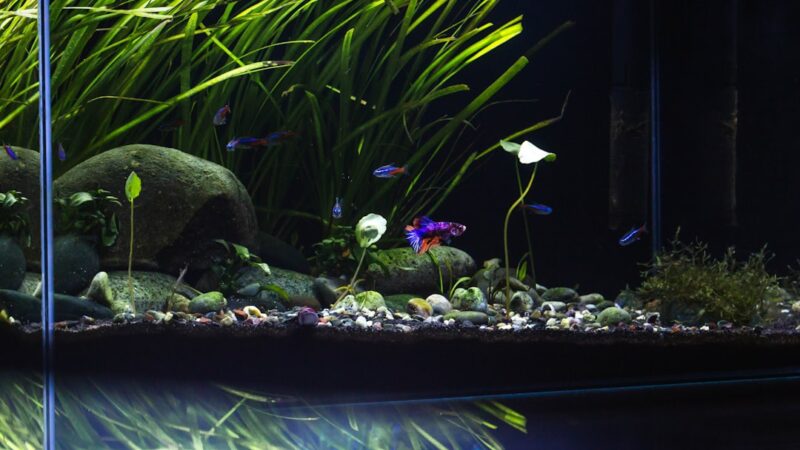
Draw three clusters of plants rising from the substrate. The tallest cluster on the left is made of long curving vertical lines — this is Vallisneria. The middle-back cluster is rounded oval leaves stacked up — this is Anubias or Amazon Sword. The right-side cluster is short, spiky vertical strokes — dwarf hairgrass. Mixing plant heights gives depth. Avoid drawing all plants the same size; variety is what makes it read as a real tank.
Step 4: Add Rocks and Driftwood
On one side of the substrate, draw a chunky pentagon shape for a large stone. Add one smaller stone leaning against it. On the opposite side, draw a curved branch shape for driftwood rising diagonally out of the substrate — like a tree root reaching up. These are the hardscape elements. Keep them to one side rather than centred; asymmetry looks more natural, matching the rule-of-thirds composition used in real hardscape layouts.
Step 5: Swim in the Fish
Draw three to five simple fish shapes. Each fish is a teardrop body with a triangular tail and a dot for the eye. Place them at different heights — one near the top, one mid-water, one near a plant cluster. Drawing fish facing different directions (some left, some right) makes the scene feel alive rather than frozen. Skip trying to draw detailed scales or fins at this stage; simple shapes are enough.
Step 6: Bubbles and Details
Small circles rising from one corner suggest the bubble stream of an air stone. Two or three curved lines at the very top hint at water surface ripples. A small shape on the tank floor could be a shell or piece of decor. These tiny details turn a generic tank drawing into yours specifically. Resist adding too many — three detail points in the whole drawing is plenty.
Step 7: Basic Shading
With your pencil held on its side, lightly shade the back wall of the tank to suggest water depth — darker at the top, fading lighter near the substrate. Shade under each stone and driftwood piece more firmly to create shadows anchoring them to the ground. Leave the fish, the front glass, and a few leaves unshaded so they pop. Three different pencil pressure levels — light, medium, firm — give you all the tonal range you need.
Step 8: Highlights and Glass
The final touch is the glass reflection. Along the top-left of the tank frame, draw a soft white diagonal streak by either leaving the paper untouched or lifting pencil with your eraser. A second small highlight on the right edge doubles the glass effect. On the fish, a tiny white dot near the eye brings them to life. These highlights take ten seconds and transform the drawing from flat sketch to believable scene.
Making It Your Own
Once the basic tank drawing is complete, start variations. Swap the plants for a betta tank with floating Indian almond leaves. Change the substrate to a dark sand for a moody blackwater scene. Add a small castle if drawing for a younger child. The tank outline from Step 1 stays the same; everything inside changes. This is the same planning process our team uses when designing a custom aquarium cabinet build — sketch variations, pick a favourite, then build it.
Practice and Progression
Draw the same tank five times over a week, changing only one element each day — different fish, different plants, different hardscape. By the fifth drawing, your hand knows the sequence and you can start focusing on realism rather than mechanics. Save sketches dated in the corner; after a month of daily practice the improvement is measurable. Kids keep theirs on the fridge; adult scapers file them as mood boards for future builds.
Related Reading