Nature Aquarium Balance Formula Guide: Amano Composition Rules
Takashi Amano’s nature aquarium look has been imitated thousands of times and rarely replicated correctly because the underlying formula is more mathematical than mystical. The nature aquarium balance rests on three measurable principles — golden-ratio focal placement, asymmetric mass distribution, and atmospheric perspective — and once you internalise them, every Amano-inspired scape feels structured rather than random. This guide from Gensou Aquascaping at 5 Everton Park breaks down the named rules from ADA’s design philosophy, the proportions that translate into a 60 cm tank, and the planting choices that hold the composition together long-term.
The Golden Ratio Applied to Aquariums
The golden ratio (1:1.618 or roughly 38:62) places the focal point at either 38 per cent or 62 per cent of tank length, never centre. For a 60 cm tank, that is 22.8 cm or 37.2 cm from the left edge. The focal point is the single visual peak — usually the tallest hardscape element or the brightest plant cluster — and everything else supports it. Centre-aligned focal points feel static; off-centre placement reads as natural.
Triangular Mass Distribution
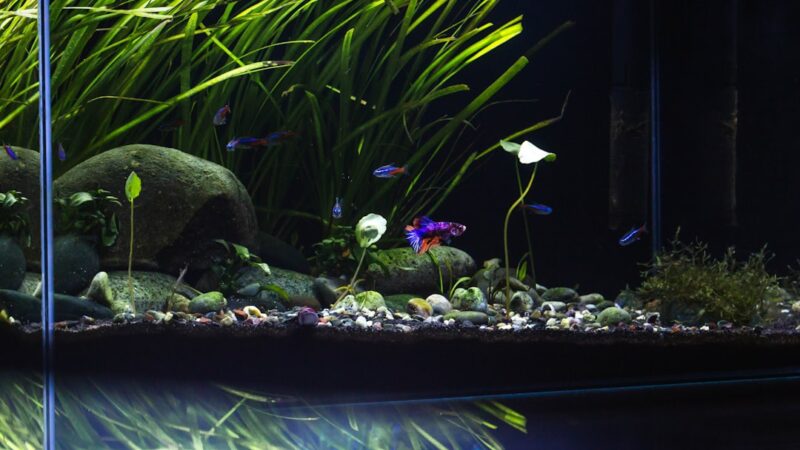
Nature aquariums use one of three primary compositions: triangular, convex (mountain), or concave (valley). Triangular is the most common and easiest. Mass slopes from one upper corner down to the opposite lower corner, with the focal point at the high side. Convex peaks in the centre with mass falling to both sides. Concave dips in the middle with mass rising at both ends. Pick one and commit; mixed compositions look incoherent.
Substrate Sloping for Depth
The substrate must slope from front to back at minimum 1:2 ratio. Front depth 4 cm, back depth 8-10 cm. This forces perspective and creates the illusion of greater depth than the tank actually has. Within the slope, lateral changes also help — pile substrate higher on the focal-point side and let it fall away on the opposite side. Source through the aquasoil substrate range.
Atmospheric Perspective With Planting
Real landscapes look hazier with distance because of atmospheric scattering. Aquascapes simulate this by using fine-leafed light-coloured plants in the background and bold-leafed dark-coloured plants in the foreground. Hemianthus micranthemoides at the back and Microsorum pteropus in front gives the depth illusion. The opposite arrangement collapses the depth and the tank feels two-dimensional.
Hardscape as the Skeleton
Driftwood and stone form the structural skeleton of a nature aquarium. Choose a single primary hardscape feature — one large piece — supported by two to four secondary pieces that echo its angle and texture. Mixing dragon stone with seiryu, or red moor wood with mopani, creates visual confusion. Source one type per scape from the aquascaping range support tools and stick with it.
Negative Space Discipline
Nature aquariums rely on emptiness to give weight to plant mass. Aim for 30-40 per cent open substrate visible from the front. Beginners often plant every available square centimetre, then wonder why the scape feels claustrophobic. Empty foreground substrate or open water columns above carpet plants serve as visual rest spots — without them the eye cannot register the focal point because everything competes equally.
Plant Species Selection
Three to five plant species maximum for a coherent nature aquarium. More species and the scape drifts toward Dutch territory. Common reliable combinations: hairgrass carpet plus moss-covered driftwood plus three midground bush plants. Or a moss-and-fern setup with java fern, anubias nana petite, and a single red accent plant like Alternanthera reineckii mini. Plants from the aquarium tank range setups are often available as combo packs.
Maintenance Rhythm
Weekly water changes of 30-50 per cent during the first two months drop to fortnightly 30 per cent once the tank stabilises. Trim plants only when they obscure the composition — the goal is preserving the original lines, not letting the tank overgrow into a jungle. Replace 10 per cent of substrate every 18 months in heavy-feeder setups. Every six months, take a front-on photo and compare against the original setup photo to track drift.
Singapore Practical Notes
Tropical 28-30°C ambient suits most nature aquarium plants but red species need a clip fan dropping tank temperature to 25-26°C for full colour. PUB tap water at GH 2-4 is ideal for aquasoil-based scapes. Budget for a 60 cm nature aquarium build sits at SGD 600-1000 covering tank, light, CO2, substrate, hardscape and plants. Plan to invest a full Saturday on the planting day and another two hours the following weekend for cleanup and parameter checks.
Related Reading