Advanced Aquascape Depth: Layered Substrate and Elevation Tricks
Depth — the illusion that your 45 cm deep tank stretches far beyond the back glass — separates competition-level aquascapes from ordinary planted tanks. Mastering advanced aquascape layered substrate depth techniques gives you the tools to trick the eye using nothing more than soil, rock, and careful planning. At Gensou Aquascaping Singapore, creating convincing depth in compact aquariums is one of our signature skills, refined over two decades of professional aquascaping. This guide sits inside our broader Planted Tank Complete Hub reference.
Why Depth Perception Matters
Human eyes judge depth through several visual cues: objects appear smaller and lighter in colour as they recede, foreground elements overlap distant ones, and converging lines suggest perspective. In a glass box measured in centimetres, you must engineer these cues deliberately. A flat substrate with evenly sized plants looks exactly as shallow as it is. A properly layered layout, however, can make a 30 cm tank feel like a window into a vast landscape.
Building Elevation With Substrate Layers
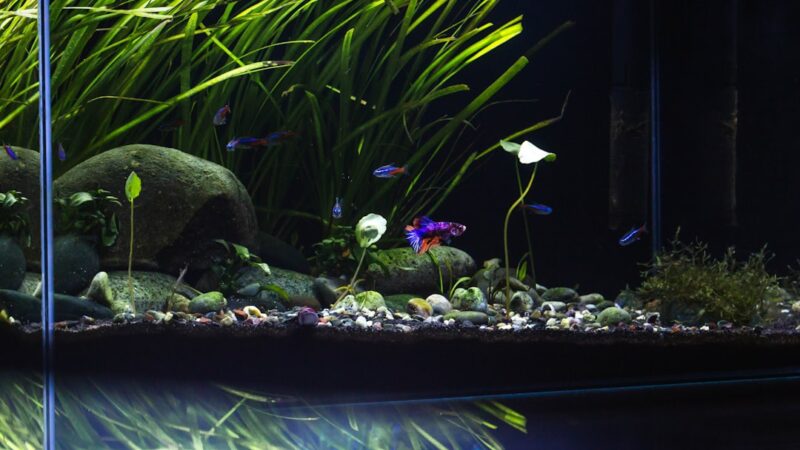
The single most effective depth trick is raising the substrate from front to back. Start with 2-3 cm at the front glass and build up to 10-15 cm at the rear. This slope creates visual perspective and gives background plants an elevated platform that makes them appear further away. Use inert materials — lava rock, pumice, or commercial substrate supports like ADA Power Sand — as the base layer to add volume without using excessive amounts of expensive aquasoil.
Contain the elevated substrate with rock barriers, plastic dividers, or mesh retaining walls hidden behind the hardscape. Without containment, soil gradually migrates forward, flattening your carefully built slope within weeks. Many competition aquascapers use strips of corrugated plastic cut to height and buried behind rocks as invisible retaining walls.
Terracing With Hardscape
Rock and wood create natural terraces that reinforce the sense of elevation. Arrange hardscape in distinct tiers — a low foreground plane, a mid-ground shelf, and a raised background plateau. Each tier should be clearly defined, with visible transitions that the eye reads as distance. Placing smaller rocks on higher tiers enhances the illusion of perspective, as our brains interpret smaller objects as being further away.
Forced Perspective With Plant Size
Select plants that graduate in leaf size from large in the foreground to small in the background. A carpet of Glossostigma or Hemianthus callitrichoides in the front, transitioning to Rotala rotundifolia in the mid-ground and fine-leaved Rotala sp. ‘Green’ or Myriophyllum at the rear, creates a scale gradient that enhances depth. Moss applied to background rocks in thin layers also reads as distant foliage. Avoid planting large-leaved species at the back — they collapse the perspective instantly.
Colour and Light Gradients
Cooler, lighter colours recede while warmer, darker tones advance. Use this principle in both plant selection and lighting. Green background plants with lighter leaves appear further away than deep red foreground species. Some aquascapers position their light fixture slightly forward, creating a subtle brightness gradient that fades toward the back glass — mimicking atmospheric haze in a landscape painting. Even a 5-10 cm shift in light position makes a noticeable difference.
Pathway and Converging Line Techniques
A sand or gravel pathway that narrows from front to back is one of the most powerful depth tools in aquascaping. The converging lines trick the brain into seeing distance. Start the path at 8-10 cm wide at the foreground and taper it to 2-3 cm at the rear. Line the path edges with contrasting plants or small stones to emphasise the converging effect. Winding paths that curve slightly feel more natural than perfectly straight lines and add visual interest to the composition.
Practical Tips for Singapore Hobbyists
Compact HDB living spaces often mean smaller tanks, making depth techniques even more valuable. A well-executed depth illusion in a 60 cm tank can rival the visual impact of a larger, less carefully designed setup. Source substrate supports and inert fillers from local shops or online on Shopee — lava rock and pumice are affordable and widely available. Invest time in the initial substrate build; correcting elevation issues after planting is disruptive and rarely successful. Plan your layers on paper or in a digital mockup before committing soil to glass.
Related Reading