Aquascape Lighting Placement Guide: Angles, Height and Shadows
This aquascape lighting placement guide covers the essentials of positioning your fixture for optimal plant growth, natural shadow effects and the best visual presentation of your underwater landscape. At Gensou Aquascaping at 5 Everton Park, Singapore, we treat lighting placement as seriously as hardscape design because where you put the light matters just as much as which light you buy.
Height Above the Tank
The distance between your light fixture and the water surface dramatically affects light distribution. A fixture mounted directly on the tank rim delivers concentrated, intense light with sharp shadows and potential hot spots. Raising the light 15 to 30 cm above the rim on a hanging kit or stand spreads the beam wider, creating softer shadows and more even coverage. For a standard 60 cm or 90 cm tank, a height of 20 to 25 cm above the water surface is a good starting point. Higher placement also reduces the shimmer effect on rippling water, which some aquascapers prefer while others find it adds natural character. In Singapore, where ceiling heights in HDB flats average around 2.6 metres, pendant-style lighting with adjustable cables is a practical solution.
Centred vs Offset Positioning
Most hobbyists centre their light directly over the tank, which provides symmetrical illumination. This is the safest choice for ensuring even plant growth. However, shifting the light slightly toward the back of the tank can create a front-to-back light gradient that adds depth. The foreground receives slightly less light, creating a subtle shadow zone that makes the brightly lit background appear to recede further. Competition aquascapers sometimes use this trick to enhance the sense of perspective in their layouts. Be aware that offset positioning may require adjusting plant choices in the dimmer zones to species that tolerate lower light levels.
Using Shadows Creatively
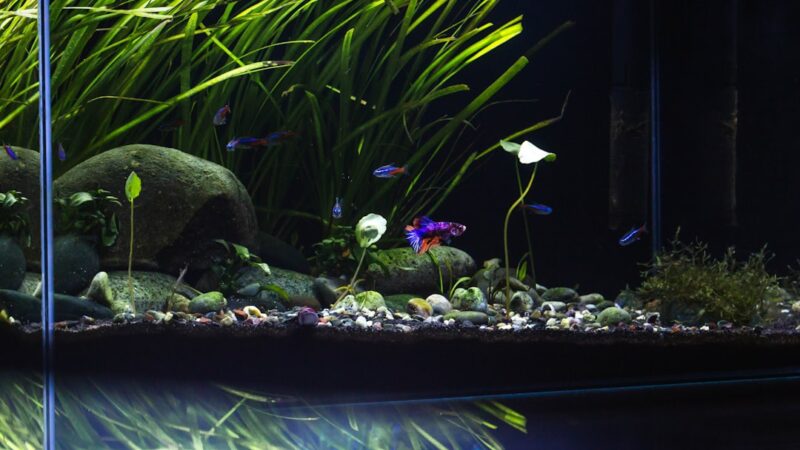
Shadows are not flaws to be eliminated; they are compositional tools. A piece of tall driftwood or a high stone that casts a shadow across the substrate adds drama and realism to your aquascape. Position your light so that shadows fall in visually pleasing directions. A light placed slightly to one side creates directional shadows that mimic natural sunlight filtering through a forest canopy. Placing a secondary, dimmer light on the opposite side can fill in harsh shadows without eliminating them entirely. The interplay between light and dark is what gives a mature aquascape its three-dimensional, immersive quality.
Multiple Light Sources
Larger tanks often benefit from two or more light fixtures. A 120 cm tank, for instance, may need two 60 cm LED bars to achieve uniform coverage. When using multiple lights, overlap the beams slightly in the centre to avoid a dark band where the fixtures meet. You can also use lights of different intensities or colour temperatures for creative effect. A cooler 8000K fixture over one section and a warmer 6500K unit over another can simulate the transition from open sky to shaded canopy. This technique works particularly well in nature-style aquascapes that depict a slice of riverbank or forest floor.
Angle of Incidence
The angle at which light hits the water surface matters. Light entering the water at a steep, near-vertical angle penetrates deeper with less refraction. Light entering at a shallow angle reflects off the surface more, reducing the amount reaching the substrate. This is why raising your light directly overhead gives better substrate-level illumination than a fixture angled from the side. If you use supplemental side lighting for effect, keep it at a low intensity to avoid excessive algae growth on the side glass. For most planted tanks, overhead lighting at a near-perpendicular angle remains the most efficient approach.
Adjusting for Tank Depth
Water absorbs and scatters light, so deeper tanks require stronger fixtures or closer placement to achieve adequate illumination at the substrate level. In a tank 45 cm deep, a standard LED bar typically delivers sufficient PAR for low to medium-light plants. At 60 cm deep, you may need a more powerful fixture or CO2 injection to compensate for the light loss at depth. Tall tanks popular for angelfish or discus setups in Singapore often benefit from pendant-style lights that can be lowered closer to the water surface. Measure PAR at the substrate level with a light meter if you want precise data for fine-tuning plant selection and placement.
Photoperiod and Timing
How long you run your lights is inseparable from how you position them. A well-placed light running for seven to eight hours daily provides consistent results for most planted tanks. Poorly placed lighting that creates hot spots may cause localised algae blooms even within a reasonable photoperiod. Use a timer to maintain a consistent schedule. Some aquascapers incorporate a midday siesta period, running lights for four hours, off for two, then on for another four, to reduce algae pressure while maintaining total light duration. In Singapore, where natural light levels are high year-round, keep tanks away from windows to ensure your lighting schedule remains the sole determinant of what your plants receive.
Practical Tips for Singapore Setups
If you hang lights from the ceiling, use hooks rated for the fixture weight and ensure the cable length allows adjustment. Magnetic cable guides keep hanging wires tidy against walls. For tanks on wooden stands, clamp-on light arms from brands like Chihiros and Twinstar offer flexible positioning without drilling. Visit Gensou Aquascaping at 5 Everton Park to see how different lighting placements affect the look and health of planted tanks, and get advice on choosing the right height, angle and fixture for your specific aquascape.
Related Reading
- Colour Temperature and Lighting in Aquascaping: Kelvin, CRI and Mood
- Focal Point Placement in Aquascaping: Where the Eye Should Land
- Aquascape Lighting Spectrum Guide: Colour Temperature and PAR
- How to Create an African River Biotope Aquascape
- Amazon Biotope Aquarium: Blackwater, Tetras and Driftwood