How to Aquascape a Room Partition Tank: Viewed From Both Sides

This aquascape room partition tank guide walks you through the unique challenges and creative opportunities of designing an aquarium meant to be viewed from two or more sides. At Gensou Aquascaping at 5 Everton Park, Singapore, we have installed partition tanks in homes and offices across the island and understand the specific design principles that make them work beautifully as living room dividers.
Why a Partition Tank Is Different
A standard aquascape is designed with a clear front and back. The front is the viewing pane, and the back is hidden by a background, equipment and rear planting. A partition tank sits in the open, dividing two spaces, which means every side is potentially a viewing angle. This fundamentally changes how you approach the layout. You cannot hide equipment behind the tank, and the hardscape must read well from multiple directions. The result, when done right, is an immersive centrepiece that transforms the feel of a room on both sides.
Tank Selection and Placement
Rimless tanks with clear glass on all sides are essential for partition setups. Standard sizes of 90 cm, 120 cm or 150 cm in length work well for room dividers. The tank width should be at least 40 cm to allow enough depth for a convincing layout when viewed from either side. Height depends on the furniture it sits on and the sightlines from seating areas in both rooms. In Singapore HDB flats, placing a partition tank between the living room and dining area is a popular choice. Ensure the cabinet or stand is sturdy enough to support the filled weight and positioned where floor loading is adequate, particularly for tanks above 200 litres.
Designing for Two Viewing Sides
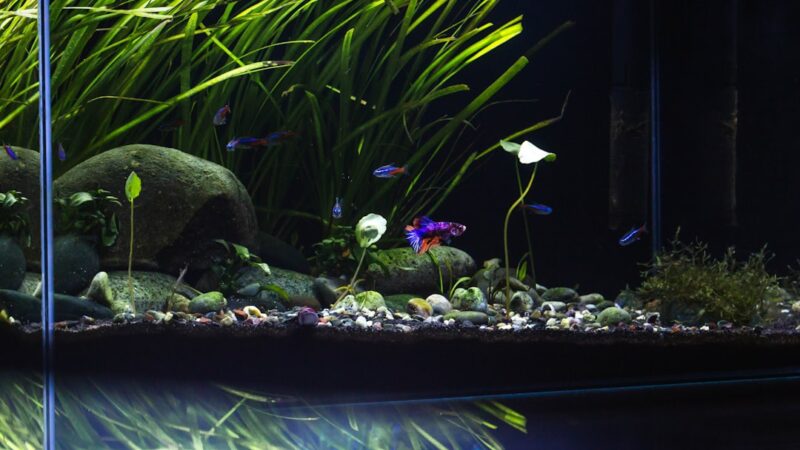
The central challenge is creating a layout that looks complete and intentional from both the front and back. Island-style aquascaping, where the hardscape is clustered in the centre with open space around it, naturally suits partition tanks. Build your rockwork or driftwood arrangement as a central island or ridge that runs along the tank’s length, slightly off-centre for visual interest. Both sides should reveal appealing compositions without one looking like the neglected rear of the other. Walk around the tank repeatedly during the hardscape phase, checking the view from every angle before committing to the final arrangement.
Hardscape Strategies
Choose hardscape materials that look attractive from all angles. Dragon stone and seiryu stone have interesting textures on every face, making them ideal for partition setups. Driftwood with multiple branches that radiate outward serves both viewing directions simultaneously. Avoid flat-backed stones or driftwood pieces with an obvious good side and bad side. Stack and arrange materials so that caves, overhangs and details are visible from both the primary and secondary viewing panes. Use aquarium-safe epoxy or silicone to secure stacked elements, as partition tanks are more likely to be bumped from either side during daily life.
Planting for Transparency
Dense background planting that blocks the view through the tank defeats the purpose of a partition setup. Instead, use open, airy plant arrangements that allow light and sightlines to pass through. Stem plants like Rotala rotundifolia and Ludwigia palustris can be trimmed to create a hedge that is full but not opaque. Attach Bucephalandra and Anubias to exposed hardscape surfaces where they add greenery without blocking views. Foreground carpets of Micranthemum monte carlo or Eleocharis parvula work well on both sides. If you want taller plants, position them at the ends of the tank rather than the centre so they frame the view rather than obstruct it.
Hiding Equipment
Equipment concealment is the biggest practical challenge. Inline heaters and inline CO2 diffusers installed on the external filter tubing eliminate hardware from inside the tank entirely. If you must use a submersible heater, place it behind the central hardscape island where it is least visible from either side. Glass lily pipes and clear acrylic inlet/outlet fittings are far less obtrusive than dark plastic hardware. Route tubing over the back edge of the tank on the side closest to a wall or furniture to minimise visibility. In Singapore, the Chihiros inline heater and UP Aqua inline diffuser are popular choices for clean partition setups.
Lighting Considerations
A pendant light hung from the ceiling directly above the tank provides even illumination without blocking the view from either side. Ceiling-mounted lights also eliminate the visual clutter of rim-mounted fixtures. If ceiling mounting is not feasible, a slim LED bar resting on the tank rim is the next best option. Choose a fixture narrow enough that it does not dominate the top view. Adjustable hanging kits allow you to raise or lower the light to fine-tune the spread and intensity. In Singapore, many aquascapers use the Twinstar or Chihiros pendant kits with stainless steel hanging wires for a sleek, minimal look above a partition tank.
Bringing Your Partition Tank to Life
A well-designed partition aquarium transforms a room, creating a living wall of colour and movement that enriches both spaces it divides. The design process takes more planning than a standard tank, but the payoff is extraordinary. Visit Gensou Aquascaping at 5 Everton Park for consultation on partition tank design, equipment selection and installation. We can help you plan a layout that looks stunning from every angle and integrates seamlessly into your Singapore home or office.
Related Reading