Dental Clinic Aquarium Design Guide: Calming Waiting Rooms
Patients who watch fish for three minutes show measurable drops in blood pressure and self-reported anxiety — a finding dentists have quietly exploited for decades. A thoughtful dental clinic aquarium design guide goes well beyond picking a pretty tank; it has to reconcile MOH infection-control expectations, waiting-room acoustics, and the reality that nobody wants a surgical cancellation because a pump failed overnight. This guide from Gensou Aquascaping at 5 Everton Park is written for practice owners, clinic architects, and the procurement leads who sign off on the spec.
Quick Facts
- Recommended volume for waiting rooms: 200-600 litres
- Installed cost in SGD: $8,000-$28,000 including cabinetry and livestock
- Typical patient dwell time: 8-20 minutes — design for passive viewing, not interaction
- Noise budget: keep tank under 35 dB at 1 m; use DC return pumps and sump isolation
- Floor loading: 400 L tank ≈ 900 kg concentrated — check slab on upper-floor units
- Monthly maintenance in SGD: $350-$700 for a standard clinic display
- MOH/NEA: tank must not be in treatment rooms or near sterilisation areas
Placement Within the Clinic
The tank belongs in the waiting room and nowhere else. Treatment bays, autoclave zones, and dispensing counters are out of scope because aerosolised water and clinical asepsis do not mix. A face-on position at 110-120 cm floor-to-centre aligns with seated eye level across adult and child patients. Position the tank perpendicular to the reception desk so the receptionist can spot equipment faults without leaving the counter — a leaking sump noticed in minute five is a different problem from one noticed in hour three.
Structural and Fit-Out Considerations
Most dental clinics in Singapore occupy strata units in medical suites or upper-floor commercial space. A 400 litre tank with hardscape and cabinet loads the slab at roughly 900 kg over 1.6 m². Ask your BCA-registered PE to confirm permissible concentrated loads before cabinetry is ordered. Where flooring cannot be reinforced, specify a 350 litre shallow footprint (150 x 50 x 45 cm) that distributes weight across a wider base.
Livestock Choices for a Medical Setting
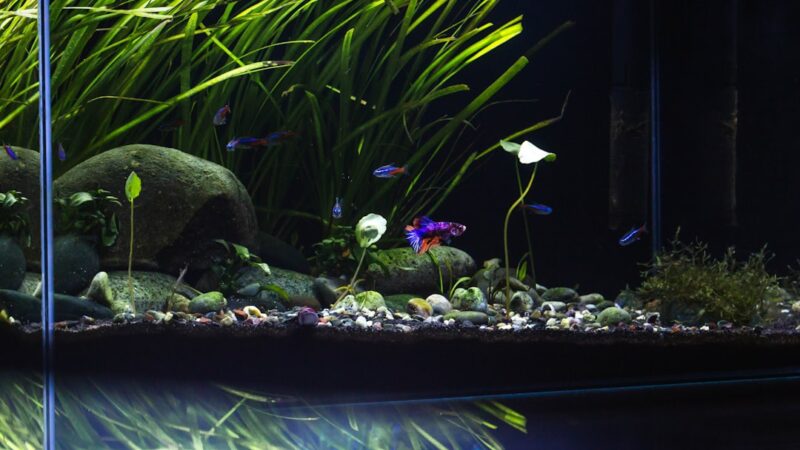
Anxious patients do not relax watching aggressive fish. Choose calming, slow-moving schooling species: cardinal tetras, rummy-nose tetras, or lemon tetras in groups of 20-30 move like a single organism and pull the eye. A centrepiece of three to five Pterophyllum scalare angelfish adds vertical interest without drama. Avoid cichlids that squabble, bettas that dart, and any species that spends most of the day hidden. Shrimp and otocinclus handle algae duty without adding visual chaos.
Lighting and Acoustic Design
Clinic lighting is typically 500-750 lux daylight-balanced LED, which competes with any aquarium light under 40 PAR. Specify a Twinstar or ADA Solar RGB capable of at least 6000 lux at substrate and run a 7-hour photoperiod matched to clinic hours. Acoustically, the tank should disappear. DC return pumps at low RPM, sump isolation with rubber matting, and a fully enclosed cabinet with acoustic foam keep the installation under 35 dB at listening distance. Air pumps are banned — they tick audibly in quiet waiting rooms.
Infection Control and Hygiene
MOH’s clinic licensing does not ban aquariums but expects clear separation from clinical zones. Waterline splash is the concern: specify a fully covered top (acrylic cover with feeding slot) and a condensation-resistant cabinet. Maintenance tools stay in a locked cupboard away from clinical supplies, and the servicing technician wears non-sterile gloves and brings dedicated buckets. Log every water change, medication, and livestock introduction in a bound book kept beside the tank — useful if questions ever arise during a clinic audit.
Equipment Reliability Is Non-Negotiable
A dental clinic cannot afford a sump overflow at 9 AM. Redundancy is the design principle. Specify a sump with a float switch and secondary mechanical overflow, a DC return pump with memory, an auto top-off with a high-level cutoff, and a UPS on the return pump and heater. If the clinic closes on Sundays, install a remote temperature monitor (Inkbird ITC-308 Wi-Fi or better) that alerts the practice manager on failure. UV sterilisation at 9-13 W reduces disease risk in a tank where quarantine timing is awkward.
SGD Pricing Tiers for Clinics
A 200 litre planted display with cabinet, filtration, lighting, and livestock runs $8,000-$12,000 SGD installed. A 400 litre mid-tier installation with aquasoil, imported hardscape, and CO2 injection lands at $14,000-$22,000. Flagship 600 litre feature walls with integrated millwork and premium livestock reach $25,000-$35,000. These are turnkey figures — electrical provisioning, carpentry integration, and the PE letter sit outside the aquarium quotation.
Service Contracts and Staff Responsibilities
Clinic staff feed once daily and wipe the front glass. Everything else — water changes, filter cleaning, livestock health, CO2 top-up, testing — belongs to a fortnightly professional visit at $350-$700 monthly. The technician should arrive before or after clinic hours to avoid patient disruption. Build a named backup contact into the contract so a Sunday power failure does not become a Monday crisis.
Related Reading
Aquarium for Dental Clinic Waiting Room
Aquarium for Waiting Room Singapore
Aquascape for Dental Clinic Waiting Room Singapore
Aquarium Maintenance Cost Singapore
Aquarium for Aesthetic Clinic Singapore