Formal vs Naturalistic Pond Design Singapore Guide: Style Match
The same 8,000-litre pond can read as a Versailles fountain centrepiece or a Bornean stream depending on edge treatment, planting, and rock choice — and choosing the wrong one for your home’s architecture undermines both. The formal vs naturalistic pond decision sets the entire visual language of your garden long before a single fish goes in. This guide from Gensou Aquascaping at 5 Everton Park unpacks the two styles, matches them to Singapore housing types, and covers the build differences that follow from the choice.
What Defines a Formal Pond
Formal ponds are geometric — circle, rectangle or hexagon — with hard edges, symmetrical planting, and often a fountain or sculpted spillway as the focal point. The visual language is architectural rather than ecological. Walls are vertical, rim heights are precise, and surrounding hardscape uses straight lines and grids. Materials lean toward stone slab, polished granite, or rendered concrete. Plants are restrained and repeat in pairs or rows.
What Defines a Naturalistic Pond
Naturalistic ponds are irregular in shape, use boulder edges with gravel beaches, and the planting layout looks self-seeded rather than placed. The visual language imitates a wild stream or pool — Borneo, Sumatra, Tembeling. Rocks vary in size and orient with bedding planes; gravel sizes grade from cobble to pebble at water’s edge. Plants are mixed-species drifts rather than blocks; vertical accents come from bamboo, ferns and palms.
Match Formal to Colonial Black-and-White Houses
Singapore colonial bungalows — the black-and-white architecture in Alexandra, Mount Pleasant, Adam Park — sit best with formal ponds. The geometric house facade demands a geometric water feature. A 3m × 2m rectangular reflecting pond with a single central fountain plays well against the symmetry of the verandah. Edge with hand-cut granite slab or honed Indian sandstone (SGD 80-200/m²) and plant water lilies in a single bold massing.
Match Naturalistic to Tropical Modern Houses
Tropical modern Singapore houses — open-plan, deep eaves, timber and concrete with planted courtyards — work with naturalistic ponds. The architecture borrows from kampung and Balinese vocabulary, and a boulder-edged pond with marginal planting reinforces that lineage. Use Seiryu blue-grey or Frodo brown rocks (SGD 8-20/kg from the decoration substrate range) in irregular massing, plant papyrus, water iris and ferns at the edge.
Edge Treatment Differences
Formal: capping stone or render with a sharp 90-degree rim, water held at exactly 5cm below the cap, no visible substrate. Naturalistic: rounded boulders set above and below water level so the rim line disappears, gravel beach sloping into water at 1:3 grade, marginal plants right at the waterline. The formal edge is precise and engineered; the naturalistic edge is sculpted to look unplanned.
Planting Strategies
Formal ponds plant by repetition — three identical clumps of papyrus equally spaced around the rim, or a single central lotus in a clean basket. Colour palette is restrained, often green-and-white. Naturalistic ponds plant by drift — a clump of water iris on the south side, blending into a fern carpet on the rocks, with a single marginal palm as accent. The variety in planting echoes a riparian ecosystem.
Rock and Material Choices
Formal: dressed granite, basalt cobbles cut to size, Carrara or Indian sandstone slab. Cost SGD 60-200/m² for surface materials. Naturalistic: rough Seiryu, Frodo, Ohko dragon stone, river cobbles, sourced by-the-kilogram with sizes between 5cm and 60cm. Cost SGD 8-20/kg, with a typical pond using 200-500kg. Stock both classes from the decoration substrate range.
Filtration Visibility
Formal ponds hide all filtration — pumps in dry housings behind walls, returns through clean spillway slots. The water surface stays unbroken between fountain bursts. Naturalistic ponds celebrate flow — a tumbling waterfall over a boulder face, a babbling stream feeding the main pool, a gravel beach showing the return manifold under cobbles. Pick the build approach to match the visible-versus-hidden philosophy.
Lighting Approach
Formal: precise underwater spotlights aimed at the fountain plume, perimeter ground-recessed lights at equal spacing. Cool 4000K colour temperature suits the architectural feel. Naturalistic: warm 2700-3000K lights aimed up into rocks and trees, irregular placement, some lights aimed at unexpected angles to mimic moonlight through canopy. The pond equipment range stocks 12V LED fixtures suited to both approaches.
Stocking Compatibility
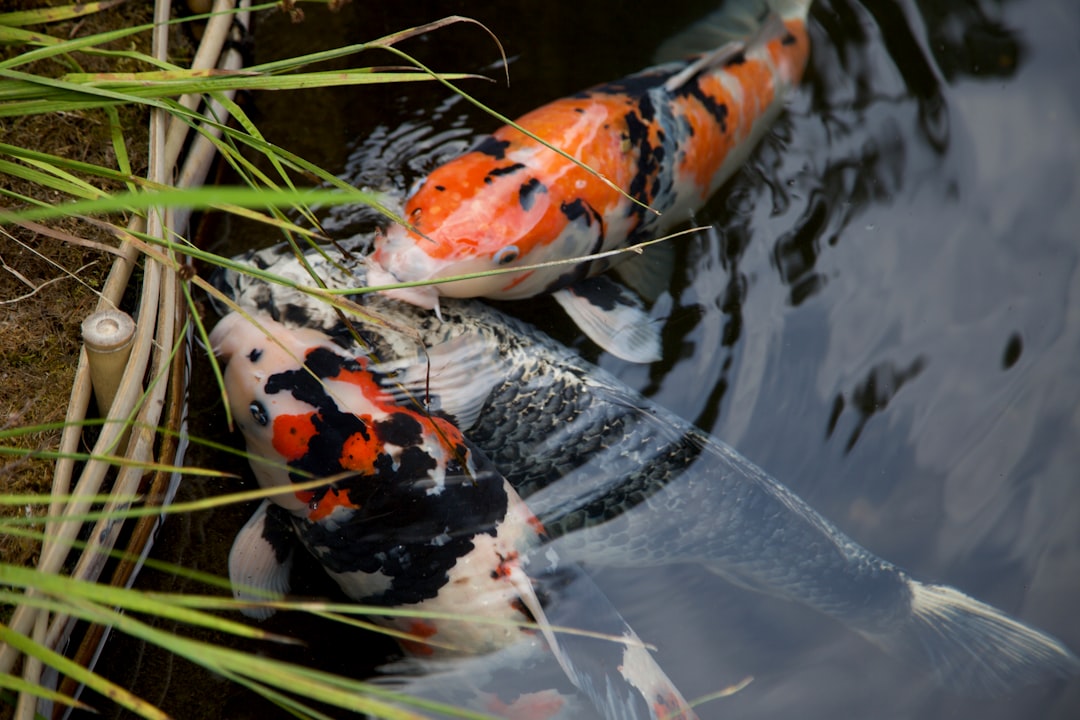
Both styles support koi and goldfish, but the visual reading differs. Show-grade koi (Kohaku, Sanke, Showa) with their bold colour blocks read better in formal ponds where they become deliberate visual elements. Wild-pattern koi (Asagi, Shusui) and goldfish read better in naturalistic ponds where they blend into the ecosystem aesthetic. Stock to match the design intent.
Build Cost Implications
Formal ponds cost more per square metre because of the hard materials, sharp lines and precise levels — typical Singapore landed property formal pond runs SGD 25,000-80,000. Naturalistic ponds save on dressed stone but spend more on planting and rock variety — SGD 18,000-55,000 for the same volume. Beyond 50,000-litre custom builds, both styles converge in cost as filtration and structural engineering dominate.
Related Reading