How to Create a Paludarium Step by Step: Land Meets Water
Half aquarium, half terrarium, entirely captivating — a paludarium recreates the meeting point of land and water in a single enclosed ecosystem. Mosses drip from rocky ledges, tree frogs shelter beneath broad-leaved plants, and fish swim in the water zone below a living bank of tropical vegetation. Learning to create a paludarium step by step requires planning across two separate ecosystems simultaneously, but the result is arguably the most spectacular display type in the live-animal hobby. Gensou Aquascaping at Everton Park, Singapore consults on paludariums for both home and commercial settings, and Singapore’s tropical climate makes it one of the easiest places in the world to keep one thriving.
Step 1: Choose the Right Tank
A paludarium needs height — the land zone must have sufficient vertical space for terrestrial plants and any animal inhabitants above the waterline. Tall format tanks (height greater than or equal to width) are ideal; standard choices include 30×30×45 cm glass terrariums, 45×45×60 cm, or custom-built rimless tanks with a high aspect ratio. Exo Terra and ADA produce front-opening tall tanks specifically suited to paludariums — front doors simplify maintenance of the land zone dramatically compared to top-only access. Calculate your desired water zone depth first (typically 15–25 cm), then ensure the tank height above provides at least 20–30 cm for the land zone and overhead humidity space.
Step 2: Build the Land Zone Structure
The land zone is constructed before any substrate or water enters the tank. The standard material is expanding foam (polyurethane foam, available at hardware shops for $8–$15 per can) sculpted to create rockface, slope, or ledge forms. Allow the foam to cure fully (24 hours), then carve it to shape with a serrated knife. Coat the foam surface with aquarium-safe silicone and press a mixture of peat, coco fibre, and fine gravel into the wet silicone — this creates a rough, natural-looking surface to which live mosses and plants will attach. Avoid standard expanding foam that contains biocides; check that it is labelled safe for aquarium or terrarium use after curing.
Step 3: Install the Waterfall and Water Circulation
A small submersible pump in the water zone, fed through silicone tubing up the back of the land structure to a shelf or channel cut into the foam, creates a recirculating waterfall or drip-wall feature. The pump’s flow rate determines waterfall intensity; for a paludarium, a gentle flow of 100–300 litres per hour suits most setups, keeping the land zone misted and preventing stagnant water at the bottom of the drip channel. Position the outlet behind the land zone wall so water emerges naturally through the rockface rather than from an obviously artificial pipe. A pre-filter sponge on the pump intake prevents substrate particles from entering the pump.
Step 4: Add Substrate to Each Zone
The water zone uses aquarium substrate — dark aquasoil or fine gravel depending on whether you plan to grow aquatic plants in the water section. For the land zone, a drainage layer of LECA (lightweight expanded clay aggregate) at the base prevents waterlogging, topped by a living soil mix of coconut fibre, orchid bark, and sphagnum moss at 5–8 cm depth. This substrate supports root growth for terrestrial plants and retains moisture without becoming anaerobic. Do not use standard potting soil — it compacts, becomes hydrophobic, and releases fertiliser salts that are toxic to amphibians and sensitive aquatic life.
Step 5: Plant the Land and Water Zones
Plant selection divides between the two zones. For the water zone: aquatic plants like Cryptocoryne wendtii, Anubias barteri, Microsorum pteropus, and aquatic mosses provide underwater greenery and filtration. For the land zone: tropical plants that tolerate high humidity and indirect light thrive — Fittonia (nerve plant), Peperomia species, small Ficus pumila (creeping fig), Selaginella (spike moss), and Tillandsia air plants positioned on rocky ledges. Singapore’s tropical climate means most of these grow vigorously in an open-front paludarium without supplemental heating — the challenge is often containment rather than growth stimulation.
Step 6: Lighting for Two Environments
Full-spectrum lighting serves both zones. LED fixtures rated for vivariums — such as the Arcadia Jungle Dawn LED or Exo Terra Jungle Dawn — provide the spectral balance that aquatic plants and tropical terrestrial species both require. In Singapore, a 10–12 hour photoperiod is natural for tropical plants; humidity within the paludarium reduces the need for UV wavelengths that outdoor plants rely on for stress responses. Mount the light above the tank, positioning it to illuminate the full water zone and as much of the land zone as the tank height allows. Misting from the waterfall and evaporation from the water surface maintain interior humidity above 70%.
Step 7: Inhabitants and Ongoing Care
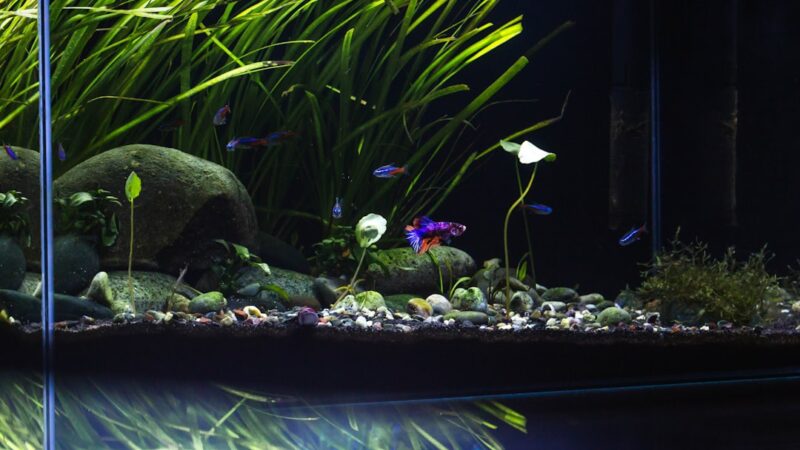
Small fish for the water zone — ember tetras, microdevario species, or rice fish (Oryzias) — tolerate the variable water depth without stress. For the land zone, small dart frogs, tree frogs, or geckos (check Singapore AVA import and keeping regulations before acquiring amphibians or reptiles — licensing requirements apply). Invertebrates like isopods and springtails are excellent custodial additions that break down plant debris and control fungus on the land substrate without any negative effects. Monthly maintenance includes trimming fast-growing terrestrial plants, pruning aquatic plants, and cleaning the pump pre-filter — the waterfall handles most water circulation and surface agitation independently.
Related Reading