Rio Negro Blackwater Biotope Aquascape: Dark Water Jewel Box
Dark, tea-stained water, a floor of decomposing leaves, and the flash of cardinal tetras weaving through tangled driftwood — a Rio Negro blackwater biotope aquascape captures one of the most dramatic freshwater habitats on Earth. This style strips away the manicured perfection of Dutch or Nature aquascaping and replaces it with something raw and deeply atmospheric. Gensou Aquascaping at 5 Everton Park, Singapore, has built several blackwater biotopes for clients who want their tanks to feel like a portal to the Amazon basin. This guide sits inside our broader Aquascaping Styles Design Hub reference.
Understanding the Rio Negro Habitat
The Rio Negro is the Amazon’s largest tributary, running over 2,200 km through Brazil, Colombia, and Venezuela. Its waters are stained dark brown by humic and tannic acids leached from decomposing vegetation in the surrounding igapo forests. pH ranges from 3.5 to 5.5 in the wild, with virtually zero general hardness. The substrate is white sand overlaid with thick leaf litter, and submerged wood forms the primary structure.
Water Parameters to Target
You do not need to replicate extreme wild conditions to achieve the look and feel. Aim for a pH of 5.5-6.5, GH below 4, and KH of 0-2. Singapore’s tap water starts soft (GH 2-4) and slightly acidic, which gives you a head start. Add Indian almond leaves or catappa bark to release tannins gradually. For deeper staining, brew a tannin extract by soaking a handful of leaves in hot water overnight and adding the cooled liquid during water changes.
Hardscape: Wood and More Wood
Spider wood, Malaysian driftwood, and mopani are all suitable. Choose pieces with complex branching that mimic submerged root systems and fallen trees. Pile them asymmetrically — nature is not symmetrical. Avoid rocks entirely for a purist biotope; the Rio Negro’s substrate is almost devoid of stone. If you must anchor wood, use stainless steel screws hidden beneath the substrate rather than glue, which looks unnatural in this style.
Substrate and Leaf Litter
Fine white or beige sand replicates the Rio Negro’s silica sand bed. Layer it 2-3 cm deep. On top, scatter dried catappa leaves, jackfruit leaves, and oak leaves at varying stages of decomposition. Fresh leaves provide tannins; partially decomposed leaves host biofilm that feeds shrimp, otocinclus, and fry. Replace about a third of the leaf litter every two weeks to maintain tannin levels without overwhelming filtration.
Flora: Less Is More
True blackwater habitats support very little aquatic plant growth due to low light penetration and acidic conditions. If you want vegetation, stick to species found in the region: Echinodorus species along the margins, Cabomba in shallow zones, or floating Salvinia and Pistia at the surface to diffuse light. Heavy planting contradicts the biotope’s character — restraint is key.
Fauna: Wild-Type Species
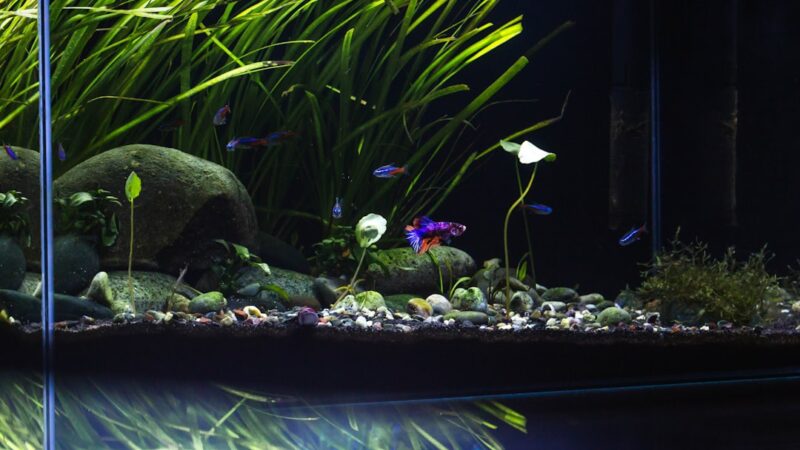
Cardinal tetras (Paracheirodon axelrodi) are the signature fish. A school of 20-30 in a 90 cm tank, their neon blue and red stripes glowing against dark water, is genuinely breathtaking. Add a pair of Apistogramma — A. elizabethae or A. mendezi are Rio Negro endemics. Corydoras duplicareus or C. adolfoi work as bottom dwellers. Avoid mixing in Asian or African species if biotope accuracy matters to you.
Lighting for Blackwater Ambience
Dim, warm-toned lighting between 3,000-4,000K enhances the amber water colour and creates the moody atmosphere that defines this style. Run your LEDs at 30-50% intensity. A single spotlight angled from one end produces dramatic shadow play through the wood. Avoid bright white 6,500K fixtures — they wash out the tannin colour and make the tank look murky rather than mysterious.
Maintenance in Singapore’s Climate
Blackwater tanks run warm naturally — 26-28°C is typical, which aligns perfectly with unheated Singapore tanks. Filtration should be gentle; a sponge filter or a small canister on low flow suits the still-water nature of the habitat. Perform 20% water changes weekly, dosing conditioned water with fresh tannin extract to maintain colour. Monitor pH carefully, as organic decomposition in a low-KH environment can cause sudden drops. A blackwater biotope aquascape rewards patience and restraint — resist the urge to add more, and let the water do the decorating.
Related Reading