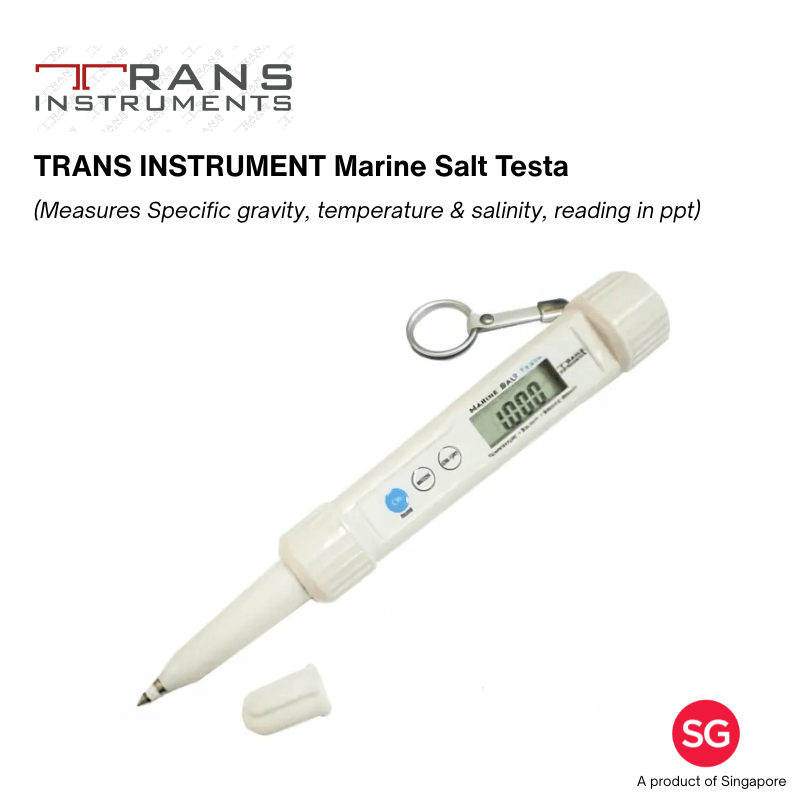
TRANS INSTRUMENT Marine Salt Testa pen (marine salinity test)
You save
Description
The Marine Salt Testa is designed for marine aquaria for the measurement of salt concentration in water.
Advanced Features:
3 in 1 meter that measures Specific Gravity, Temperature, and Salinity
Easy one-touch calibration
Why salinity or specific gravity needs to be measured?
Natural seawater is the most ideal condition for all marine species but is difficult to replicate. The major element in seawater is salt; the more salt, the higher the density. Marine water concentration generally fluctuates due to evaporation in a closed tank, thus measuring specific gravity or salinity is important to maintain the right reading for fish to survive.
Most aquarist handbooks use this unit of measurement to recommend the amount of salt to be added into a tank. As the hydrometer is calibrated at 15°C, a correlation table must be used to get the correct reading. A simple pointer-hydrometer does not even have a table to make correlations, thus the measurement is highly inaccurate. This is one of the reasons why so many fail in keeping a marine aquarium. The Marine Salt Testa uses a new method of measuring salinity via the conductivity method which allows users to obtain a reading of salinity in grams per litre. This is usually represented in ppt (parts-per-thousand). The best feature about this method is that readings are automatically compensated despite differing temperatures. The Marine Salt Testa is an indispensable tool for serious marine aquarists.
Marine Salt Testa Instructions Manual
TRANS INSTRUMENT Marine Salt Testa Pen for SG Reefkeepers
Maintaining stable salinity is one of the trickier parts of running a marine or reef tank in Singapore, where high ambient humidity and warm rooms drive constant evaporation. This pen reads specific gravity, salinity and temperature in one dip, giving you a fast daily check before top-offs. We find it handy for HDB and condo reefers who cannot always run a dedicated controller but still need to catch creeping salinity quickly.
Because evaporation here can swing levels overnight, we suggest checking before each top-up rather than only at water changes. One-touch calibration keeps readings honest, and we recommend recalibrating against a known reference solution every so often. Rinse the probe in RO or distilled water after each measurement, as dried salt creep on the electrode is the usual cause of drifting numbers in our climate.
Browse our wider water testing and care selection to build a complete marine kit. For context on salinity targets and routine, see our marine starter kit guide and marine water change schedule.