Triangular Composition in Aquascaping: How to Master It
Table of Contents
- What Is a Triangular Layout?
- Why the Triangular Composition Works
- Hardscape Placement and the Slope
- Creating the Slope With Substrate and Rocks
- Plant Height Gradient
- Left vs Right: Which Side Gets the High Point?
- Examples for 60cm and 90cm Tanks
- Common Mistakes to Avoid
- Frequently Asked Questions
What Is a Triangular Layout?
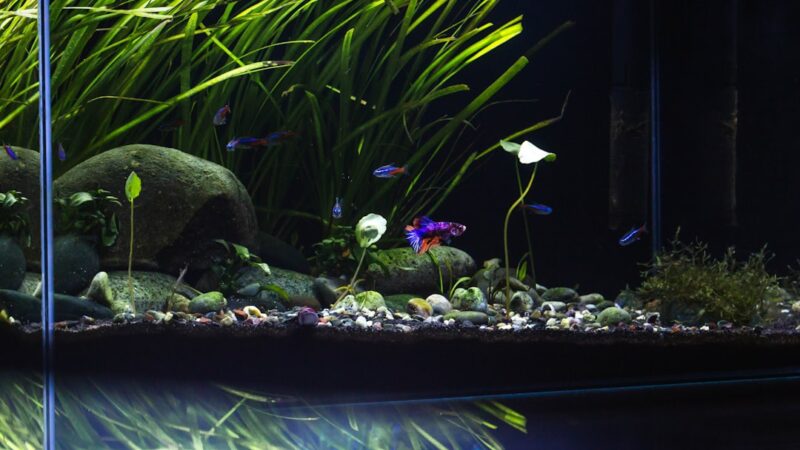
The triangular layout is the most intuitive composition in aquascaping and, for good reason, the one most beginners gravitate towards first. The concept is straightforward: one side of the tank features a high point that gradually slopes down to the opposite side, forming a triangle when viewed from the front. The highest point typically consists of tall hardscape elements and background plants, while the lowest point reveals open space, a carpet plant or bare substrate. This guide sits inside our broader Aquascaping Styles Design Hub reference.
This layout mimics how we often see landscapes in nature — a hillside sloping into a valley, a riverbank dropping towards the water, or a mountain ridge tapering into flatland. That natural familiarity is precisely why it reads so well to the human eye, even in a glass box sitting in your HDB living room.
At Gensou, we have spent over 20 years helping aquascapers in Singapore refine their compositions, and the triangular layout remains one of the most requested designs at our Everton Park studio. It suits tanks of almost every size, works with a wide variety of hardscape materials and is forgiving enough to look impressive even when execution is slightly imperfect.
Why the Triangular Composition Works
The triangular layout succeeds because it leverages several principles of visual design simultaneously:
- Asymmetry — The off-centre high point creates visual tension and interest, following the rule of thirds naturally.
- Directional flow — The slope guides the viewer’s eye from the high point down to the open space, creating a clear visual journey.
- Depth perception — The gradient from tall to short gives a strong sense of three-dimensionality.
- Negative space — The low side provides breathing room, preventing the aquascape from feeling cluttered.
Unlike symmetrical arrangements, which can feel static and predictable, the triangular layout conveys movement and energy. It suggests a landscape that continues beyond the glass, which is the hallmark of a convincing aquascape.
Hardscape Placement and the Slope
Your hardscape — the rocks, driftwood or a combination of both — forms the skeleton of the triangular layout. The tallest piece of hardscape should sit at or near the high point of the triangle, ideally positioned at roughly one-third of the tank’s width from the chosen side.
Key Principles for Hardscape
- Dominant piece first — Place your largest stone or piece of driftwood at the apex. Everything else should be subordinate in scale.
- Supporting pieces descend — Arrange secondary stones or branches in descending height, following the slope line.
- Vary angles — Avoid placing all hardscape pieces at the same angle. Slight tilts and rotations create a more natural appearance.
- Connect the line — The hardscape should suggest a continuous slope, not a staircase of disconnected elements.
For a rock-based triangular layout, consult our hardscape layout guide for detailed placement techniques. When using driftwood, select a piece with branches that naturally extend upward on one end and taper down on the other — spider wood and horn wood are excellent choices available at our Everton Park shop.
Creating the Slope With Substrate and Rocks
The substrate does a significant portion of the heavy lifting in a triangular layout. Without proper substrate mounding, even well-placed hardscape will fail to convey the slope convincingly.
Substrate Depth Guide for Triangular Layouts
| Zone | Depth (cm) | Purpose |
|---|---|---|
| High point (rear corner) | 10–15 | Supports tall plants, anchors hardscape |
| Mid slope | 5–8 | Transitional zone for mid-ground plants |
| Low point (opposite front) | 2–3 | Carpet plants or open sand |
To prevent the substrate from flattening over time — a common frustration in Singapore’s warm 28–32°C tanks where maintenance is frequent — use retaining structures behind the visible face:
- Lava rock chunks buried within the substrate add volume without excessive cost.
- Plastic egg crate cut to size and placed at the rear can support the mound.
- Rock dams — smaller stones arranged as a low wall behind the visible hardscape — hold substrate in place effectively.
If you are using aquasoil (ADA Amazonia or similar), keep in mind that it compacts over time. Build your initial mound roughly 20% higher than your target height to account for settling.
Plant Height Gradient
Plants reinforce the triangular shape established by hardscape and substrate. The principle is simple: tall plants at the high point, progressively shorter plants as you move towards the low side.
Suggested Plant Placement
| Position | Plant Type | Examples |
|---|---|---|
| Apex (tallest) | Tall stems, Vallisneria | Rotala rotundifolia, Ludwigia repens, Vallisneria nana |
| Upper slope | Medium stems, ferns | Hygrophila pinnatifida, Bolbitis, Java fern |
| Mid slope | Low-medium plants | Cryptocoryne wendtii, Bucephalandra, Anubias nana |
| Lower slope | Carpet and low plants | Monte Carlo, Marsilea hirsuta, dwarf Sagittaria |
In Singapore’s consistently warm water (28–32°C without a chiller), some plants grow faster than others. Rotala and Ludwigia, in particular, will need regular trimming to maintain the triangular silhouette. Factor this into your maintenance routine — uncontrolled growth at the apex quickly turns a crisp triangle into an amorphous blob.
Left vs Right: Which Side Gets the High Point?
This question generates surprisingly passionate debate in aquascaping circles. The short answer: either side works, but viewer psychology plays a role.
Research in visual arts suggests that most people (particularly those who read left to right) tend to scan an image from left to right. A high point on the left with a slope descending to the right follows this natural scanning pattern, creating a comfortable, “downhill” reading experience. Conversely, a high point on the right can feel more dynamic and dramatic because it works against the eye’s default path.
Practical Considerations
- Room placement — If the tank sits against a wall with a window on one side, place the high point on the side nearest the wall to avoid blocking light from the open side.
- Equipment hiding — Use the high point to conceal filter inlets, heaters or CO2 diffusers behind the dense planting.
- Viewing angle — In an HDB flat where the tank is viewed primarily from the sofa, consider which direction feels most natural from that seated position.
Ultimately, choose the side that best suits your room and equipment layout. Both orientations produce stunning results.
Examples for 60cm and 90cm Tanks
60cm Tank (Standard 60 x 30 x 36 cm)
The 60cm tank is Singapore’s most popular planted tank size — compact enough for a BTO flat shelf unit yet large enough for meaningful aquascaping. For a triangular layout in a 60cm tank:
- Use one dominant stone or driftwood piece (roughly 25–30 cm tall) at the apex.
- Limit yourself to two or three supporting hardscape pieces to avoid overcrowding.
- Keep the slope relatively steep — a 60cm tank does not have enough horizontal space for a gentle gradient.
- Choose three to four plant species maximum. Too many species in a small tank creates visual chaos.
90cm Tank (Standard 90 x 45 x 45 cm)
A 90cm tank gives you considerably more room to develop the slope and creates a more dramatic sense of scale:
- The dominant hardscape piece can be 30–40 cm tall, with four to six supporting elements.
- The longer horizontal axis allows for a gentler, more natural-looking gradient.
- You can incorporate a mid-ground transition zone that is difficult to achieve in 60cm tanks.
- Five to seven plant species work well, giving you room for distinct planting zones.
Visit us at 5 Everton Park to see examples of both sizes set up as triangular layouts in our showroom.
Common Mistakes to Avoid
After two decades of guiding aquascapers through their first triangular layouts, we have identified the mistakes that crop up most frequently:
- Too symmetrical — A triangle with the apex dead centre is not a triangular layout; it is an island layout. The high point must be clearly off-centre for the composition to work.
- Slope too gentle — If the height difference between the high and low points is not pronounced enough, the triangle reads as a flat line. Aim for the apex to be at least three times the height of the lowest point.
- Ignoring the rear — Many beginners focus only on the front face. The substrate and planting should also slope from back to front, creating a three-dimensional triangle rather than a flat, two-dimensional one.
- Uniform plant height — Using plants of similar height across the entire tank negates the hardscape slope. Be deliberate about the height gradient.
- Overfilling the low side — The open space on the low side is not wasted space; it is essential negative space. Resist the urge to fill every corner with plants.
- Neglecting maintenance — Fast-growing stems at the apex need regular trimming (every one to two weeks in Singapore’s warm conditions). Without trimming, the triangular shape disappears within a month.
Frequently Asked Questions
Is the triangular layout suitable for nano tanks under 30cm?
It can work, but it becomes challenging. In very small tanks, the slope is compressed and the height differential is minimal, making the triangle difficult to read. For nano tanks, a simple focal-point design or a basic planting arrangement often produces better results. If you do attempt a triangular layout in a nano, use only one or two hardscape pieces and two plant species to keep the composition clean.
Can I combine a triangular layout with an iwagumi style?
Absolutely. An iwagumi-style triangular layout uses stone groupings arranged in a descending slope with a carpet plant as the only vegetation. This is a beautiful and minimalist approach. Place your main stone (oyaishi) at the high point and arrange secondary stones (fukuishi, soeishi) following the descending line. The simplicity of iwagumi suits the triangular composition very well.
How do I prevent substrate from sliding to the low side over time?
Substrate migration is the most common maintenance issue with triangular layouts, especially in Singapore where frequent water changes (necessary due to our chloramine-treated PUB tap water) can disturb the slope. Use retaining structures — rock dams, plastic mesh barriers or lava rock fill — buried within the substrate at key points. During water changes, direct the flow towards the glass rather than directly onto the substrate slope.
What fish work best with a triangular layout?
The triangular layout works with virtually any community fish suitable for planted tanks. However, mid-water schooling fish like cardinal tetras, rummy-nose tetras or harlequin rasboras look particularly striking as they tend to swim in the open space on the low side, emphasising the negative space and adding life to the composition. Avoid large bottom-dwellers that might disturb the substrate slope.
Start Your Triangular Layout at Gensou
The triangular composition is a superb starting point for any aquascaper, whether you are setting up your first planted tank in a Clementi HDB or upgrading a mature scape in a Sentosa Cove villa. With the right hardscape, a well-built substrate slope and a thoughtful plant gradient, the triangular layout delivers dramatic results with a structure that is genuinely forgiving to maintain.
Visit us at 5 Everton Park to discuss your triangular layout project, or explore our custom aquarium service if you would like us to design and build the complete setup for you. With over 20 years of aquascaping experience in Singapore, we will help you get the triangle right the first time.
Related Reading