Convex Layout in Aquascaping: The Island Mound Design
The convex layout — also called the island or mound layout — concentrates the planting and hardscape in the centre of the tank, creating a single focal mass surrounded by open space on all sides. It is the opposite of the concave layout: high in the middle, low at the edges. This convex layout aquascaping guide from Gensou Aquascaping at 5 Everton Park shows you how to execute this elegant, focused composition.
What Is a Convex Layout?
Viewed from the front, the planting and hardscape form a dome or hill shape in the centre, with the substrate falling away to low or bare areas on the left and right sides. The result looks like an island in the sea or a lone hill in a meadow. The surrounding negative space frames the central mass and gives the composition a calm, balanced feel. This layout works exceptionally well in cube and short tanks where the central mass fills the frame naturally.
Step 1: Define the Island Position
Place the centre of the mound slightly off-centre — approximately at the one-third or two-thirds point of the tank’s width. A perfectly centred island can work in cube tanks but looks static in longer rectangular tanks. The mound should occupy roughly 40–60 per cent of the tank’s width, leaving ample open space on both sides.
Step 2: Build the Substrate Mound
Create a raised central area reaching 8–12 cm at the peak, sloping gradually to 2–3 cm at the edges. The slope should be gentle and natural — not a steep pyramid. Use substrate retainers (small rocks or mesh) at the edges to prevent the mound from spreading flat over time. The smooth, dome-shaped profile is the foundation of the entire composition.
Step 3: Hardscape the Centre
Place the main hardscape element at or near the peak of the mound. A single dramatic rock, a piece of driftwood or a small cluster creates the apex of the island. Secondary elements cascade down the slopes, decreasing in size. The hardscape provides structure and visual weight that anchors the central mass. In a pure convex layout, no hardscape should extend into the open side areas.
Step 4: Plant in Concentric Zones
Centre/peak: Tall plants — stem plants or a featured epiphyte cluster on wood. This is the highest point of the dome.
Inner ring: Medium-height plants — Cryptocoryne, Staurogyne, small Bucephalandra. These form the body of the mound.
Outer ring: Low carpet or spreading plants — Monte Carlo, Marsilea, Eleocharis mini. These taper to substrate level, creating the soft edge of the island.
Surrounding area: Bare substrate (sand or aqua soil) with minimal or no planting. The negative space is integral to the composition — do not fill it.
The Power of Negative Space
The open areas around the island are not wasted space — they are essential to the composition. They make the central mass appear larger, create a sense of calm, and allow the viewer’s eye to rest before refocusing on the focal point. The ratio of planted to open space should be approximately 40:60 or 50:50. Too much negative space makes the island look lonely; too little and the island effect is lost.
Fish in a Convex Layout
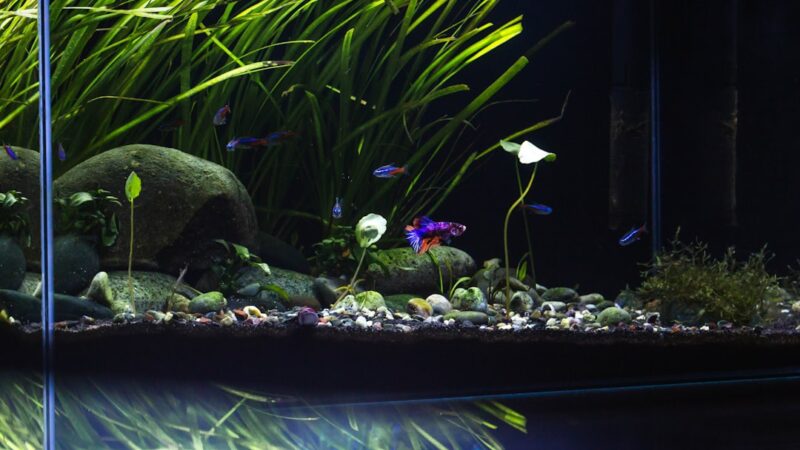
The open swimming space around the island is perfect for schooling fish that benefit from room to manoeuvre. A school circling the central island creates mesmerising movement. Choose one species for maximum impact — the uniform school contrasts with the textured island centre. Small tetras, rasboras or danios work beautifully.
Maintenance
Trim the central mound regularly to maintain its dome shape. The top should trace a smooth, rounded curve — no flat tops or spiky protrusions. Remove any plants that spread into the negative space zones. The convex layout is arguably the easiest of the three basic compositions to maintain, as the planting is concentrated in one area rather than spread across the entire tank. Focus all your pruning energy on shaping that one central mass to perfection.
Common Mistakes
Flat-topped mound: A plateau looks like a table, not an island. Maintain a smooth dome curve.
Mound too small: A tiny cluster in a large tank looks like an afterthought. The island should be substantial enough to command attention.
Planting the edges: Any planting in the open side areas dilutes the island effect. Keep them bare.
Sharp edges: The transition from mound to open substrate should be gradual and organic, not a sudden cliff edge. Spreading ground cover at the base creates this natural transition.
Related Reading