The Rule of Thirds in Aquascaping: A Detailed Breakdown
A thorough rule of thirds aquascaping detailed guide helps you move beyond instinct and compose layouts with intention. At Gensou Aquascaping, our studio at 5 Everton Park in Singapore, we teach every workshop attendee this principle first because it underpins nearly every award-winning aquascape and turns a random collection of plants and rocks into a coherent scene.
What Is the Rule of Thirds
The rule of thirds is a compositional guideline borrowed from photography and painting. Imagine dividing your tank’s front glass into a grid of nine equal rectangles — three columns and three rows — by drawing two equally spaced vertical lines and two equally spaced horizontal lines. The four points where these lines intersect are called power points. Placing your focal elements at or near these intersections creates a balanced yet dynamic composition that naturally pleases the eye.
Why It Works in Aquascaping
Centering the focal point — a striking piece of driftwood, the tallest rock, or a splash of red plants — feels static and predictable. Placing it on a power point creates tension and visual energy. The viewer’s eye is drawn to the focal element, then travels across the negative space, exploring the rest of the layout. This movement through the scene is what distinguishes a compelling aquascape from a merely planted tank.
Applying the Vertical Thirds
Divide the tank width into three equal sections. The left-third and right-third lines are where your primary focal elements should sit. In a classic triangular layout, the peak of the triangle aligns with one of these vertical thirds. In a concave layout, the two high points sit on or near both thirds, with the valley in the centre. In a convex or island layout, the apex of the mound aligns with the centre third but the densest planting shifts slightly off-centre toward one power point.
For a 60 cm tank, the vertical third lines fall at 20 cm and 40 cm from the left edge. Mark these measurements with small pieces of tape on the rim during planning to guide your hardscape placement.
Applying the Horizontal Thirds
The horizontal lines govern the height distribution in your aquascape. The lower horizontal third typically marks the top of the foreground carpet or the substrate line where the midground begins. The upper horizontal third marks the point where background plants or hardscape should peak — leaving a band of open water above for breathing room. Filling the tank to the very top with plant mass looks cluttered. Allow the upper third to remain open or lightly planted for a sense of calm.
Placing the Focal Point on a Power Point
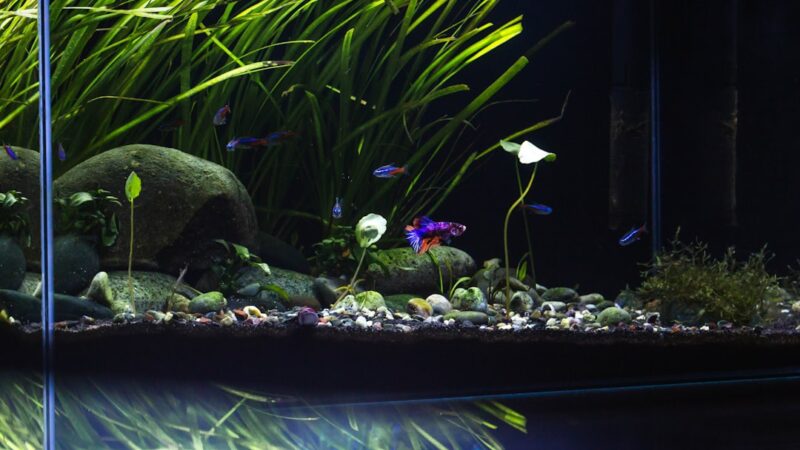
The focal point is the single element your eye lands on first. It could be the tallest piece of Seiryu stone, a uniquely shaped branch, or a cluster of vivid red Rotala. Position this element where two grid lines cross — the lower-left, lower-right, upper-left, or upper-right power point. Most aquascapers in Singapore favour the lower-left or lower-right power point because it grounds the composition and leaves headroom for background plants.
If your layout has a secondary focal element, place it on the diagonally opposite power point at reduced visual weight — smaller size, softer colour, less contrast. This creates a subtle visual dialogue between the two elements.
Using Negative Space Effectively
The rule of thirds inherently creates negative space — the open water, bare substrate, or sparse planting that occupies the sections without focal elements. Negative space is not wasted space; it gives the viewer’s eye a place to rest and makes the focal elements stand out. In competition aquascaping, judges frequently penalise layouts that fill every square centimetre with plants, as the result is overwhelming and directionless.
When to Break the Rule
Rules in art are guidelines, not laws. A perfectly centred layout — an island aquascape with a single tree at dead centre — can be breathtaking if executed with skill. The rule of thirds is most useful as a starting point and a troubleshooting tool. If a layout feels wrong but you cannot articulate why, overlay the thirds grid mentally and check whether the focal elements fall awkwardly between power points. A small shift of a few centimetres often resolves the discomfort.
Practical Exercise for Beginners
Before setting up your next tank, photograph the empty tank from the front and print the image — or open it in a phone app — and draw the thirds grid over it. Sketch where you intend to place the tallest stone, the main driftwood branch, and the densest planting. Adjust until the key elements sit on or near the power points. This five-minute exercise prevents hours of rearranging hardscape underwater.
In Singapore, aquascaping workshops and competitions hosted by groups like the Aquatic Plant Society regularly use grid overlays to critique layouts. Attending one of these events is an excellent way to train your eye. Alternatively, visit Gensou Aquascaping at 5 Everton Park — we are always happy to walk you through composition principles using our display tanks as live examples.
Related Reading