How to Aquascape a Cylinder Tank: 360-Degree Design

Cylinder tanks are eye-catching centrepieces, but they present a design challenge most rectangular-tank aquascapers have never faced: every angle is the front. A proper aquascape cylinder tank guide demands radial thinking, careful plant selection and hardscape that works from 360 degrees. At Gensou Aquascaping in Singapore, we have installed cylindrical displays in restaurant lobbies and living rooms where guests walk around the tank, and every viewpoint matters.
Why Cylinder Tanks Are Different
Rectangular tanks have a back wall you can hide equipment behind and a single viewing pane to optimise. Cylinders have neither. Filters, heaters and CO2 diffusers are visible from every angle. The curved glass distorts images slightly, making fine details less critical but overall shape and proportion more important. Designing for a cylinder means thinking in concentric rings rather than foreground-midground-background.
Central Focal Point Design
The most effective cylinder layout places a single dramatic element at the centre: a piece of branching driftwood reaching upward, a tall stone formation or a cluster of epiphyte-covered wood. This central structure draws the eye from every direction and provides vertical interest in what is typically a tall, narrow water column. Build height with the hardscape rather than relying on tall stem plants, which look thin and leggy when viewed from the side.
Planting in Concentric Zones
Work outward from the centre. Attach epiphytes like Anubias nana petite, Bucephalandra and mosses directly to the central hardscape. Surround the base with a ring of midground plants such as Cryptocoryne wendtii or Staurogyne repens. The outer ring, closest to the glass, can feature a low carpet of Eleocharis or dwarf Sagittaria. This layered approach ensures something interesting is visible at every height and every angle.
Substrate Mounding
Mound substrate highest at the centre, tapering down toward the glass. A centre height of 10-12 cm sloping to 3-4 cm at the edges creates a natural hill that elevates the focal point and improves depth perception. Use a substrate retainer ring made from plastic mesh or stones at the base of the mound to prevent aquasoil from flattening over time. This conical substrate shape is fundamental to making a cylinder layout look three-dimensional.
Hiding Equipment
This is the biggest practical challenge. Inline heaters and canister filters with intake and outlet positioned behind the central hardscape are the cleanest solution. Nano internal filters can be disguised with moss-covered mesh. Lily pipe inlets and outlets in clear glass are less visible against the curved walls than black plastic fittings. Some hobbyists run a sump below the tank stand, eliminating visible equipment entirely, which is the approach we recommend for display-grade installations.
Fish Selection for Round Spaces
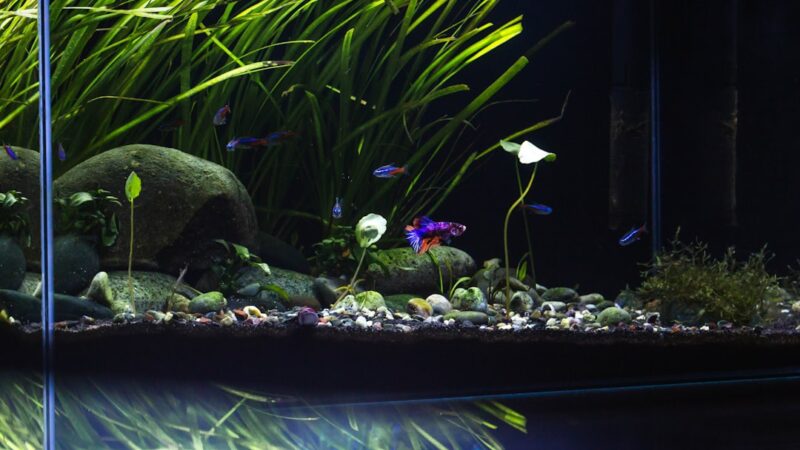
Choose species that look good from all sides and swim at multiple levels. A school of celestial pearl danios or ember tetras provides constant movement through the middle zone. A few Otocinclus keep the glass clean, which is essential when every panel is a viewing pane. Avoid large, fast swimmers that may become stressed in the curved confines of a cylinder. Most cylinder tanks hold 20-60 litres, so nano species are the natural fit.
Lighting Challenges
Standard rectangular LED bars do not fit cylinder tanks. Pendant lights suspended above the open top are the most elegant solution, casting even illumination across the circular footprint. Clip-on nano lights work for smaller cylinders under 30 cm diameter. Ensure light reaches the outer edges where carpeting plants sit, as the central hardscape can cast shadows if the light source is too narrow. A fixture with a spread angle of 120 degrees or wider works well.
Maintenance Realities
Cleaning curved glass requires flexible algae scrapers or magnetic cleaners designed for curved surfaces. Standard flat scrapers leave gaps. Trimming plants at the centre requires longer tools since reaching over the rim of a tall cylinder is awkward. Long-handled scissors and tweezers, at least 35 cm, are essential. Despite these quirks, a well-planned cylinder aquascape rewards the extra effort with a uniqueness that rectangular tanks simply cannot match.
Related Reading