How to Aquascape a Corner Cabinet Tank

Corner tanks solve the perennial Singapore housing problem of limited floor space, fitting neatly where two walls meet. But their unusual triangular or bow-front footprint creates aquascaping challenges that standard rectangular layouts do not prepare you for. This aquascape corner cabinet tank guide from Gensou Aquascaping in Singapore covers the design principles, plant choices, and practical tricks that turn an awkward shape into a compelling underwater display.
Understanding the Corner Tank Shape
Most corner tanks are either true triangles with a flat front panel, or pentagonal with a curved or angled front. Typical sizes range from 80 to 200 litres. The depth from the front glass to the rear corner is the defining challenge: it can exceed 50-60 cm, which is deeper than many standard rectangular tanks. This depth affects light penetration, planting access, and viewing perspective. Your aquascape needs to account for a single primary viewing angle, straight on from the front, rather than the multiple angles a rectangular tank offers.
Layout Principle: The Central Vanishing Point
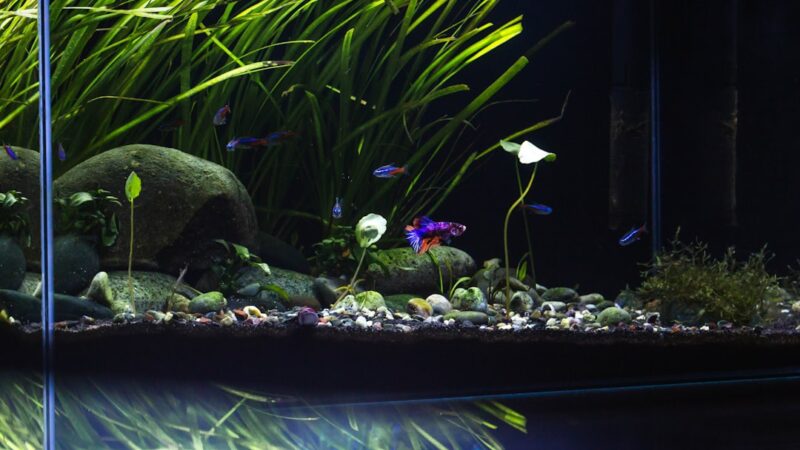
With a corner tank, the rear corner acts as a natural vanishing point. Use this to your advantage by building height toward that back corner, creating a sense of depth and perspective. Place the tallest hardscape and plants at the rear corner, sloping downward and outward toward the front edges. This triangular composition mirrors the tank shape itself and draws the viewer’s eye into the deepest part of the aquascape.
Hardscape Placement
A single dramatic rock or driftwood piece positioned slightly off-centre toward the rear corner anchors the composition. Radiating smaller pieces outward from this focal point creates visual flow. Dragon stone works particularly well because its textured surface catches light at varying angles as the viewer moves. Avoid placing large hardscape against the front glass, as it crowds the viewing pane and makes the tank feel smaller than it is.
Substrate Sloping
Build the substrate deeper at the rear corner (8-10 cm) and slope it down to 3-4 cm at the front edges. This height difference enhances the depth illusion and gives background plants a raised platform that brings them closer to the light. Use substrate retainers or small stones at transition points to prevent the slope from flattening over time. In a 200-litre corner tank, you may need 15-20 kg of substrate to achieve proper depth, so factor this into floor load calculations for upper-floor HDB flats.
Plant Selection and Zones
Divide the tank into three zones from front to back. Foreground plants along the front glass should stay under 5 cm: Eleocharis parvula, Marsilea hirsuta, or Lilaeopsis brasiliensis. Mid-ground species like Cryptocoryne wendtii and Staurogyne repens fill the middle third. The rear corner gets tall background plants: Rotala species, Limnophila aquatica, or Vallisneria. Because the rear corner is so deep, choose plants that tolerate moderate light, as even a strong LED loses intensity over 50 cm of water.
Lighting Challenges and Solutions
Standard rectangular LED bars do not cover a corner tank evenly. The centre receives adequate light while the rear corner falls into shadow. A pendant-style light hung directly above the tank provides better coverage than a bar mounted at the front. Alternatively, use two shorter LED units angled to overlap in the centre. Aim for 40-60 PAR at the substrate in the front third and accept that the deepest rear section will receive less. Plant shade-tolerant species like Anubias and java fern in that back corner.
Filtration and Flow
The deep rear corner can become a dead zone where debris accumulates. Position your filter outflow to create circulation that reaches this area. A canister filter with a spray bar along one side wall, angled toward the back corner, pushes water through the entire volume. For smaller corner cabinet tanks, a hang-on-back filter on one of the side walls combined with a small powerhead aimed at the opposite rear section prevents stagnation. Check the back corner during water changes and vacuum mulm build-up.
Making the Most of Limited Space
Corner tanks shine in living room corners, bedroom nooks, and entryway alcoves in Singapore homes. The cabinet beneath stores all equipment out of sight. Gensou Aquascaping designs custom corner cabinets that maximise storage for canisters, CO2 cylinders, and maintenance supplies. The tank itself becomes a natural focal point because it occupies space that would otherwise sit empty. Embrace the unusual footprint rather than fighting it, and the result is an aquascape that feels uniquely intentional.
Related Reading