How to Aquascape for Apistogramma Breeding: Caves and Territory

Breeding dwarf cichlids successfully depends as much on the aquascape as on water chemistry. Apistogramma are cave-spawning fish with complex territorial behaviour, and a tank that provides the right structural cues — broken sight lines, multiple cave sites, dense plant cover — produces breeding activity far more consistently than bare or minimally decorated setups. Designing an Apistogramma breeding tank aquascape is a study in applied fish behaviour: every hardscape element and plant placement serves a biological function. Gensou Aquascaping at 5 Everton Park, Singapore has bred multiple Apistogramma species successfully and can share what actually works.
Understanding Apistogramma Territorial Behaviour
Male Apistogramma establish and defend territories. In a typical breeding setup with one male and two females, the male holds a larger territory that encompasses two female spawning sites. Each female guards a smaller core territory around her cave. Without adequate visual barriers between these micro-territories, the male harasses females continuously — subordinate females will hide, refuse food and eventually die from stress. The aquascape must create genuine broken sight lines, not just decorative planting.
Cave Design and Placement
Coconut shell caves, small terracotta pots (half-pots placed opening-sideways), ceramic breeding caves and stacked flat stones are all effective spawning sites. The cave opening should be just large enough for the female to enter comfortably — 3–4 cm in diameter for smaller species like A. borellii or A. cacatuoides, 4–5 cm for larger species like A. macmasteri. Position at least one cave per female, spaced well apart in the tank, ideally in opposing rear corners. A cave mid-tank that the male can hover near without blocking female access to her site works well as a central territory marker.
Plants as Functional Cover
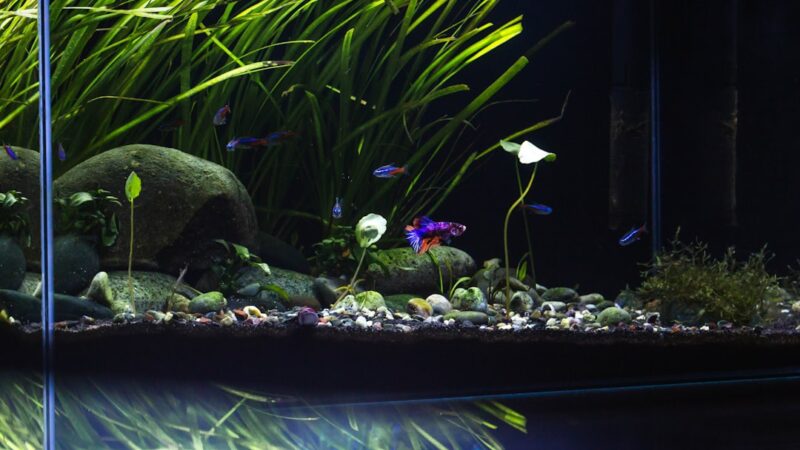
Dense planting is not decoration in an Apistogramma breeding tank — it is shelter infrastructure. Java moss attached to driftwood above cave entrances creates a visual curtain females retreat behind when stressed. Clumps of Echinodorus or large Vallisneria provide vertical cover the male can patrol without seeing through. Low foreground plants like Sagittaria subulata give fry cover once the female brings them out of the cave. Floating plants — Salvinia or Limnobium — diffuse lighting and signal the soft, shaded forest floor streams where Apistogramma originate.
Water Parameters for Breeding Success
Most Apistogramma species breed most readily in soft, slightly acidic water: pH 6.0–6.8, GH 1–4, temperature 26–28°C. In Singapore, a 50:50 mix of RO water and PUB tap water achieves GH 1–2 and TDS 70–100 ppm without additional acidification. Leaf litter from Indian almond (ketapang) leaves, readily available at local aquarium shops, adds tannins that lower pH gently and create the brown-stained water of Amazonian forest streams. A twice-weekly 20% water change with slightly cooler replacement water can trigger spawning behaviour — it mimics a rainfall event in the natural habitat.
Lighting: Dimmer Is Better
Apistogramma originate from heavily shaded blackwater streams where light levels are low. High-intensity aquascape lighting stresses these fish and discourages breeding behaviour. Floating plant cover is the simplest solution: a layer of Salvinia covering 50–70% of the surface reduces substrate PAR to 10–20 without changing your fixture. Alternatively, run your light at 50–60% intensity. The dimmer, more natural light environment encourages bold colour display in males — they’re far more likely to show full finnage in subdued conditions than under bright LED spotlighting.
Tank Sizing and Population
A 60-litre tank suits a breeding trio (one male, two females) of most dwarf Apistogramma species. The footprint matters more than depth — a 60 × 30 cm base provides enough horizontal territory space, and fish rarely use more than the bottom 20 cm of the water column anyway. Avoid adding other bottom-dwelling fish to a breeding setup; even peaceful species like Corydoras stress brooding females by venturing near the cave. A small school of surface-oriented dither fish (five to eight small tetras) is beneficial — their calm, active behaviour signals to the cichlids that no predator is nearby, encouraging them to feed and breed normally.
Watching for Breeding Signs
A female ready to spawn develops an intense yellow colouration with black markings — the classic Apistogramma breeding dress. The male will intensify his colour display and court the female near a cave site. After spawning (typically 40–80 eggs laid inside the cave), the female guards aggressively and will chase the male away from her territory. At this point, providing dense cover becomes critical — a harassed male with nowhere to retreat will repeatedly test the female’s defence until she abandons the clutch. Eggs hatch in 48–72 hours at 27°C; fry are free-swimming after another 4–5 days and should be fed baby brine shrimp and commercial micro-food from day one.
Related Reading