How to Aquascape for a Harlequin Rasbora Shoal: Mid-Level Colour

A shoal of harlequin rasboras moving through a planted tank is one of the classic pleasures of the hobby — the copper-orange flanks and distinctive black triangular patch catching light as the fish turn in formation, restless and purposeful, filling the mid-water column with living colour. Designing an aquascape specifically to showcase a harlequin rasbora shoal means thinking carefully about background contrast, mid-water open space, and the natural Southeast Asian environment these fish come from. Gensou Aquascaping at 5 Everton Park, Singapore knows this fish well — Trigonostigma heteromorpha is native to Singapore and the surrounding region, and getting their aquascape right honours that.
Why the Mid-Water Column Matters Most
Harlequins are mid-water fish. Unlike corydoras that hug the substrate or surface feeders that drift near the top, harlequins occupy the central zone — roughly the middle third of the tank’s depth. An aquascape for this species must leave that zone deliberately open: a clear swimming lane with no dense planting or hardscape intruding into the mid-water. This is the stage where the shoal performs, and obscuring it wastes the fish’s best quality.
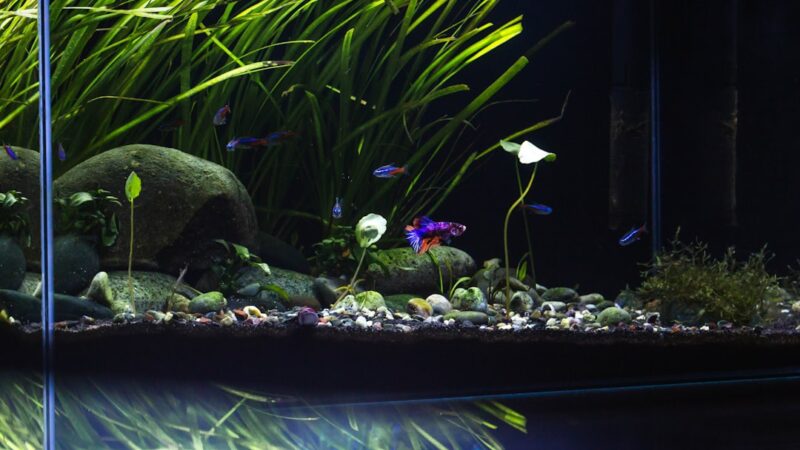
Dense background planting and a clean foreground with minimal obstruction creates this open mid-water naturally. Think of the design as a theatre: dense green backdrop, clear centre stage, low front row. The fish fill the space naturally.
Background Planting for Maximum Contrast
The copper-orange colouration of harlequins contrasts beautifully against mid-green and dark green backgrounds. Rotala rotundifolia, planted thickly at the rear, creates a mid-green curtain that makes the fish pop visually. Microsorum pteropus (Java fern) attached to driftwood in the back corners adds darker texture. Adding a small section of red-toned plant — Alternanthera reineckii ‘Mini’ or Rotala macrandra in a single cluster — creates a complementary colour anchor without overwhelming the design.
Avoid pure white or very pale backgrounds behind a harlequin tank — the fish’s colouration reads best against medium to dark green. A dark blue or dark vinyl background behind the tank glass also works well if the internal planting is not yet thick enough to serve as the visual backdrop.
Hardscape: Driftwood and Broad-Leaf Plants
Harlequins originate from peat swamp forests and blackwater streams of the Malay Peninsula and Sumatra — environments of submerged tree roots, driftwood, and large-leafed aquatic plants. Spider wood or smooth river driftwood pieces placed at the sides and rear of the tank feel natural for this species. Attach Anubias barteri or Anubias nana to driftwood surfaces — their broad, waxy leaves replicate the large aquatic vegetation of the peat swamp and provide a resting association for the fish without blocking swimming space.
Keep hardscape asymmetric and off-centre. A cluster of driftwood to one side, angled to suggest a fallen branch structure, leaves the opposite side of the tank more open for shoaling display.
Foreground Options: Low and Open
Harlequins occasionally drop to the lower third of the tank, particularly when feeding. A fine-textured foreground carpet — Helanthium tenellum or Cryptocoryne parva — keeps the bottom zone interesting without adding vertical obstruction. Cryptocoryne wendtii in its smaller forms also suits the Southeast Asian biotope theme of the tank while staying low enough to maintain visual sight lines into the mid-water shoal.
Resist filling the foreground heavily with tall plants. Any stem plant growing beyond 15 cm in the front half of the tank will break the clear view of the shoal from the front, which is where the aquascape is meant to be appreciated.
Water Parameters and Singapore Conditions
Harlequins are native to Southeast Asian soft, acidic, warm water — exactly what Singapore’s PUB tap provides in its naturally soft state. GH 2–6, KH 1–3, pH 6.0–7.2, temperature 24–28°C. No heater is needed in most Singapore homes. The fish are robust and tolerate the slightly higher pH of treated tap water (around 7.0–7.2) without issue.
For optimal colour and spawning behaviour, slightly lower pH (6.5–6.8) achieved with driftwood tannin or peat filtration is beneficial, but this is refinement rather than necessity. A healthy shoal in well-oxygenated tap water at neutral pH will still colour up beautifully.
Shoal Size and Social Behaviour
Minimum shoal size for confident behaviour is 8–10 fish; 15–20 produces the tight, synchronised movement that is visually compelling at aquascape scale. Under-shoaled groups of 4–5 fish hang back near cover and do not display the open mid-water swimming the species is known for. More fish means better behaviour — and in a well-planted 60–90 cm tank, a shoal of 20 is entirely appropriate for the bioload.
Lighting and Colour Rendering
Harlequins look their best under warm to neutral spectrum lighting — 5000–6500K. The copper-orange colouration shifts toward a washed-out yellow under very cool daylight spectrums (above 7000K). A moderate photoperiod of 7–8 hours prevents algae while providing enough duration for the fish’s copper pigment to fully activate under light. Mid-afternoon dimming programmes, if your light supports them, create a natural dawn-to-dusk cycle that adds subtlety to observation sessions.
Related Reading
- How to Aquascape for Exclamation Point Rasboras: Dense Nano Jungle
- How to Aquascape for a Rummy Nose Tetra Shoal: Open Swimming Space
- How to Breed Harlequin Rasboras: Under-Leaf Spawners
- Harlequin Rasbora Colour Varieties: Classic, Purple and Black
- Harlequin Rasbora vs Lambchop Rasbora: Spot the Difference
A harlequin rasbora shoal pairs beautifully with a busy bottom layer, so consider adding cories with help from our pygmy corydoras shoal care guide.