
Echinodorus Ozelot Care Guide: Spotted Leopard Sword Plant
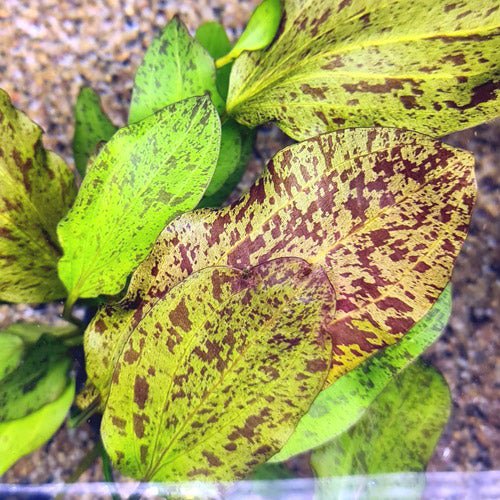
The Echinodorus genus has given the planted tank hobby some of its most reliable and adaptable background plants, but Ozelot stands apart from the classic green Amazon sword through its distinctive leaf patterning — dark reddish-brown or olive spots scattered across bronze-green to red-brown leaves that emerge more intensely coloured in good growing conditions. Named for its resemblance to the ocelot’s spotted coat, this hybrid cultivar (a cross between Echinodorus schluteri and Echinodorus barthii) combines visual interest with genuine ease of care. This Echinodorus ozelot care guide from Gensou Aquascaping at 5 Everton Park covers the specific conditions that bring out its best colouration and keep it thriving as a long-term aquarium resident.
Appearance and Growth Form
Ozelot produces broad, oval-to-lanceolate leaves on sturdy petioles, forming a rosette growth habit similar to other Echinodorus species. Leaf colouration varies considerably between specimens and growing conditions — young leaves typically emerge with the most intense reddish or bronze tones, fading to a more olive-green as they mature. The dark spotting pattern is present from early growth and intensifies under adequate iron levels and moderate to high light.
Adult plants in good conditions reach 30–50 cm in height, making Ozelot a genuine background or centrepiece plant suited to tanks of 100 litres or more. In smaller tanks it can be kept trimmed by removing older outer leaves, but its natural size should be considered in placement planning.
Light Requirements
Moderate light suits Echinodorus ozelot well — approximately 30–50 PAR at the substrate level. This is lower than many stem plants require, making Ozelot a practical choice for setups without high-end lighting. Under low light, growth slows significantly and leaf spotting becomes less distinct, but the plant survives and remains acceptable. Under high light with CO₂, growth accelerates and new leaves emerge with pronounced reddish colouration before transitioning to the spotted mature form.
Substrate and Root Nutrition
Echinodorus species are heavy root feeders. A nutrient-rich substrate — aquasoil, clay-based planted tank substrate, or a capped laterite or dirt substrate — supports much better growth than inert gravel or sand alone. Root tabs placed near the root zone every four to six months provide ongoing nutrition in systems using inert substrate.
Plant the rhizome at substrate level with roots spread outward and downward — the rhizome itself should not be buried, only the roots. A newly planted Ozelot may experience a two to four week adjustment period with slow growth before establishing; this is normal. Once rooted, growth is steady and the plant becomes a reliable fixture in the aquascape.
CO₂ and Fertilisation
Echinodorus ozelot does not require CO₂ injection, which is one of its greatest practical advantages. It grows adequately from dissolved CO₂ in the water column, making it one of the best choices for beginner planted tank setups without pressurised gas systems. That said, CO₂ injection at 20–30 ppm noticeably improves growth rate and leaf colouration in this cultivar.
Liquid fertilisation should address both macro and micronutrients. Iron is particularly important for maintaining the reddish and bronze leaf tones — dose chelated iron at 0.1–0.3 ppm weekly and look for new leaf colour as an indicator. If new leaves emerge pale or yellowish, increase iron and trace element dosing before assuming a macronutrient deficiency.
Water Parameters
Echinodorus ozelot is adaptable across a broad range of water conditions — pH 6.5–7.8, GH 4–15, temperature 22–28°C. Singapore’s treated tap water suits it without modification, making it an ideal plant for beginners who have not yet invested in water parameter management equipment. The species tolerates temperatures at the upper end of this range better than many stem plants, an important consideration in Singapore’s climate where tanks can run at 28–30°C without air conditioning.
Propagation
Ozelot propagates readily via runners — long horizontal stolons sent out from the base of the parent plant that produce daughter rosettes at intervals. These runners appear most frequently in mature, well-established plants with good nutrition. Allow daughter plants to develop three to four leaves and a visible root system before severing the runner and replanting them elsewhere in the tank or sharing with other hobbyists.
Flower stalks sometimes emerge from mature plants in aquariums, growing above the water surface. Adventitious plantlets develop on these stalks in a form of aerial propagation — leave them to develop until they produce small leaves and roots, then detach and plant them in the substrate. Echinodorus ozelot is one of the most generous propagators among the sword plants, a quality that makes it a practical long-term investment. Visit Gensou Aquascaping at 5 Everton Park for specimen plants and advice on establishing a nutrient-rich substrate for maximum colour and growth.
Related Reading



