How to Aquascape a Breeding Pair Tank: Privacy and Spawning Sites
Breeding fish is one of the most rewarding parts of the hobby — but a tank that looks great and functions as a breeding environment requires thoughtful design. An aquascape for a breeding pair tank must balance visual appeal with the biological needs of spawning adults and vulnerable fry. At Gensou Aquascaping in Singapore, we have designed breeding setups for species ranging from Apistogramma dwarf cichlids to discus, and the layout principles are surprisingly universal.
Why Layout Matters for Breeding
Stressed fish do not breed. Open, barren tanks leave pairs feeling exposed, which suppresses spawning behaviour. Conversely, overly cluttered tanks make it impossible for pairs to establish territory or for you to observe eggs and fry. The goal is structured space — clear territorial boundaries, line-of-sight breaks, and accessible spawning surfaces — wrapped in an aesthetic that you actually enjoy looking at.
Tank Size for a Breeding Pair
Most small to medium species breed comfortably in 40-80 litres. A 60 cm tank gives enough room for a pair plus a few dither fish that encourage natural behaviour. Avoid tanks smaller than 30 litres unless you are breeding nano species like Dario dario or Pseudomugil blue-eyes. Larger cichlid pairs — angelfish, rams, kribs — benefit from 80-120 litres, which provides buffer space during aggressive spawning moods.
Creating Privacy Zones
Use hardscape to divide the tank into two or three distinct zones. A tall piece of driftwood or a cluster of rocks at the one-third mark creates a visual barrier. The pair claims one zone; any dither fish retreat to the other. Caves formed from stacked stones or coconut shell halves give cave-spawning species like Apistogramma and bristlenose plecos an irresistible nest site. Position caves so the opening faces the front glass — this lets you monitor eggs without disturbing the parents.
Spawning Surfaces
Different species prefer different substrates for egg deposition. Angelfish and discus favour broad, flat surfaces — angled slate or large Echinodorus leaves. Corydoras scatter eggs on glass and plant leaves. Killifish often need yarn mops or dense Java moss clumps. Research your target species before designing the scape, and integrate the correct spawning surface as a natural-looking element rather than an afterthought.
Plant Choices for Fry Cover
Dense, fine-leaved plants provide essential hiding spots for newly free-swimming fry. Java moss (Taxiphyllum barbieri) is the universal fry shelter — drape it over rocks and driftwood in generous clumps. Ceratophyllum demersum (hornwort) floats densely at the surface and offers immediate refuge from hungry adults or dither fish. Cryptocoryne species planted along the sides create shaded ground-level cover where bottom-dwelling fry feel secure.
Filtration Without Fry Loss
Standard filter intakes are death traps for tiny fry. Always cover the intake pipe with a fine-pore prefilter sponge (50 PPI or finer). Better still, use a sponge filter as the primary filtration — it provides gentle flow, excellent biological filtration, and zero risk of fry being sucked in. Sponge filters also create minimal current, which prevents fragile fry from being buffeted around the tank. A Qanvee or equivalent sponge filter costs under $10 on Shopee and is perfect for breeding setups.
Water Parameters and Triggers
Many species spawn in response to water parameter shifts. A large, cool water change of 30-40 % using PUB tap water at 2-3 °C below tank temperature simulates a rainstorm — a proven trigger for Corydoras, tetras, and many South American cichlids. Keep water clean with twice-weekly partial changes of 15-20 %. Singapore’s soft tap water (GH 2-4) naturally suits many popular breeding species without needing RO or remineralisation.
Balancing Beauty and Function
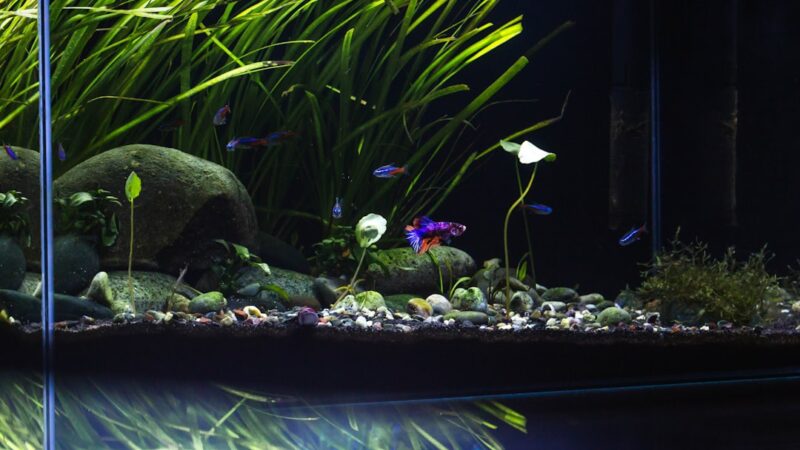
A breeding tank does not have to look clinical. Mossy stones, curving driftwood, and layered plants create a scape that is genuinely attractive while meeting every reproductive requirement. The key is intentionality — every element should serve a purpose, whether it is a cave for egg deposition, a moss clump for fry refuge, or a visual barrier for territory definition. A well-designed breeding pair tank aquascape is proof that form and function are not in conflict.
Related Reading