Aquascaping With River Pebbles Only: Smooth Round Stone Layouts
Aquascaping purists tend to reach for dramatic Seiryu stone or craggy dragon stone, but there is a quiet elegance to working with smooth, rounded river pebbles. An aquascape using river pebbles only captures the look of a natural streambed with minimal fuss, and the stones are among the cheapest hardscape materials available. Gensou Aquascaping in Singapore has used this understated approach in several client setups, proving that simplicity can be just as visually compelling as complexity.
Why River Pebbles Work
Round stones immediately evoke moving water. Their smooth surfaces tell a geological story of erosion and transport that viewers instinctively understand, even if they cannot articulate it. Pebbles also lack the sharp edges that can injure bottom-dwelling fish like corydoras or loaches. From a practical standpoint, they are inert, do not alter water chemistry, and are virtually maintenance-free.
Sourcing Pebbles in Singapore
Aquarium shops across Serangoon North and online sellers on Shopee stock bags of river pebbles in various sizes, typically from 1-2 cm up to 8-10 cm diameter. Prices range from $3-$12 per kilogram depending on colour and source. Natural mixed-tone pebbles in greys, browns, and creams look the most authentic. Avoid polished or dyed pebbles, which appear artificial underwater.
If you want larger feature stones, landscape supply stores sell river boulders of 15-30 cm diameter by weight. A single large boulder as a focal point surrounded by smaller pebbles creates a powerful visual hierarchy.
Layout Principles
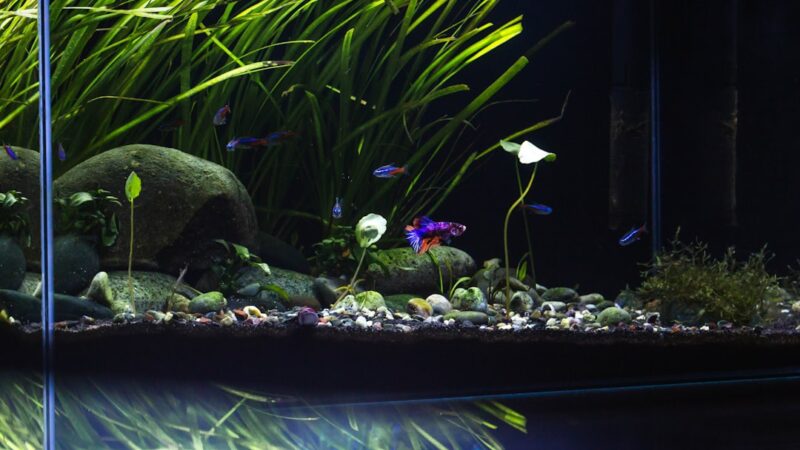
Scatter pebbles in natural-looking clusters rather than spreading them uniformly. In a real river, current sorts stones by size: larger pieces settle in certain areas while smaller gravel accumulates downstream. Mimic this by grouping larger pebbles on one side and letting the size gradient decrease toward the opposite end. Leave open patches of sand between clusters for visual breathing room.
Odd numbers look more natural than even groupings. A cluster of three or five pebbles reads as organic, while a pair or quartet looks deliberate.
Substrate Pairing
Fine sand in a pale neutral tone is the ideal companion for river pebbles. Pool-filter sand or natural river sand, 1-3 mm grain size, sits naturally between the stones. Avoid dark aqua soils, which clash with the light, airy river aesthetic. Lay sand 2-3 cm deep and let the pebbles rest on top, partially buried for a natural embedded look.
Adding Plants Sparingly
A pebble-only aquascape benefits from restraint with plants. Small tufts of Eleocharis acicularis (dwarf hairgrass) growing between stones add a gentle green accent without overwhelming the hardscape. Mosses tied to larger pebbles soften their profiles over time. Anubias nana ‘Petite’ glued to a feature stone adds a single focal point of green. Keep plant coverage below 20% of the floor area to maintain the clean stone aesthetic.
Fish That Suit the Style
Bottom dwellers like Corydoras habrosus and Corydoras pygmaeus look perfectly at home navigating a pebble bed. White Cloud Mountain minnows (Tanichthys albonubes) and Danio margaritatus (celestial pearl danio) suit the stream-like environment. Hillstream loaches work if you provide adequate flow and cooler water. Avoid large, boisterous species that would look out of scale against the gentle pebble arrangement.
Flow and Filtration
A moderate linear flow along the length of the tank reinforces the stream illusion. A hang-on-back filter or small canister with the outlet directed lengthwise creates a gentle current that you can watch move fine particles along the sand, just like a real streambed. Pebbles do not trap detritus the way rough-textured stone does, so maintenance is minimal. A quick pass with a gravel vacuum during water changes keeps the sand pristine.
Designing for Long-Term Enjoyment
River pebble layouts age gracefully. There is no stone crumbling, no dramatic colour change over time. Biofilm and a thin layer of diatoms may develop on the stones in the first weeks, which algae-eating shrimp and snails will manage naturally. Over months, the tank settles into a tranquil, mature appearance that requires very little intervention. An aquascape built with river pebbles only is proof that you do not need rare or expensive materials to create something beautiful. Gensou Aquascaping in Singapore encourages every hobbyist to try this approach at least once.
Related Reading