How to Aquascape for Denison Barbs: Fast Flow River Layout
Denison barbs need space, current, and company. In the wrong tank — small, still, and overcrowded with decoration — these torpedo-shaped, vibrantly striped fish pace along the glass, lose colour, and rarely behave naturally. A purpose-built aquascape for Denison barbs as a river tank changes everything: a school of six or more Sahyadria denisonii holding position in a strong current, their red lateral stripes bright under clear water, is one of the most spectacular sights a freshwater aquarist can create. Gensou Aquascaping at 5 Everton Park, Singapore, regularly designs river-style setups and considers the Denison barb one of the most rewarding centerpiece species available locally.
Understanding Denison Barb Natural Habitat
Sahyadria denisonii is endemic to the fast-flowing, boulder-strewn rivers of the Western Ghats in Kerala and Karnataka, India. Natural water is clear, well-oxygenated, cool (20–25°C), and moderately soft. The fish school in midwater, using the main current channel while seeking relief in eddies behind large rocks. This behaviour translates directly into aquascape design requirements: you must create both a strong flow axis and calmer refuge zones. Mimicking this hydraulic complexity is what separates a great Denison barb tank from a merely adequate one.
Tank Size and Dimensions
A minimum 120-litre tank is the baseline — and that’s for a small group of six. Denison barbs reach 12–15 cm and are active swimmers that need lateral swimming space above all else. A long, shallow tank performs better than a tall cube of the same volume: 120 cm × 40 cm × 40 cm offers significantly more useful swimming length than 60 cm × 60 cm × 45 cm at similar litreage. A 150-litre or 180-litre long tank is ideal and allows a school of eight to ten fish to school naturally. In Singapore, custom glass tanks of these dimensions are available from a number of fabricators for $150–$300, often better value than imported branded tanks.
Hardscape: River Rock Layout
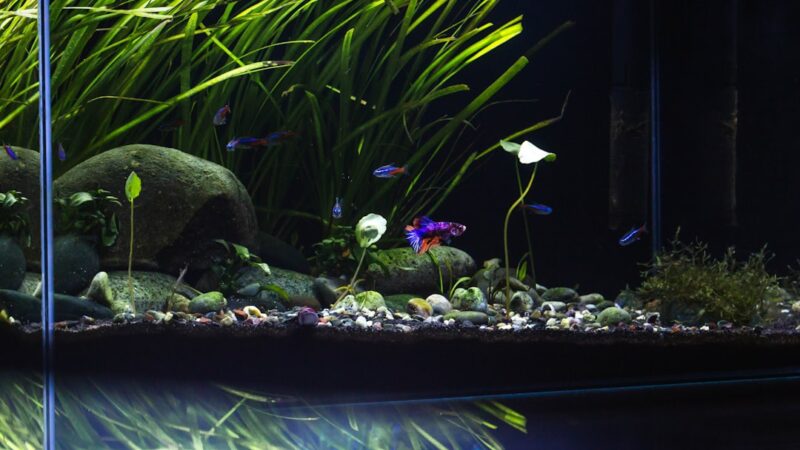
Smooth rounded river pebbles and larger granite boulders define the layout. Arrange larger stones at the back and sides to create flow channels through the mid-tank area. Flat stones can be stacked to create ledges and overhangs that generate eddies — still-water zones where resting fish shelter. Avoid tall, narrow rock formations; Denison barbs need open horizontal space more than vertical height. Leave the front third of the tank as open sand or fine gravel — the fish use this area for feeding sweeps and it gives viewing clarity for the observer. Dark grey or brown river stones suit the Western Ghats biotope palette.
Flow Rate and Filtration
This is the non-negotiable technical parameter. Target 10–15 times tank volume per hour total turnover. For a 150-litre tank, that means 1,500–2,250 litres per hour from combined filtration and powerheads. Position outflow across the tank length to create a horizontal current corridor. Denison barbs actively swim into the current — a behaviour called rheotaxis — and will spend hours holding station at different flow intensities across the tank. Without adequate flow, the fish become lethargic and colouration fades. A canister filter (ADA, Eheim, or equivalent) plus one or two Jebao or Koralia powerheads gives the necessary volume without a single overwhelming jet.
Temperature and Cooling
Wild Denison barbs live at 20–25°C — cooler than Singapore ambient. A chiller is required for long-term success. A 1/10 HP chiller maintaining 24–25°C in a 150-litre tank costs around $200–$280 from local aquarium shops and adds approximately $25–$35 per month to the electricity bill. The difference in fish behaviour and colour between 28°C (ambient) and 24°C (chilled) is dramatic. At 28°C the fish are often dull in colour, breathing faster, and less active. At 24°C they are visibly brighter, more energetic, and school with considerably more cohesion.
Plants for a High-Flow River Tank
Plant selection must match the current. Most stem plants cannot anchor against strong flow and will uproot continuously. Suitable options include Microsorum pteropus (Java fern) and Bolbitis heudelotii (African water fern), both attached to hardscape. Anubias species on rocks or driftwood are also current-tolerant. Mosses — particularly Taxiphyllum species — attached to mid-tank stones add green texture and biofilm for grazing. These attach-and-grow plants survive the flow and are easily maintained through pruning without substrate disturbance. Avoid substrate-rooted stem plants entirely in the flow zones.
Schooling Size and Behaviour
Six Denison barbs is a minimum for natural schooling behaviour — fewer than this produces timid, skittish fish that hide rather than displaying. Eight to twelve fish in an appropriate tank produce the constantly shifting, synchronized schooling that makes this species spectacular. Males develop deeper red on the dorsal fin during maturity and engage in low-level sparring within the school without injury. Feed primarily sinking pellets, frozen bloodworm, and occasional brine shrimp — Denison barbs are omnivorous and will accept most quality foods, though they prefer feeding in the mid-to-lower water column rather than at the surface.
Related Reading