Forced Perspective in Aquascaping: Making Small Tanks Look Huge
A well-executed aquascape can make a 60 cm tank look like an endless underwater landscape stretching to a distant horizon. The secret is forced perspective aquascaping, a technique borrowed from cinema and architecture that manipulates visual cues to create an illusion of depth far beyond a tank’s actual dimensions. At Gensou Aquascaping, 5 Everton Park, Singapore, we have applied forced perspective principles to competition layouts and client installations for over 20 years. This guide breaks down the technique into practical steps you can implement in any planted tank.
How Forced Perspective Works
Your brain estimates distance using familiar reference points — the relative size of objects, the convergence of lines, colour saturation, and the sharpness of detail. Forced perspective exploits these cues deliberately. By placing larger elements in the foreground and progressively smaller versions of similar elements towards the background, you trick the viewer into perceiving greater depth than physically exists. Road photographers use this technique to make subjects appear to hold distant landmarks; aquascapers use it to transform a 30 cm tank depth into what looks like metres of landscape.
Scaling Hardscape Materials
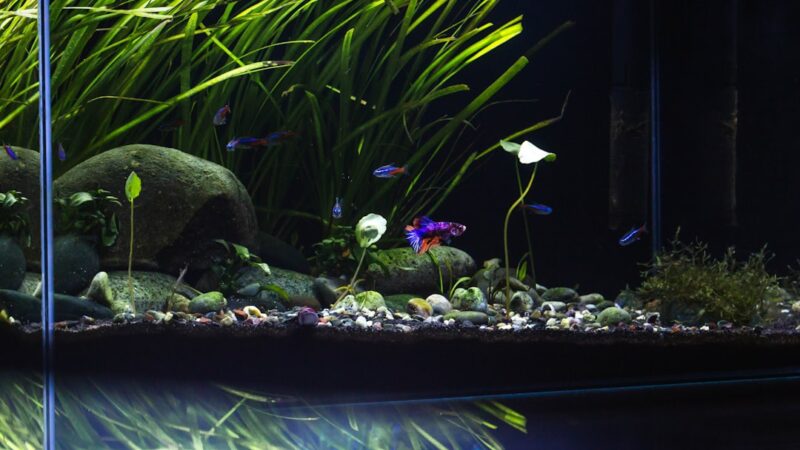
Rocks are the foundation of forced perspective in aquascaping. Use larger stones (8-15 cm) in the foreground and gradually transition to smaller pieces (2-5 cm) towards the rear. Select rocks from the same type — Seiryu stone, dragon stone or lava rock — so the texture remains consistent while only the scale changes. The largest foreground stone might weigh 500 grams; its “twin” at the back weighs 50 grams. This size gradient is the single most powerful tool in your forced perspective toolkit. Driftwood follows the same principle: thick, prominent branches in front, thin, delicate twigs behind.
Substrate Grading for Depth
Substrate manipulation amplifies the illusion significantly. Create a gentle slope rising from front to back, with the substrate at the rear 5-8 cm higher than at the front. Use coarser grain substrate (2-3 mm) in the foreground and finer grain (0.5-1 mm) towards the rear. The coarse-to-fine transition mimics how ground texture appears to lose detail with distance in natural landscapes. In Singapore’s aquascaping community, many competition scapes use a mix of ADA Amazonia in the main bed with fine cosmetic sand paths that narrow towards the back, drawing the eye deeper into the layout.
Plant Selection and Placement
Plants are where forced perspective becomes truly convincing. Use larger-leaved foreground species like Staurogyne repens or Cryptocoryne parva at the front. In the midground, transition to medium-textured plants such as Rotala rotundifolia or Pogostemon helferi. At the very back, plant fine-leaved species like Micranthemum ‘Monte Carlo’ or Hemianthus callitrichoides — plants normally used as carpets — grown as small bushes. Their tiny leaves read as full-sized trees viewed from a great distance. This leaf-size gradient is arguably more impactful than hardscape scaling alone.
Pathway and Line Convergence
A pathway that starts wide at the front and narrows towards the rear creates powerful linear perspective. Use contrasting sand — white cosmetic sand against a dark soil bed — to define the path clearly. The path should narrow to roughly one-third of its starting width by the time it reaches the back glass. Slight curves add naturalism; perfectly straight paths look artificial. Edge the pathway with small stones or low-growing plants to define its borders and prevent substrate mixing. This single technique can add perceived metres of depth to a tank that is physically only 30 cm deep.
Colour and Atmospheric Perspective
In nature, distant objects appear lighter, bluer and less saturated than nearby ones due to atmospheric haze. Replicate this in your aquascape by planting warmer, more saturated colours (deep reds, bright greens) in the foreground and cooler, lighter tones (pale green, silvery) towards the back. Red-leaved Alternanthera reineckii in front, mid-green Rotala in the middle, and pale Micranthemum at the rear creates a convincing colour recession. Strategic lighting placement, slightly dimmer towards the rear, reinforces the atmospheric effect.
Common Mistakes
Inconsistent scaling breaks the illusion instantly. A single large rock placed in the background destroys the size gradient you have carefully built. Overly aggressive slopes cause substrate collapse — support steep rear areas with hardscape barriers or mesh retaining walls. Using identical plant species at different sizes only works if growth rates are carefully managed through trimming; neglected plants quickly outgrow their intended scale. Forced perspective also demands a specific primary viewing angle — the effect weakens or breaks when viewed from the side, so orient the strongest perspective towards the room’s main sightline.
Applying the Technique in Singapore Homes
Forced perspective is particularly valuable in Singapore, where living spaces often dictate smaller tanks. A 45 cm or 60 cm desktop tank using these techniques can achieve visual impact rivalling much larger setups. The technique works in both low-tech and high-tech planted tanks, though CO2 injection and good lighting give you finer control over plant growth rates and leaf sizes. Whether you are competing in local aquascaping contests or simply want your living room tank to feel bigger, mastering forced perspective transforms what a small tank can achieve.
Related Reading
- How to Create Depth in a Small Aquascape: Forced Perspective
- How to Create Depth in Your Aquascape: Perspective Tricks
- 3D Printed Aquarium Accessories: Practical DIY Projects for Fishkeepers
- Advanced Aquascape Depth: Layered Substrate and Elevation Tricks
- How to Create an African River Biotope Aquascape