How to Create Depth in a Small Aquascape: Forced Perspective
Knowing how to create depth small aquascape forced perspective illusions is the difference between a nano tank that feels cramped and one that looks vast. Forced perspective manipulates scale, colour, and positioning to trick the eye into perceiving more space than physically exists. Gensou Aquascaping Singapore, with over 20 years of hands-on experience at 5 Everton Park, uses these techniques daily in client nano tanks across HDB flats and condos where space is at a premium.
What Forced Perspective Means in Aquascaping
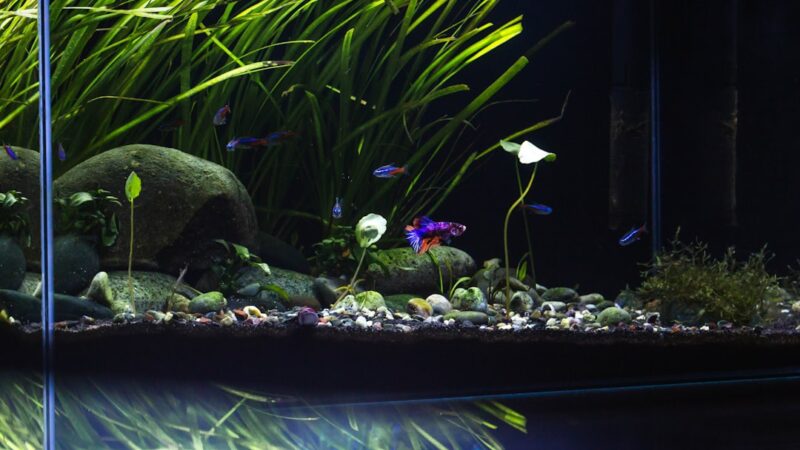
Forced perspective is borrowed from film and architecture. Objects placed further away appear smaller; converging lines suggest distance. In a 30 cm or 45 cm tank, you recreate this effect by graduating hardscape size from large in front to small at the back, sloping substrate upward, and using progressively finer-textured plants toward the rear.
The viewer’s brain interprets these cues as genuine depth. A well-executed 30 cm nano tank can look like it stretches a metre deep.
Substrate Slope: The Foundation
Build your substrate dramatically higher at the back — 8-10 cm — and slope it down to 2-3 cm at the front. This steep gradient does two things: it creates a physical sense of rising terrain receding into the distance, and it positions background plants higher, reinforcing the layered depth effect.
Use lightweight filler beneath the substrate to reduce aqua soil usage and prevent compaction. Pumice, lava rock chunks, or even crumpled plastic mesh keep the base porous. A 30 cm cube might need only 3 litres of actual aqua soil instead of 6 when the lower half is filler.
Hardscape Size Graduation
Place your largest stone or driftwood piece in the front third of the tank. Position progressively smaller pieces behind it. The largest rock might be 8-10 cm tall; the smallest at the back might be 2-3 cm. When viewed from the front, the decreasing scale reads as increasing distance.
Choose hardscape materials with consistent texture. Mixing rock types breaks the illusion because the brain registers different materials as separate objects at potentially equal distances. Stick to one type — seiryu stone, dragon stone, or lava rock — throughout the entire layout.
Plant Selection by Scale
Foreground plants should have larger, bolder leaves. Anubias nana ‘Petite’ or Bucephalandra in the front midground provides visible detail. Midground species like Cryptocoryne parva have smaller leaves and shorter stature.
Background plants must be the finest-textured of all. Micranthemum ‘Monte Carlo’, Hemianthus callitrichoides, or finely trimmed moss creates a miniature canopy effect. From the front, these tiny leaves look like distant full-sized trees. This plant scale graduation is arguably the most powerful create depth small aquascape forced perspective trick available.
Colour and Value Gradients
Darker colours appear closer; lighter colours recede. Place deeper green or red plants at the front. Use pale green or yellowish species toward the back. The subtle shift in value pulls the eye backward through the composition, extending perceived depth.
Substrate colour follows the same principle. Darker sand or soil in the foreground transitioning to lighter tones at the rear amplifies the effect. Even a slight shift — charcoal to medium brown — makes a noticeable difference in a small tank.
Converging Lines and Pathways
A sand pathway that narrows as it moves from front to back is the classic forced perspective tool. Start the path at 6-8 cm wide at the front glass and taper it to 1-2 cm where it meets the back. The converging edges create a vanishing point that the eye follows instinctively, generating a powerful sense of distance.
Rocks lining the path should also decrease in size progressively. Even two or three stones on each side, graduating down, strengthens the illusion dramatically.
Avoiding Common Mistakes
Do not overcrowd. Small tanks tempt hobbyists to fill every centimetre. Negative space — open substrate, gaps between rocks — is essential. It gives the eye room to travel and prevents the layout from feeling cluttered. In Singapore’s typical nano setups of 20-30 litres, restraint matters more than abundance.
Keep equipment hidden. A visible heater or filter intake shatters scale illusions instantly because it provides a real-world reference point. Use inline equipment or position hardware behind tall hardscape where it cannot be seen from the primary viewing angle.
Maintaining the Illusion Over Time
Plants grow. Unchecked, background plants will outgrow foreground species and destroy your carefully built perspective. Trim background plants more aggressively and more frequently than foreground ones. Keep the height gradient strict — background never taller than midground relative to their starting positions on the sloped substrate.
Reassess the layout every month. Shift small stones if needed, replant thinning areas, and adjust the sand path edges. A forced perspective aquascape is a living composition that requires ongoing stewardship. The reward is a miniature world with the visual depth of a tank three times its size — proof that to create depth small aquascape forced perspective skill matters far more than tank dimensions.
Related Reading