Room Divider Aquarium Design Guide: Dual-View Feature Tank Layouts
A room divider aquarium separates two living spaces with a sheet of moving water, creating two distinct viewing angles from a single tank. This room divider aquarium design guide from Gensou Aquascaping at 5 Everton Park covers the structural and aesthetic decisions that make dual-view tanks work, including scaping for two sides, weight distribution into a freestanding partition, lighting from above rather than behind, and pricing for Singapore custom installations. The format is ambitious but when executed well, no other aquarium style delivers the same spatial transformation.
The Dual-View Challenge
A standard aquarium has a front view, a top view, and three sides you rarely see. A room divider exposes two long faces equally, so every rock, piece of driftwood, and plant group must read from both directions. Traditional triangular Iwagumi compositions that slope from one high corner to a low opposite corner do not work, because the slope viewed from the reverse side reads as the inverse landscape.
Successful dual-view scapes use symmetrical or near-symmetrical layouts, with a central ridge or island hardscape that presents distinct but balanced profiles from each side. Dutch-style planting in layered bands also translates well because the bands read from either direction.
Structural Integration
Room divider aquariums typically sit within a purpose-built partition wall that carries the tank weight through integrated steel framing down to the floor. The partition often includes cabinetry below for filtration and above for lighting housing, with the tank occupying the central visual zone at 90 to 140 cm from the floor.
Partition depth usually runs 40 to 60 cm to accommodate tank depth plus cabinet allowance. Shallower dividers at 30 cm limit fish species to small schoolers; deeper dividers at 60 cm open up medium community stocks but project further into both rooms.
Weight and HDB Considerations
A 150 x 50 x 50 cm room divider tank holds 375 litres, which combined with cabinet, substrate, rock, and the partition frame itself reaches 500 to 650 kg loaded. This exceeds HDB’s 150 kg per square metre limit in a concentrated footprint and requires load distribution through the partition structure.
The partition should rest on a continuous floor plate that spreads the load across at least two square metres of floor, bringing the effective load density within limits. Skilled fabricators engineer this transparently; if your quote does not address load distribution, ask explicitly.
Lighting Strategy
Back-lit aquariums rely on light entering from above and behind the tank, but room dividers have no back, so all light must enter from above. This demands more intense fixtures than a typical tank because light cannot reflect off a rear black background.
Specify high-output LED bars capable of 40 to 60 PAR at substrate level, mounted inside the top cabinet hood. Chihiros Vivid II or Twinstar 900SP fixtures work well for 120 cm builds; larger builds often use two fixtures side by side.
Filtration and Plumbing
Dual-view tanks cannot use conventional rear-mounted internal filters because the rear is a visible face. All filtration must run through drilled bulkheads to a sump below the tank, housed in the partition base cabinet. This makes a Herbie or Bean Animal overflow system virtually mandatory, with drain and return lines concealed in the partition framing.
Specify bulkhead cutouts on both long faces or down into the base. Overhead return spray bars should be minimal and clear, or better still, replaced with sump returns routed through the substrate to hidden outputs.
Fish Selection for Dual-View
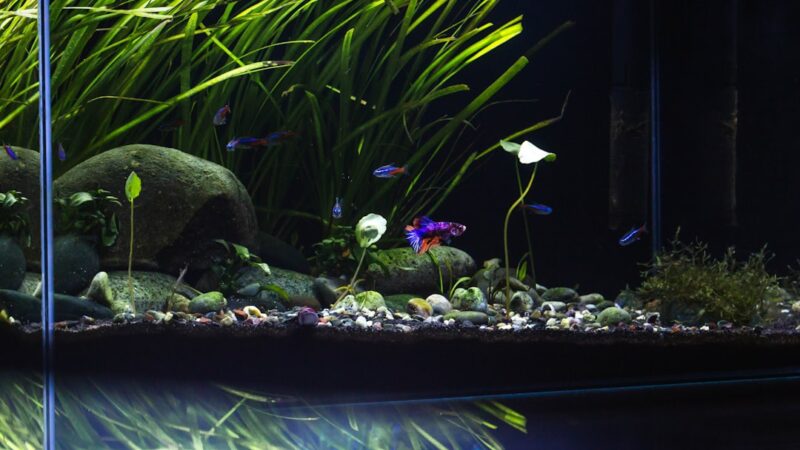
Schooling species that navigate in three dimensions show best. Cardinal tetras, rummynose tetras, harlequin rasboras, and pearl danios swim through the full tank volume and are visible from both faces. Bottom-dwelling species like corydoras and kuhli loaches contribute but read primarily from one side depending on their chosen hiding spots.
Avoid species that claim territories on one side of hardscape, such as many cichlids, because they create a busy side and an empty side. Peaceful community stocks that mill throughout the tank deliver the most balanced dual-view experience.
Aquascaping Hardscape
Choose rocks and driftwood that read as sculptures rather than scenery. Dragon stone arranged in a symmetric central ridge works; seiryu stone in an offset triangular arrangement does not. Driftwood with interesting form from multiple angles, such as spider wood or manzanita with radial branches, performs better than flat slab wood that has a front and back.
Plant placement follows the same logic. Central clumps of stem plants read from both sides; substrate carpets like Monte Carlo or Eleocharis parvula fill the foreground from either viewpoint.
Styling Both Rooms
Room divider aquariums visually connect the two rooms they separate, so consider colour palette and lighting temperature in both spaces. Warm 3000 K room lighting on one side and cool 6000 K on the other creates jarring dual impressions of the same tank. Match room lighting to within 1000 K across the spaces.
Furniture arrangement should give each side a viewing position, typically a sofa or armchair facing the tank at 2 to 3 metres distance. Avoid placing tall furniture immediately beside the partition that blocks sightlines to the tank from either room.
Singapore Fabricators and Pricing
Full room divider aquarium builds are rare as off-the-shelf products and typically involve a tank fabricator partnering with a carpenter or interior contractor. Aquazonic and AquaDecor take bespoke briefs; budget $4500 to $8000 for a 120 cm divider build including partition, tank, sump, lighting, and basic commissioning.
Premium 150 to 180 cm divider builds with low iron glass, hardwood partition, hidden plumbing, and integrated lighting easily reach $10,000 to $18,000. Lead times typically run ten to sixteen weeks, often constrained by the partition carpentry rather than the tank itself.
Related Reading
- Custom Aquarium Build Guide Singapore
- Dutch Aquascape Layout Guide
- Rummynose Tetra Schooling Guide
- HDB Aquascaping Floor Load Guide
- Sump and Overflow Plumbing Design
Conclusion
A room divider aquarium is the most architecturally ambitious format an aquascaper can take on, demanding dual-view scaping, integrated partition engineering, overhead lighting, and plumbing hidden through drilled bulkheads. Done thoughtfully, it reshapes how two rooms relate to each other and delivers a feature no other aquarium can match. Approach the build with a fabricator-plus-carpenter team, budget generously, and allow four months from first sketch to first fish.