Fish Tank Design Ideas Complete Guide: Layout Plans
Design is what separates a tank you walk past from a tank you sit in front of — composition, rhythm, negative space, and the way a single focal point pulls the eye through everything else. This fish tank design ideas complete guide from Gensou Aquascaping at 5 Everton Park breaks down the layout plans that actually read well on 45 cm cubes, 60 cm standards and 90-120 cm condo console displays. Every plan below names hardscape, plant zones and stocking so you can sketch on paper and then build it. Good design comes from rules you can state out loud; once you know them, you can break them on purpose.
Rule of Thirds and Golden Ratio
Never place the hero rock or main driftwood piece in the exact centre of the tank. Divide the footprint into thirds both ways and set focal points on the intersections. On a 60 cm tank, that means your tallest stone sits around 20 cm or 40 cm from one end, and your tallest plant mass rises to roughly two-thirds of tank height. This single rule turns a beginner scape into one that photographs well from any angle.
Triangular Composition Plan
Draw an imaginary right triangle with the longest slope running diagonally across the tank. Plant and hardscape mass piles on one side — a stack of three Ohko stones from the rock and stone range, tall Vallisneria behind, a slope of Rotala ‘Green’ coming down — and tapers to open substrate at the other end. Works beautifully on rectangular 60-90 cm tanks because it exaggerates length.
Concave Valley Plan
Two masses, one at each end, with a valley carving down the centre. Place stone clusters at both 20 cm and 75 cm on a 90 cm tank, stem plants rising on both inner slopes, and a sand path winding through the middle. The Manten rock in matched but non-identical pieces anchors both sides while keeping asymmetry intact. Draws the eye into the scape and creates a sense of distance.
Convex Island Plan
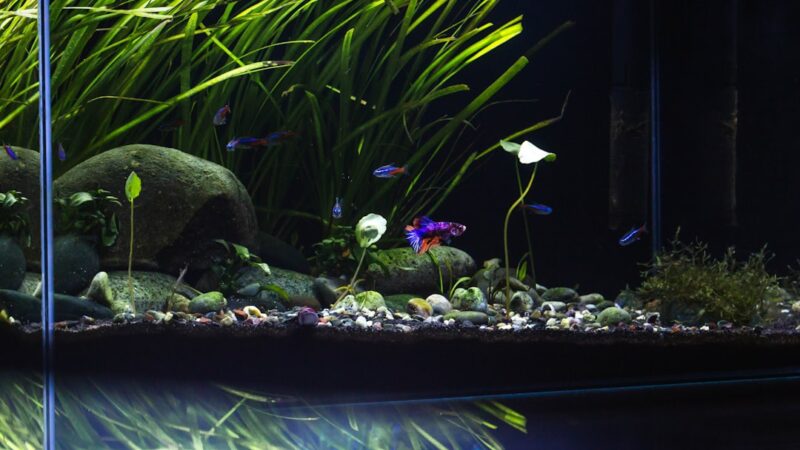
A single raised mass in the middle third of the tank surrounded by lower planting and open sand — an island rising from the floor. A large Seiryu or lava boulder wrapped in java moss and Anubias, Monte Carlo carpet sweeping away on three sides, a school of cardinal tetras orbiting it. Reads best on square cubes or wide panoramic tanks.
Forced Perspective Diorama Plan
Layer the scape front-to-back to suggest a far-away horizon. Big driftwood and stone at the front, progressively smaller pieces behind, fine-grained sand “roads” narrowing into the distance. Foreground plants stay low and fine-leaved (Marsilea hirsuta, HC cuba), midground transitions (Bucephalandra, Cryptocoryne parva), background fills with tall stems. On a 90 cm tank this reads like a miniature mountain valley.
Focal Point and Negative Space
Pick one object — the tallest stone, the most dramatic driftwood limb, the densest planted mass — and make it unmistakable. Everything else supports it. Leave one-third of the substrate clean sand so the eye has somewhere to rest. A tank crammed full of features has no focal point; a tank with one hero piece and breathing room around it looks like art.
Substrate Topography and Slope
Flat substrate reads as boring. Build slope from front-low to back-high, typically 3 cm at the glass to 8-12 cm at the rear. Use inert sand in the front third for walkable “paths” and aquasoil like JUN Platinum Aquasoil in the rear two-thirds for planting. Retain slope with a low stone or wood “wall” so the layers stay separated after three months.
Colour and Plant Zoning
Group plants by colour and leaf texture into distinct zones rather than scattering varieties. A block of red Ludwigia next to a block of green Rotala reads cleaner than the two species mixed. Match warm colours (reds, oranges) with warm lighting around 6500K; match green-heavy scapes with 6500-8000K for clarity. Browse the lighting collection for colour-temperature-appropriate options.
Viewing Angle and Height
Design for the sitting height of the main viewer. An HDB living room sofa puts eye level roughly 110-120 cm off the floor, so a 60 cm tall cabinet and 45 cm tank top out just below eye line — ideal. Desk tanks design for looking down into the scape; floor-standing display tanks design for looking slightly up. Browse the cabinets and stands range to match.
Planning on Paper First
Sketch the layout before you buy a single rock. Draw the tank footprint to scale, mark focal points, shade plant zones, note substrate depth at front and back. Ten minutes of pencil work saves fifty dollars of returned stones and two weeks of dissatisfaction — the tank you plan first is the tank you don’t tear down in a month.
Related Reading