How to Aquascape a Rainbowfish Display Tank: Open Water and Colour
Rainbowfish are living colour — iridescent flanks that shift from turquoise to gold depending on the light. Yet too many keepers house them in cluttered layouts that hide their best feature: movement. A proper aquascape rainbowfish display tank balances open swimming space with planted zones that frame the fish like a living gallery. Gensou Aquascaping at 5 Everton Park, Singapore has designed rainbowfish displays for homes and commercial spaces, and these principles consistently deliver stunning results.
Tank Size and Dimensions
Most rainbowfish species — Melanotaenia boesemani, M. praecox, Glossolepis incisus — are active swimmers that reach 8–12 cm. A tank of at least 120 cm long and 200 litres gives them room to shoal and display. Depth matters less than length; a 120 x 40 x 45 cm footprint suits most species well.
In Singapore’s HDB flats, ensure the cabinet or stand sits on a load-bearing wall or floor beam. A 200-litre setup with hardscape weighs roughly 250–280 kg fully filled. Condos with raised flooring should verify load limits before going larger.
Layout Concept: Open Centre, Planted Sides
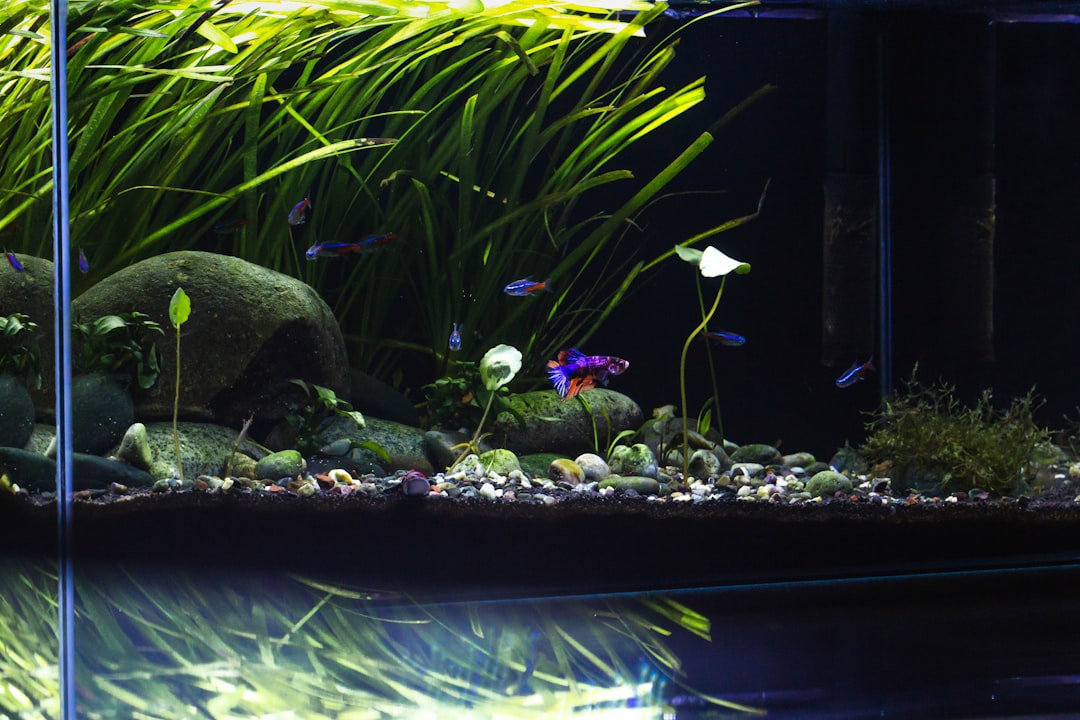
The key principle is a U-shaped or concave layout. Dense planting occupies the left and right thirds of the tank, while the centre remains open for swimming. This island-style composition gives rainbowfish a clear corridor to cruise back and forth, displaying their colours against a green backdrop. Tall stem plants at the rear — Rotala rotundifolia, Hygrophila pinnatifida, Limnophila aromatica — frame the open space vertically.
Avoid filling the midground with bushy plants or large driftwood pieces that fragment the swimming lane. One or two smaller pieces of spider wood placed near the sides add structure without blocking flow.
Substrate and Hardscape Choices
Rainbowfish prefer slightly alkaline to neutral water (pH 7.0–7.8), so inert substrates work best. Fine gravel in natural earth tones — browns and tans — complements the fish’s colours without competing visually. A 3–4 cm layer provides adequate rooting depth for stem plants and is easy to vacuum during maintenance.
Smooth river stones or dragon stone make effective hardscape accents. Avoid sharp-edged rock near the open swimming zone — startled rainbowfish dart fast and can injure themselves on jagged surfaces.
Plant Suggestions
Background stems create height and colour contrast. Rotala H’ra turns orange-red under strong light, pairing beautifully with the blue tones of boesemani rainbows. Vallisneria nana provides movement with its flowing leaves and tolerates the moderate hardness rainbowfish prefer. Midground options include Cryptocoryne wendtii and Anubias barteri var. nana attached to wood or stone.
Floating plants like Salvinia minima diffuse light and reduce surface glare, encouraging bolder fish behaviour. Keep coverage under 30 % to maintain gas exchange and avoid shading the stems below.
Lighting for Maximum Colour
Full-spectrum LEDs with a colour temperature of 6500–8000K bring out the iridescence in rainbowfish scales. A slightly higher blue component enhances the metallic sheen that makes these fish spectacular. Twinstar, Chihiros, and ONF lights all deliver suitable spectrums for both plant growth and fish display.
Run lights for eight hours daily on a timer. A gradual ramp-up and ramp-down over 30 minutes mimics dawn and dusk, reducing the startled dashing that occurs when lights snap on suddenly in a dim room.
Filtration and Flow
Rainbowfish enjoy moderate to strong current. A canister filter rated for 8–10 times the tank volume per hour provides both adequate filtration and beneficial flow. Position the outlet at one end and the intake at the other to create a linear current down the open centre lane. Spray bars or lily pipes diffuse output evenly and prevent dead spots.
Strong surface agitation is fine — rainbowfish are not labyrinth breathers and appreciate well-oxygenated water. This also helps in Singapore’s warm ambient temperatures, where dissolved oxygen drops as water warms above 28 degrees C. A clip-on fan blowing across the surface lowers temperature by 2–3 degrees through evaporation.
Stocking and Companions
Keep rainbowfish in groups of six or more of each species. Males display their brightest colours when competing for female attention, so a ratio of two males to three females works well. Suitable tank mates include corydoras catfish, bristlenose plecos, and larger rasboras. Avoid slow, long-finned species that may be outcompeted at feeding time.
A well-scaped rainbowfish display tank is one of the most visually rewarding setups in the hobby. At Gensou Aquascaping, we find that clients who invest in the layout are consistently amazed by how much more vibrant their fish look when given the right stage.
Related Reading