How to Create a Natural Stream Effect in Your Aquascape
Most aquascapes depict still ponds or lake beds, but some of the most captivating layouts simulate the energy of a flowing stream. Smooth pebbles arranged in current lines, plants bending in one direction, and visible water movement across the tank create an illusion of a living river frozen in glass. This create natural stream effect aquascape guide from Gensou Aquascaping at 5 Everton Park, Singapore covers the techniques that make a stream scape convincing, from substrate choice to flow engineering.
Studying Natural Streams
Before building, observe how real streams look. Water carves around obstacles, depositing fine sand on the inside of bends and leaving exposed rock on the outer edges. Debris collects behind large stones. Plants grow along margins where current is gentler, often trailing downstream. Replicating these patterns in miniature is what transforms a random rock arrangement into a believable streambed. Singapore’s own waterways in nature reserves like MacRitchie and Bukit Timah offer excellent reference points.
Substrate Layering for Realism
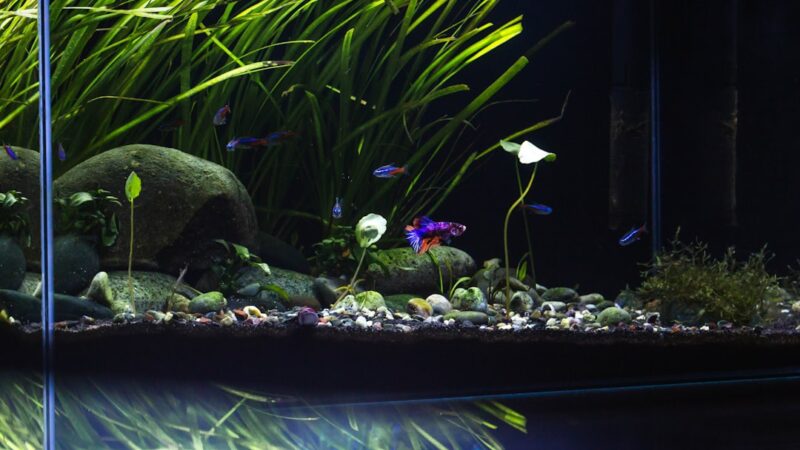
Use three grades of substrate to mimic natural sediment sorting. Coarse gravel (4-8 mm) sits in the “fast flow” zones between large rocks. Medium gravel (2-4 mm) lines the main channel. Fine sand (0.5-1 mm) accumulates in sheltered areas behind rocks and along the tank edges where current would slow. This layering reads as authentic because it follows the same physics that sort river sediments in nature. Colours matter too: mix grey, brown, and beige tones rather than using a single uniform substrate.
Rock Placement and Flow Lines
Arrange rocks in staggered groups running diagonally from one rear corner to the opposite front corner, suggesting the path of a current. Tilt stones slightly in the same direction, as though pushed by flowing water. Larger boulders sit upstream (the higher end of the diagonal), with progressively smaller stones trailing downstream. Leave a clear sand channel between rock groups to represent the streambed itself. Smooth river rocks and rounded pebbles suit this style better than angular stones.
Engineering Visible Water Movement
A stream scape needs actual flow to complete the illusion. Position your filter outlet or a small wave maker at the “upstream” end and direct the current along your diagonal channel. A flow rate of 8-12 times tank volume per hour creates visible movement without being destructive. Use a spray bar or lily pipe to distribute the current evenly. In a 60 cm tank, a small powerhead rated at 500-800 litres per hour, combined with your filter output, achieves the right effect.
Plants That Suit Stream Environments
Choose species that tolerate or thrive in moderate current. Microsorum pteropus (Java fern) attached to rocks withstands flow well, and its long leaves trail downstream attractively. Bolbitis heudelotii grows naturally in African streams and loves the extra circulation. Eleocharis species (hairgrass) planted along the stream margins sway gently in the current. Avoid delicate stem plants in the main flow channel, as they uproot easily and break the illusion of a natural streambed.
Fish for a Stream Biotope
Hillstream loaches (Sewellia, Beaufortia) are the ultimate stream tank inhabitants, clinging to rocks and grazing on biofilm in the current. White cloud mountain minnows (Tanichthys albonubes) and danios enjoy active swimming in flowing water. Stiphodon gobies, found in Southeast Asian streams, are another excellent choice and available periodically at Singapore fish shops. Stock species that naturally inhabit moving water; slow swimmers like bettas and gouramis are poor fits for this layout.
Maintaining the Stream Look
Over time, fine substrate migrates downstream and debris accumulates behind rocks, just as it would in nature. During water changes, gently redistribute sand back to its original position and vacuum the debris pockets. Trim trailing plants before they grow long enough to block the flow channel. Algae on rocks is actually desirable in a stream scape, as it mimics the biofilm-coated stones of a real waterway. Let a thin layer of green algae establish on exposed rock surfaces for added realism.
Adapting for Singapore Conditions
Many stream species prefer cooler water in the 22-26 °C range, which conflicts with Singapore’s ambient 28-32 °C. A clip-on fan dropping water temperature by 2-4 °C is often sufficient for subtropical species. Alternatively, focus on tropical stream species from Southeast Asian and South American habitats that are comfortable at 27-29 °C. Increased flow from the stream design also improves oxygen levels, partially compensating for the reduced oxygen solubility at higher temperatures.
Related Reading