
Tiger Barb Complete Care Guide: Puntigrus tetrazona
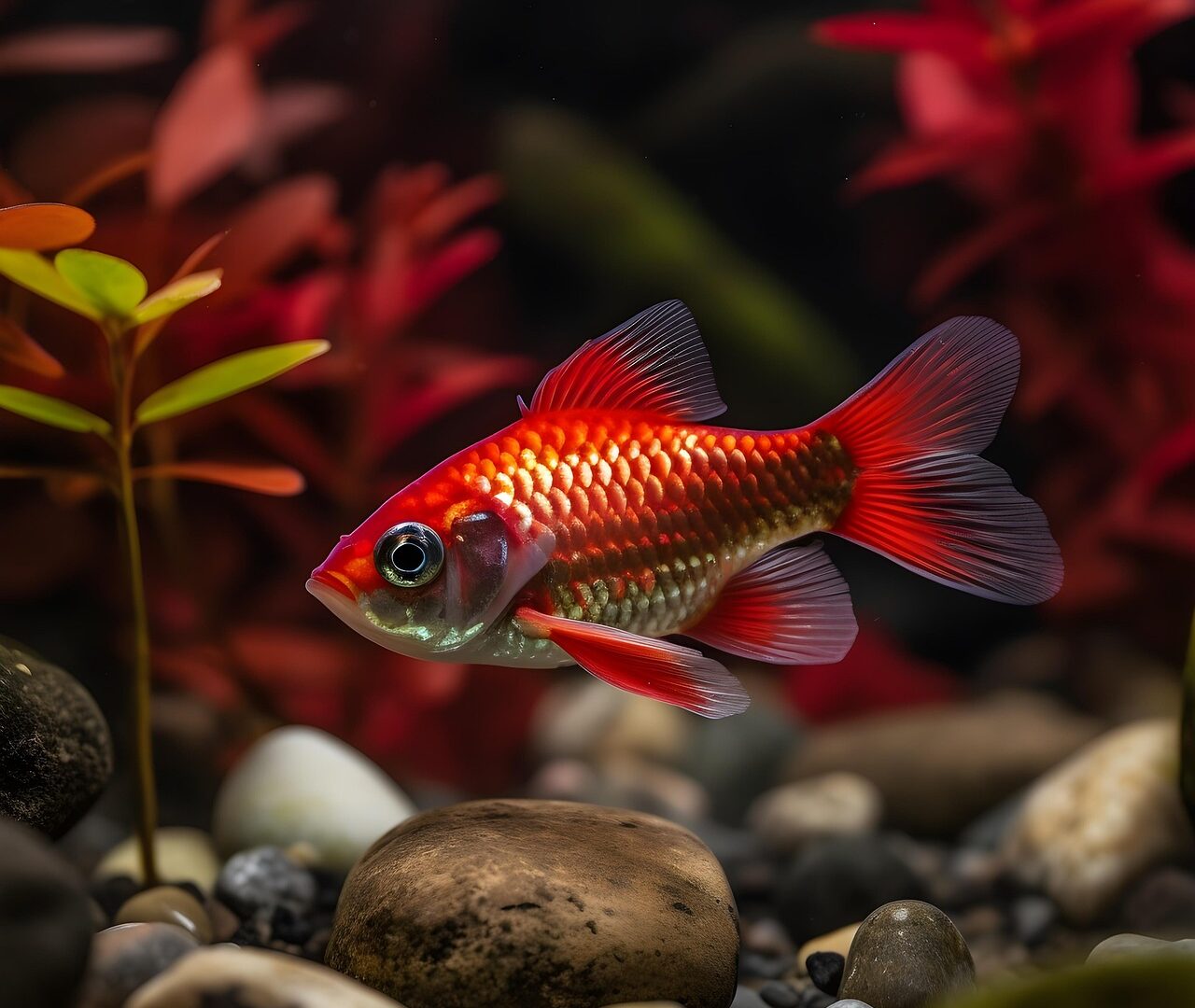
Tiger barbs are brilliant when you stock them properly and a disaster when you do not. The fin-nipping reputation is real, but it is almost entirely a function of group size — a school of three in a mixed community will terrorise every long-finned tank mate, while a school of eight or ten in a species-appropriate setup behaves far better. This tiger barb complete care guide from Gensou Aquascaping at 5 Everton Park covers the group size rule, compatible tank mates and sourcing in Singapore for Puntigrus tetrazona. Proper schooling starts with tank size from the aquarium tanks range.
Why Tiger Barbs Fin-Nip
Tiger barbs establish a dominance hierarchy within their school through chasing and fin-tugging. In a school of eight or more, this behaviour stays contained within the group. In a school of three, the lowest-ranked member dies quickly and the remaining two redirect their drive onto the next most-vulnerable target — usually long-finned tank mates. Group size is not a nicety; it is the mechanism that keeps the species peaceful outward.
Tank Size and Minimum Group
Eight tiger barbs minimum, ten or twelve preferred, in 90 litres with a 75 cm footprint minimum. A 60 cm tank is too short — the school needs lane length to diffuse chases. Green tiger barbs, albino tiger barbs and standard tiger barbs all behave the same way and can school together provided they were stocked simultaneously at similar sizes.
Water Parameters
Target 24-28°C, pH 6.0-7.5, GH 4-12, KH 2-8, ammonia and nitrite zero, nitrate under 30 ppm. Tiger barbs tolerate a wide chemistry range thanks to decades of captive breeding. Singapore PUB tap water is well within their tolerance after dechlorination. Weekly 25-30% water changes support their reasonably high bioload — this is an active, food-hungry species that pollutes faster than tetras of similar size.
Tank Mate Selection
Compatible: Other medium barbs (cherry, rosy, odessa), denison barbs, congo tetras, rainbowfish, clown loach, yoyo loach, medium gourami, plecos. Incompatible: Bettas, angelfish, gouramis with long pelvic filaments, fancy guppies, discus, pearl gouramis, any fish slower than the tiger barb shoal. The rule is simple — if it trails fins, tiger barbs will test them.
Aquascape and Planting
Tiger barbs accept dense planting and do not uproot stems or nibble leaves aggressively. Tall Vallisneria, Cryptocoryne thickets and Amazon sword create sight-line breaks that reduce intra-group aggression. Open swimming zones in the middle of the tank allow the school to cruise together. Hardy plants from the live plants catalogue handle the active swimming without damage.
Feeding Behaviour
Enthusiastic, competitive surface feeders. Flake, small pellets, frozen bloodworm, frozen daphnia and the occasional live food all work. Feed twice daily, small amounts — tiger barbs will gorge if allowed, and obesity shortens lifespan. One weekly fast day maintains digestive health. The fish food catalogue stocks suitable formulas.
Colour Morphs
The standard tiger barb carries orange-yellow flanks with four vertical black bars. Green tiger (moss-green iridescent body) and albino tiger barbs (pink-white with faded bars) are both stable colour morphs, not dyed fish. GloFish tiger barbs — fluorescent pink, green or orange variants — are not currently permitted imports in Singapore; stick with natural or established morphs.
Breeding
Tiger barbs are egg scatterers that spawn readily in soft water at 26-28°C. Parents eat eggs aggressively, so a dedicated breeding tank with a mesh bottom or spawning mop is required for any meaningful yield. Fry accept microworms and crushed flake from day four. Captive breeding supplies 99% of the Singapore trade.
Common Health Issues
Ich appears after temperature swings — treat with heat (raise to 30°C for a week) plus a copper-based medication. Fin damage on a subordinate member points to group size being too small. Chunky swimming or bloating signals overfeeding. Products from the water care range handle common treatments; tiger barbs tolerate most medications well.
Sourcing in Singapore
Universally available at Y618, C328 Clementi, Polyart, Seaview and most neighbourhood LFS. Expect SGD 2-4 per juvenile for standard, SGD 3-5 for green and albino morphs. Buy a complete group of 8-10 in one transaction at similar sizes — adding a second school of three to an existing group usually triggers immediate aggression.
Lifespan and Expectations
Healthy tiger barbs live 6-8 years. They are active, visually striking and genuinely engaging in a larger community tank that respects their group size. Treat them as a proper schooling species rather than a colour accent and the fin-nipping problem mostly disappears.
Related Reading



