
Tiger Barb Care Guide: Bold, Active and Full of Character
Introduction
Few freshwater fish match the sheer energy and visual punch of the tiger barb (Puntigrus tetrazona). With their bold black stripes set against a warm golden-orange body, tiger barbs bring constant movement and personality to any community aquarium. Originally from Borneo and Sumatra — not far from Singapore — these fish are well adapted to our tropical climate, making tiger barb care straightforward for local hobbyists. This guide sits inside our broader Tropical Fish Species Master Index reference.
That said, tiger barbs have earned a reputation as fin nippers, and for good reason. Kept in small numbers or with the wrong tank mates, they can terrorise slower fish. But housed correctly in a proper school, their semi-aggressive tendencies turn inward, producing an entertaining pecking order rather than trouble for neighbours. This guide covers everything you need to know to keep tiger barbs thriving in a Singapore aquarium.
Appearance and Colour Varieties
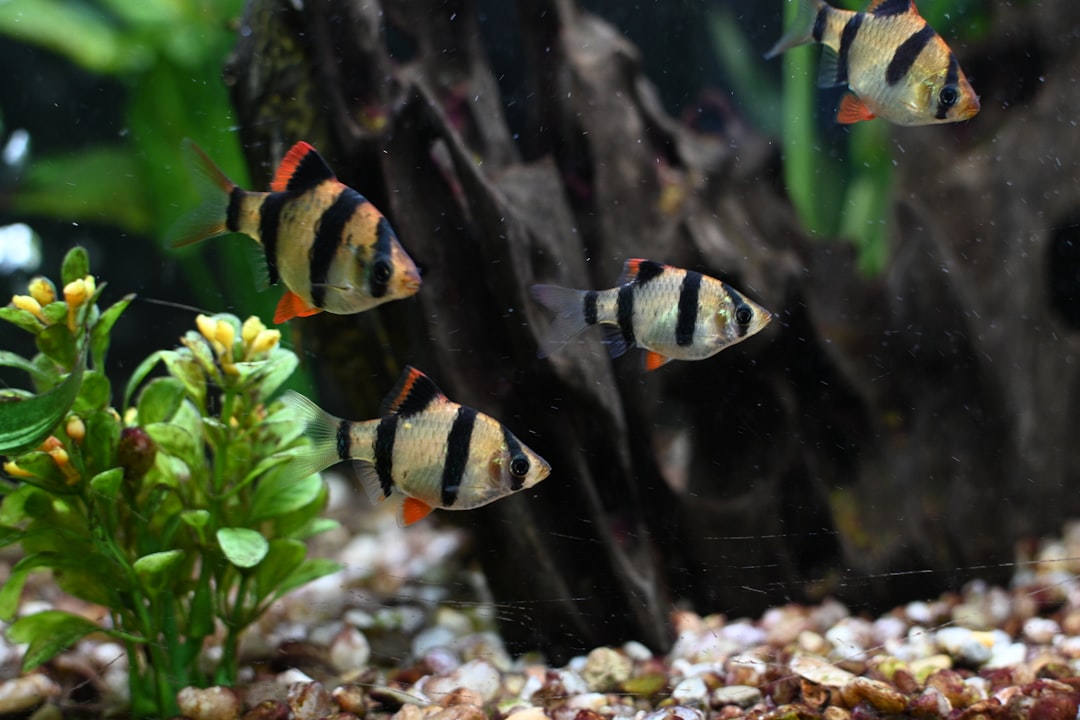
The classic tiger barb features four distinct vertical black bands on a golden to reddish-orange body. The dorsal fin is edged in red, and the snout and ventral fins flush with bright orange-red, particularly in dominant males. Adults typically reach 5 to 7 centimetres in length.
Selective breeding has produced several popular colour morphs:
- Green tiger barb — dark greenish-black body with a metallic sheen; stripes are less visible against the dark background.
- Albino tiger barb — pale cream body with faint white or light gold stripes and red-orange fins.
- GloFish tiger barb — genetically modified fluorescent variants available in electric green, starfire red and other neon colours. These are legal to purchase in Singapore but cannot be released into waterways.
All varieties share the same care requirements, so feel free to mix them in a single school for a striking display.
Tank Requirements
Tiger barbs are active, fast-swimming fish that need room to dart around. A minimum tank volume of 120 litres (roughly a standard 90-centimetre tank) is recommended for a school. Anything smaller leads to stress, heightened aggression and fin nipping directed at tank mates.
Provide a mix of open swimming space in the centre and planted areas along the sides and back. Driftwood, rocks and live plants like Cryptocoryne and Java fern offer visual breaks and retreating spots without restricting movement. A moderate current from the filter suits their active swimming style.
If you are setting up a new planted tank for tiger barbs, our aquascaping service can design a layout that balances aesthetics with the swimming space these fish demand.
Water Parameters
| Parameter | Ideal Range | Notes |
|---|---|---|
| Temperature | 24–28 °C | Singapore ambient (28–32 °C) is at the upper end; use a fan or chiller if room temperature regularly exceeds 30 °C |
| pH | 6.0–7.5 | PUB tap water (pH 7–8) works after dechlorination; driftwood can help lower pH naturally |
| GH | 4–10 dGH | Moderate hardness is fine |
| Ammonia / Nitrite | 0 ppm | Cycle tank fully before adding fish |
| Nitrate | < 20 ppm | Weekly 25–30 % water changes recommended |
Always treat Singapore tap water with a conditioner that neutralises chloramine — not just chlorine — before adding it to the tank. Products like Seachem Prime handle this effectively.
Temperament and Schooling Behaviour
Tiger barbs are semi-aggressive, and their notorious fin-nipping habit is the single biggest concern in tiger barb care. However, this behaviour is largely manageable through proper group size. Keep a minimum of eight tiger barbs, ideally ten or more. In a large school, the fish establish an internal hierarchy — chasing, displaying and sparring among themselves — which dramatically reduces aggression toward other species.
Groups of three or four are the worst scenario. With too few individuals, dominant fish harass the weakest members relentlessly, and the school’s aggression spills outward. If you cannot commit to eight or more, consider a different species altogether.
Even in a proper school, avoid slow-moving, long-finned fish. Bettas, angelfish and fancy guppies are prime targets. Tiger barbs will nip flowing fins regardless of group size.
Feeding
Tiger barbs are enthusiastic omnivores that eat virtually anything offered. A good feeding routine includes:
- Staple — high-quality tropical flakes or micro pellets, fed once or twice daily.
- Protein supplements — frozen or live bloodworms, brine shrimp and daphnia two to three times per week.
- Vegetable matter — blanched spinach, spirulina flakes or algae wafers occasionally.
Feed only what the school can consume in two minutes to prevent overfeeding and poor water quality. Tiger barbs are greedy eaters and will gorge themselves if given the chance.
Compatible Tank Mates
The key to choosing tank mates is selecting fish that are equally robust, active and short-finned. Good options include:
- Cherry barbs and rosy barbs
- Danios (zebra, pearl)
- Rainbowfish
- Corydoras catfish
- Bristlenose plecos
- Clown loaches (in larger tanks)
- Swordtails and platies
Avoid: bettas, angelfish, gouramis (especially pearl and dwarf), fancy guppies, and any slow-moving or long-finned species.
Need help selecting a balanced community? Drop by our shop at 5 Everton Park to discuss stocking options with our team.
Breeding Tiger Barbs
Tiger barbs are egg scatterers with no parental care — in fact, adults will eat their own eggs if given the opportunity. To breed them successfully:
- Condition the breeders — feed high-protein foods (live or frozen) for one to two weeks. Select plump females and brightly coloured males.
- Set up a breeding tank — a 40-litre tank with a mesh or marbles on the bottom to protect falling eggs. Temperature at 26–27 °C, slightly acidic water (pH 6.5).
- Introduce a pair or trio — spawning usually occurs in the morning. The female scatters eggs among plants or over the substrate while the male fertilises them.
- Remove adults immediately after spawning to prevent egg predation.
- Eggs hatch in 36–48 hours. Fry become free-swimming after another two to three days and can be fed infusoria, then baby brine shrimp.
Common Issues
Ich (White Spot Disease)
Tiger barbs are moderately susceptible to ich, especially after temperature fluctuations. In Singapore, room temperature swings during heavy air-conditioning at night followed by warm afternoons can trigger outbreaks. Maintain a stable temperature and treat promptly with a copper-based or malachite green medication if white spots appear.
Colour Fading
If your tiger barbs look pale, check for stress factors: small group size, aggressive tank mates, poor diet or high nitrate levels. A well-kept school on a varied diet displays vivid colouration.
Fin Nipping Within the School
Some nipping within the group is normal hierarchy behaviour. Persistent damage to one individual usually means the school is too small. Add more tiger barbs to dilute the aggression.
Frequently Asked Questions
Can I keep tiger barbs with bettas or angelfish?
No. Tiger barbs are notorious fin nippers and will relentlessly target the flowing fins of bettas and angelfish. Even in a large school, this combination almost always ends badly for the slower fish. Choose short-finned, active tank mates instead.
How many tiger barbs should I keep together?
A minimum of eight, with ten or more being ideal. Larger groups distribute aggression across the school, reducing stress and fin nipping. Small groups of three to five tend to be the most problematic in terms of aggression.
Do tiger barbs need a heater in Singapore?
In most cases, no. Singapore’s ambient temperature of 28–32 °C falls within their tolerable range, though it sits at the upper limit. If your room is heavily air-conditioned and drops below 24 °C at night, a heater set to 26 °C provides stability. Conversely, if the tank consistently exceeds 30 °C, consider a clip-on fan to increase evaporative cooling.
Are GloFish tiger barbs harder to care for?
No. GloFish tiger barbs have the same care requirements as standard tiger barbs. The fluorescent colouration is genetic and does not affect their health, diet or behaviour. They can be mixed freely with other tiger barb varieties.
Tiger barbs are one of the most entertaining freshwater fish you can keep — bold, colourful and always on the move. With the right group size and compatible tank mates, they make a fantastic centrepiece for an active community tank. If you are ready to set up a tiger barb aquarium or need advice on stocking, visit Gensou at 5 Everton Park or reach out to us for a consultation.
Related Reading
- Blue Tiger Shrimp Care Guide: Orange Eyes and Blue Stripes
- How to Breed Cherry Barbs: From Courtship to Free-Swimming Fry
- Cherry Barb Care Guide: Peaceful, Hardy and Colourful
- Cherry Barb vs Gold Barb: Colour, Size and Temperament Compared
- How to Breed Denison Barbs: Torpedo Barb Spawning in Captivity



