Aquascaping With Slate Only: Flat Layers and Dark Texture

Slate is the introvert’s rock — precise, layered, unapologetically dark, and completely unlike the organic chaos of dragon stone or the rounded gentleness of river pebble. An aquascape built entirely on slate hardscape works through geometry: flat planes stacked at angles, shadow lines between layers, and a controlled palette that rewards restraint. Gensou Aquascaping at 5 Everton Park, Singapore has helped many keepers develop mono-material hardscape concepts, and slate consistently produces some of the most composed, architecturally confident results when the layout principles are understood.
What Makes Slate Different From Other Rocks
Slate is a fine-grained metamorphic rock with a pronounced layered (foliated) structure that allows it to be split into flat sheets along cleavage planes. This gives aquascapers a material with naturally flat surfaces, sharp edges, and consistent dark grey to blue-black colouration. Unlike volcanic rocks such as lava stone, slate does not significantly alter water chemistry — it is relatively inert, affecting pH only very slightly over long periods in soft water. For most planted tank setups, slate is chemically neutral enough to use without concern.
Grain texture varies by source: Welsh and Spanish slate tends to be very fine and uniform; Brazilian slate has a slightly rougher texture and often shows subtle colour banding. Both work well aquascaping — the smoother variants are better for precision stacking, while textured slate adds character to naturalistic designs.
Core Layout Principles With Slate
The defining technique in slate aquascaping is the stacked horizontal layer. Place larger base pieces flat on the substrate and angle them slightly — typically 5–15 degrees toward the viewer — to add dynamism to what would otherwise be a static horizontal arrangement. Stagger smaller pieces on top, offsetting joints rather than stacking them directly above each other. The result reads like natural geological stratification: convincing, clean, and structurally stable.
A classic composition uses a dominant mass of slate on one side — the principal formation — with smaller fragments scattered on the opposite side at decreasing scale. This creates an asymmetric balance that follows principles common in both Japanese garden design and Iwagumi aquascaping. Negative space on the low side of the composition is as important as the rock mass on the high side.
Substrate Under Slate: Practical Choices
Slate’s dark colouration pairs best with mid-to-dark substrates — black sand, dark aquasoil, or a mix of both. Bright white sand under dark slate creates visual contrast that can be striking in a minimalist design, but more often the stark contrast looks clinical rather than natural. Natural brown or grey fine sand blends better and allows the slate to be the feature rather than the contrast object.
Build up substrate height under the main slate formation and slope gradually toward the front for visual depth. Placing larger flat slate pieces as retaining walls at the rear — partially buried — holds substrate in place and maintains depth gradient without chemical additives.
Plant Choices for a Slate-Dominant Scape
In a slate-only scape, plants should enhance the rock without competing with it. Mosses — Taxiphyllum barbieri (Java moss), Vesicularia montagnei (Christmas moss), or Plagiomnium sp. (pearl moss) — grow flat against slate surfaces over time, softening the sharp edges naturally and adding green texture without interrupting the layered geometry. Attach with thread or fine fishing line; mosses root to slate well within 4–6 weeks under moderate light.
A single species of foreground carpeting plant — Helanthium tenellum or Glossostigma elatinoides — across the substrate between slate formations ties the composition together without introducing species complexity. For background interest, a cluster of Cryptocoryne in a dark substrate corner adds organic softness without changing the mineral dominant character of the design.
Livestock Choices That Complement the Palette
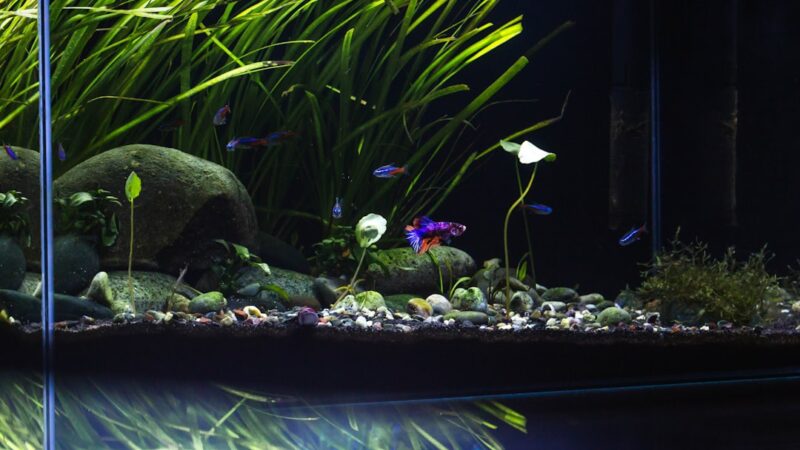
Dark substrate and dark rock make high-contrast fish shine. Bright schooling fish — harlequin rasboras, rummy nose tetras, or cardinal tetras — read clearly against a dark slate background. White cloud mountain minnows against dark slate is a classic combination. Conversely, dark-coloured fish like black phantom tetras or black neon tetras become hard to see and lose visual impact against similar-toned hardscape.
Corydoras catfish, with their preference for flat surfaces, often interact naturally with slate formations — resting on flat ledges and moving between slate planes. Corydoras pygmaeus or C. habrosus suit the scale of a nano to medium slate scape.
Sourcing Slate in Singapore
Raw slate is available from building material suppliers and tile shops in Singapore — roofing slate in particular comes in consistent flat pieces at very low cost compared to aquarium-branded stone. A kilogram of roofing slate costs $2–$5; the same weight of “aquascape slate” from an online retailer may cost $15–$30. Rinse building-supply slate thoroughly, test for chemical reaction with a small piece in vinegar (slate should show minimal or no fizzing), and it is ready for use. Aquarium-specific slate is pre-washed and sized, which saves preparation time but offers no water safety advantage.
Long-Term Maintenance of a Slate Scape
Slate accumulates algae in the low-flow zones between layers. A consistent algae-eating crew — Otocinclus, nerite snails, or amano shrimp — keeps slate surfaces clean. The dark colour of the rock makes spot-algae growth visible early, which is actually an advantage; you can address a small algae patch before it spreads. Quarterly gentle brushing with a soft toothbrush during water changes maintains the clean, defined look that makes slate compositions so compelling.
Related Reading
- Hardscape Dry Layout Tips: Plan Before You Fill
- Aquascaping With 3D-Printed Hardscape: Custom Shapes Underwater
- Aquascaping With Bamboo Hardscape: Poles, Tubes and Natural Lines
- Aquascaping With Coconut Shells: Natural Caves and Hiding Spots
- Aquascaping With Hardscape and Moss Only: No Rooted Plants